Main

December 26, 2009

How to argue 6: not 'connecting the dots', by Hoekstra

Language skill of the day: Accuse your opponent of not 'connecting the dots':

Speculation about terrorist plots based on limited information is a fool's game. We know very little about Abdul Farouk Abdulmutallab's attempts on Northwest Airlines Flight 253 yesterday, though there are some pretty obvious questions about how he got materials on board, how dangerous they were, and what his associations may be.

Responsible federal officials will wait to get a more detailed picture before popping off in the media, making reckless accusations. Rep. Peter Hoekstra (R) of Michigan, inexplicably the ranking Republican on the House Intelligence Committee, has not yet been briefed on yesterday's incident, but that hasn't stopped him from trying to exploit the Abdulmutallab matter to score some cheap partisan points.

"It's not surprising," U.S. Rep. Pete Hoekstra, a Holland Republican, said of the alleged terrorist attempt to blow up a Northwest Airlines flight in Detroit. ... "People have got to start connecting the dots here and maybe this is the thing that will connect the dots for the Obama administration," Hoekstra said.


#6 in the language series, How to argue (when facts and logic are against you)

Continue reading "How to argue 6: not 'connecting the dots', by Hoekstra" »

December 13, 2009

How to argue: deny anticipation or expectation

Might people start bracing or fleeing from dreaded future changes ? No according to washingtonmonthly / Steve Benen.

But Boehner nevertheless hasn't lost his unmitigated gall confidence, and has an op-ed in the Washington Post today about how right he is about the economy.

I was actually curious to see what he'd come up with. After all, just over the last two weeks, Boehner has blamed job losses on policies that don't exist yet, and rejected the idea of a jobs bill as "repulsive." Boehner hosted an "economic roundtable" last week with a bunch of former Bush aides, so maybe he's come up with something specific to offer by now.

While the Republican from Ohio says the decrease in the unemployment rate is encouraging, he says "anyone who views today's report as cause for celebration is out of touch with the American people, especially when Washington Democrats' policies -- whether it's a government takeover of health care, a national energy tax, or 'card check' -- are already costing jobs and will pile even more debt on our kids and grandkids."

How to argue, the series, in Language.

December 8, 2009

Progressive polemics take on the 'he'-cession

hecession: recession where male incident unemployment overhsaddows female unemployment.

Progressive take and spin on the econonomic scene:

As women's job losses mount, some women--especially unmarried women--are facing an increasingly grim job market. Unmarried women have much higher unemployment than married women. In October, 10.3 percent of unmarried women age 20 and over (3.3 million) and 5.7 percent of married women (2.1 million) were unemployed (see figure below; all data by marital status is not seasonally adjusted). Although unmarried women represent less than half (46.5 percent) of all women workers, they account for 6 in 10 (60.8 percent) of women workers who are unemployed. The situation is worse for unmarried women who head families, most of whom are single mothers, who now have an unemployment rate of 12.6 percent, 2.4 percentage points above the national average.

Question not asked: are married women more likely to drift into and out of the laborforce, given job prospects or lack thereof ?

Continue reading "Progressive polemics take on the 'he'-cession" »

November 19, 2009

Wyatt Gallery is aptly named

Mr Wyatt Gallery has a Photography Gallery.

Notably, he received a Fulbright Scholarship to travel to Trinidad and Tobago.

-- another example of the Dennis the Dentist naming rule.

Continue reading "Wyatt Gallery is aptly named" »

October 21, 2009

Surveillance 'totally unwarranted'

Suspected of sending children to an out-of-distrct school, state collected a surveillance report and the family's telephone billing records.

"As far as I'm concerned, they're within their rights to scrutinize all applications, but the way they went about it was totally unwarranted.

Continue reading "Surveillance 'totally unwarranted'" »

September 3, 2009

Are safer smokes safer ?

The law also prohibits advertising that products carry a lower health risk than traditional cigarettes without F.D.A. approval, a provision aimed at ensuring that such claims are scientifically valid not only for individual smokers but also for the population as a whole, including nonsmokers who might be enticed to smoke if they thought a cigarette was low-risk.

Continue reading "Are safer smokes safer ?" »

August 27, 2009

Criticism is judgmental and accusatory. Feedback focuses on providing concrete information to motivate

Leon F. Seltzer, a clinical psychologist who has written extensively on this subject, differentiates between criticism and feedback. In a blog he writes for Psychology Today, he notes that:

¶Criticism is judgmental and accusatory. It can involve labeling, lecturing, moralizing and even ridiculing. Feedback focuses on providing concrete information to motivate the recipient to reconsider his or her behavior.

¶Criticism involves making negative assumptions about the other person's motives. Feedback reacts not to intent but the actual result of the behavior.

¶Criticism, poorly given, often includes advice, commands and ultimatums, making the person receiving it feel defensive and angry -- and undermines any benefits. Feedback, on the other hand, looks less at how the person should change, but tries to prompt a discussion about the benefits of change.

This last point is one that Darren Gurney, a high school teacher in New Rochelle, N.Y., has thought a lot about. Mr. Gurney also coaches high school and college baseball teams and runs a summer baseball camp that my sons love. He has found that one of the most effective ways to criticize a player is not to tell him what he did wrong, but ask him to analyze what he thinks he could have done better.

Continue reading "Criticism is judgmental and accusatory. Feedback focuses on providing concrete information to motivate" »

August 26, 2009

verdes Vadera, green shoots, he scores

The popularity of the term "green shoots" shows the kind of social epidemic underlying our changing thinking. The phrase was propelled in Britain by Shriti Vadera, the business minister, in January, and mutated into a more contagious form after Ben Bernanke, the Federal Reserve chairman, used it on "60 Minutes" on March 15.

The news media didn't need to change the term for different cultures around the world. With nothing more than a quick translation -- brotes verdes, pousses vertes, grüne Sprösslinge, etc. -- it is now recognized as a symbol of a revival coming soon.

All of this suggests that a social epidemic is supporting renewed confidence. This confidence can keep growing by contagion, as a kind of self-fulfilling prophecy, and we may see the markets and the economy recover further.

Continue reading "verdes Vadera, green shoots, he scores" »

August 12, 2009

Death Panel non-fiction

Death Panels are Fiction, The case for, Part I

Right now, the charge that's gaining the most traction is the claim that health care reform will create "death panels" (in Sarah Palin's words) that will shuffle the elderly and others off to an early grave. It's a complete fabrication, of course. The provision requiring that Medicare pay for voluntary end-of-life counseling was introduced by Senator Johnny Isakson, Republican -- yes, Republican -- of Georgia, who says that it's "nuts" to claim that it has anything to do with euthanasia.

And not long ago, some of the most enthusiastic peddlers of the euthanasia smear, including Newt Gingrich, the former speaker of the House, and Mrs. Palin herself, were all for "advance directives" for medical care in the event that you are incapacitated or comatose. That's exactly what was being proposed -- and has now, in the face of all the hysteria, been dropped from the bill.

Yet the smear continues to spread. And as the example of Mr. Gingrich shows, it's not a fringe phenomenon: Senior G.O.P. figures, including so-called moderates, have endorsed the lie.

Senator Chuck Grassley, Republican of Iowa, is one of these supposed moderates

.


The case for, Part II

Painting the Giacometti-esque Emanuel as a creepy Dr. Death, Palin attacked him on her Facebook page a week ago, complaining that his "Orwellian thinking" could lead to a "death panel" with bureaucrats deciding whether to pull the plug on less hardy Americans. Never mind that Palin herself had endorsed some of the same end-of-life counseling she now depicts as putting Grandma down.

As the Democratic National Committee pointed out, Palin put out a 2008 proclamation for Healthcare Decisions Day "to raise public awareness of the need to plan ahead for healthcare decisions, related to end of life care ... and to encourage the specific use of advance directives to communicate these important healthcare decisions."

Consistency was long ago sent to a death panel in Palin world.


Part III:

The controversy over "death panels" is just the most extreme manifestation of this debate. Obviously, the Democratic plans wouldn't euthanize your grandmother. But they might limit the procedures that her Medicare will pay for. And conservative lawmakers are using this inconvenient truth to paint the Democrats as enemies of Grandma.

Continue reading "Death Panel non-fiction" »

July 25, 2009

Obama on red pills, blue pills

Just begging for a correction:

The pharmacists like to slice and dice our country into red pills and blue pills: red pills for Republicans, blue pills for Democrats. But I've got news for them, too. We get an awesome high on the blue pill, and we don't like federal agents poking around our stash of red pills.

We deal to the little league some blue pills, and, yes, we've got some gay friends hopped up on red pills.

July 5, 2009

Wordnik superdictionary

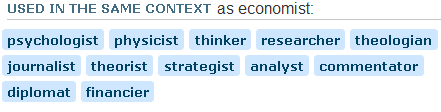
Wordnik promises to be a super dictionary, with web search driven updates of how words are used (But what does it mean to say the tool is used once per month ?) .

Better filtering tha UrbanDictionary, better page layout than most web dictionaries.

Update 2009 July 19: now with more context

wordnik_economist_context.png

June 29, 2009

Some good arguing: bad health plan is delaying your tests and denying your treatment

Some good arguing on healthcare.

Luntz also wrote: "Healthcare quality = 'getting the treatment you need, when you need it.' That is how Americans define quality, and so should you. The key opportunity here is that this commitment goes beyond what the Democrats can offer. Their plan will deny people treatments they need and make them wait to get the treatments they can actually receive. This is more than just rationing. To most Americans, rationing suggests limits or shortages -- for others. But personalizing it -- 'delaying your tests and denying your treatment' -- is the concept most likely to change the most minds in your favor" [emphasis in original].

On its "Talking Points" page, congressional Republicans similarly stated that Democrats would deny access to medical care and treatments, claiming, "The Democrats' government-takeover of health care will deny access to medical care and life-saving treatments."

May 30, 2009

Unamerican names part 3

Deferring to people's own pronunciation of their names should obviously be our first inclination, but there ought to be limits. Putting the emphasis on the final syllable of Sotomayor is unnatural in English (which is why the president stopped doing it after the first time at his press conference), unlike my correspondent's simple preference for a monophthong over a diphthong, and insisting on an unnatural pronunciation is something we shouldn't be giving in to.

Mark Krikorian, Center for Immigration Studies blogs on the Corner

April 16, 2009

Dennis the dentist, 3

The most astonishing change concerns the ending of boys' names. In 1880, most boys' names ended in the letters E, N, D and S. In 1956, the chart of final letters looked pretty much the same, with more names ending in Y. Today's chart looks nothing like the charts of the past century. In 2006, a huge (and I mean huge) percentage of boys' names ended in the letter N. Or as Wattenberg put it, "Ladies and gentlemen, that is a baby-naming revolution."

Wattenberg observes a new formality sweeping nursery schools. Thirty years ago there would have been a lot of Nicks, Toms and Bills on the playground. Now they are Nicholas, Thomas and William. In 1898, the name Dewey had its moment (you should be able to figure out why). Today, antique-sounding names are in vogue: Hannah, Abigail, Madeline, Caleb and Oliver.

In the late 19th century, parents sometimes named their kids after prestigious jobs, like King, Lawyer, Author and Admiral. Now, children are more likely to bear the names of obsolete proletarian professions, Cooper, Carter, Tyler and Mason.

Wattenberg uses her blog to raise vital questions, such as should you give your child an unusual name that is Googleable, or a conventional one that is harder to track? But what's most striking is the sheer variability of the trends she describes.

Naming fashion doesn't just move a little. It swings back and forth. People who haven't spent a nanosecond thinking about the letter K get swept up in a social contagion and suddenly they've got a Keisha and a Kody. They may think they're making an individual statement, but in fact their choices are shaped by the networks around them.

Furthermore, if you just looked at names, you would conclude that American culture once had a definable core -- signified by all those Anglo names like Mary, Robert, John and William. But over the past few decades, that Anglo core is harder to find. In the world of niche naming, there is no clearly identifiable mainstream.

Continue reading "Dennis the dentist, 3" »

January 22, 2009

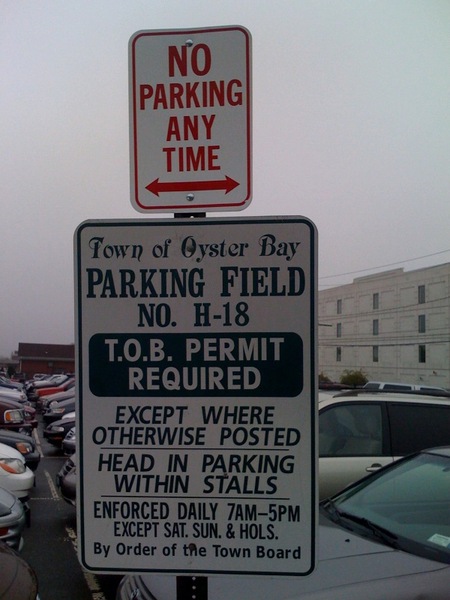
Parking no parking

Can you park here now ?

parking_no_parking_Hickville_NY.jpg

Posted in NY transit language.

January 14, 2009

Environmental impact of environmental events

The New York Times looks at the impact of gathering at Sundance to watch environmental films.

Still, a stroll here this week down Main Street -- where a dozen idling trucks were unloading supplies and equipment, while an oversize band bus, with trailer in tow, spewed fumes outside a soon-to-be-busy party site -- framed the obvious quandary: how can you cram some 46,000 people, roughly equivalent to a fifth of Hollywood's total work force, into a pretty little mountain town without contributing mightily to the problems your films hope to solve?

...

Utility officials said there was no way to determine how much extra wattage was being poured into the valley for the festival's spotlights and the strings of colored bulbs lining Park City's streets. "Pinpointing use for one city," said Margaret Oler, an information officer with Pacificorp, which provides power to the area, "can be pretty difficult."

bulb3_100W.jpg

Most electrical implements, bulbs included, have power consumption in Watts printed right on them.

MOVIES
The Films Are Green, but Is Sundance?
By MICHAEL CIEPLY
Published: January 17, 2009
This year's Sundance Film Festival has a schedule that's greener than Fifth Avenue on St. Patrick's Day, but what's the environmental impact of the festival itself?

Continue reading "Environmental impact of environmental events" »

December 26, 2008

The rise and fall of Svetlana Egorova

New York is city of excitement and dream-making. Nice American Agency introduce this girl to many nice and sexy American men of wholesome goodness with upper east side doorman buildings. One day, the girl goes to drink with George, a business man of hedgefunds who is getting in on bottom floors and is also liking of back doors. She is so nervous before date, she does the bronze of herself twice in tanning booth. Ha ha! Is not matter, George likes very much what he sees and offers her highest of compliments, she is like the Barbie Doll that is come to life!

Precis.

December 24, 2008

Mathew Yglesias

Mathew Yglesias gets some attention this week.

What makes Matt worth noting ?

He's mildly ingratiating, sometimes merely diplomatic; and he shows the education and writing ability to articulate the practical consensus of his readers.

On the downside, he moves is blog every six months, to the American Prospect, Tapped, Atlantic, to ThinkProgress; maybe he should just park it on Xanga.

Continue reading "Mathew Yglesias" »

December 21, 2008

Today's rich don't exploit the poor they just outcompete them.


Looking at upper-middle-class homes, Lareau describes a parenting style that many of us ridicule but do not renounce. This involves enrolling kids in large numbers of adult-supervised activities and driving them from place to place. Parents are deeply involved in all aspects of their children's lives. They make concerted efforts to provide learning experiences.

Home life involves a lot of talk and verbal jousting. Parents tend to reason with their children, not give them orders. They present "choices" and then subtly influence the decisions their kids make. Kids feel free to pass judgment on adults, express themselves and even tell their siblings they hate them when they're angry.

The pace is exhausting. Fights about homework can be titanic. But children raised in this way know how to navigate the world of organized institutions. They know how to talk casually with adults, how to use words to shape how people view them, how to perform before audiences and look people in the eye to make a good first impression.

Working-class child-rearing is different, Lareau writes. In these homes, there tends to be a much starker boundary between the adult world and the children's world. Parents think that the cares of adulthood will come soon enough and that children should be left alone to organize their own playtime. When a girl asks her mother to help her build a dollhouse out of boxes, the mother says no, "casually and without guilt," because playtime is deemed to be inconsequential -- a child's sphere, not an adult's.

Lareau says working-class children seem more relaxed and vibrant, and have more intimate contact with their extended families. "Whining, which was pervasive in middle-class homes, was rare in working-class and poor ones," she writes.

But these children were not as well prepared for the world of organizations and adulthood. There was much less talk in the working-class homes. Parents were more likely to issue brusque orders, not give explanations. Children, like their parents, were easily intimidated by and pushed around by verbally dexterous teachers and doctors. Middle-class kids felt entitled to individual treatment when entering the wider world, but working-class kids felt constrained and tongue-tied.


David Brooks

Continue reading "Today's rich don't exploit the poor they just outcompete them." »

November 13, 2008

Snowclones idiom warehouse

Modern folklore holds that Eskimos have a huge number of words related to snow, but it's just not true--they use no more such words than we do. Still, the factoid continues to spin off phrases on the general format of "If Eskimos have N words for snow, X have Y words for Z." For example, a 2003 article in The Economist declared, "If Eskimos have dozens of words for snow, Germans have as many words for bureaucracy." On his blog, Agoraphilia, Glen Whitman coined a snappy name for the category to which this formula belongs: the snowclone. Of course, he was punning on the snow cone, which is shaved ice flavored with syrup and carried in a paper cone. Other bloggers have since identified more members of this lexicographic species, and one of them, Erin Stevenson O'Connor, is compiling them at at http://snowclones.org.

Many snowclones are firmly entrenched in mainstream culture. For example, I'm not an X, but I play one on TV has been around for more than 20 years. It comes from a 1986 ad for Vicks Formula 44 cough syrup, in which an actor said, "I'm not a doctor, but I play one on TV."

Links: Snow Clones.

Continue reading "Snowclones idiom warehouse" »

November 12, 2008

Bush in 1978: before playing country cowboy

"Kent Hance was a down-home boy, real homey, and George W. wasn't homey like Kent," recalled Johnnye Davis, a Republican leader in Odessa. "He didn't come across to the voters as well as Kent did, with the little jokes that Kent told."

While Mr. Bush now is sometimes mocked for an ignorance of policy details, back then people thought he had the opposite problem: a tendency to drop references in his speeches that baffled audiences, like a discussion of anti-inflationary economic policy.

"He was quick, a bit too quick, so that people didn't always get it," Mrs. Davis said. "He was so darn intelligent that a lot of what he said went over people's heads. He's learned to explain things a little better since then."

Another problem was that while Mr. Bush never really had a clear campaign strategy, Mr. Hance did: he focused his campaign on emphasizing local ties and on casting Mr. Bush as a carpet-bagger from the East. One of Mr. Hance's most effective radio spots was this one, read by an announcer:

"In 1961, when Kent Hance graduated from Dimmitt High School in the 19th congressional district, his opponent George W. Bush was attending Andover Academy in Massachusetts. In 1965, when Kent Hance graduated from Texas Tech, his opponent was at Yale University. And while Kent Hance graduated from University of Texas Law School, his opponent" -- the announcer's voice plunged -- "get this, folks, was attending Harvard. We don't need someone from the Northeast telling us what our problems are."

Continue reading "Bush in 1978: before playing country cowboy" »

October 22, 2008

Paradoxically ?

The laid-back, noncompetitive and bohemian ambience of these new coffee shops has, paradoxically, limited them almost entirely to the very neighborhoods that welcome those qualities: Greenwich Village, Chelsea, and Williamsburg and Park Slope in Brooklyn.

Like flames, paradoxically limited to fires ? More in words and language.

Continue reading "Paradoxically ?" »

October 20, 2008

Middle class: only up to $250, 000 annual income ?

The definition of middle class is in flux. Many try to quantify and specify it in income terms.

Here's Charles Gibson of ABC (Via Paul Krugman): suggested that $200,000 a year was a middle-class income.

July 29, 2008

Explaining vs Stigmitizing

Conservatives believe that once you name something as evil, there's no further explanation. (Either it can't be explained, because evil is an irreducible mystery, or there's just no point in explaining it.)

Liberals believe that once you explain something, it can't be named as evil. (Because true understanding banishes the mysteriousness that makes something hateful.)


[ Via unfogged ]

June 22, 2008

How to argue part 3: complaining means losing

"When you are crying foul in a presidential campaign, it usually
means you are losing."

-- Mr. Chris Lehane, the Democratic operative, pronounced himself
delighted
that the McCain campaign was feeling victimized.

How to argue (without facts or logic), the series.

May 12, 2008

How to argue, part 8

Yglesias' argument is emphatically about a practical,
politically feasible Democratic foreign policy, and not
about seizing the quasi-pacifist moral high ground.


-- CC@unfogged.

July 20, 2007

Myalgic Encephalopathy is the new yuppie flu

Many patients point to another problem with chronic fatigue syndrome:
the name itself, which they say trivializes their condition and has
discouraged researchers, drug companies and government agencies
from taking it seriously. Many patients prefer the older British term,
myalgic encephalomyelitis, which means “muscle pain with inflammation
of the brain and spinal chord,” or a more generic term, myalgic
encephalopathy.

Continue reading "Myalgic Encephalopathy is the new yuppie flu" »

June 17, 2007

Bed Stuy, txt or die

Virgin mobile's copywriters phone it in.

“I don’t think I’ve ever heard ‘Murray Hill’ and ‘Rule’ used in the
same sentence before,” he said. “The copywriters certainly
deserve some credit for this. It’s not that easy to go from
bashing Sutton Place to selling prepaid phone service in
less than 50 words.”

-- John Reardon.

Brownstoner
BedStuy Blog

March 3, 2007

How to argue, part 2: My view

You are doing what you accuse older feminists of doing
-- declaring your views unassailable simply because you
have them.

They say,"You weren't there,"
You say, "You aren't here."

Okay, but you still have to make your case -- plenty of
young women, including young feminists, don't share
your POV. Your real beef with Ariel Levy, for example,
is not that she's too old and out of it to understand
young women (she's only in her early thirties).

It's that you don't agree with her view that today's
sexual culture (girls gone wild, hooking up etc) is
basically exploitation and exhibitionism packaged
as feminism. I'm not saying she's right or wrong,
I'm just saying that "Female Chauvinist Pigs" presents
an actual argument, not a mindless ignorant diss
of young women by some old fussbudget who
knows little about them.

Katha Pollitt, in response to The Feminist Sorority.

How to argue (without facts or logic), the series.

November 4, 2006

Squabbling vs assessing the alternatives

We, we are assessing the alternatives. The other guys,
they are divided and squabbling.

Continue reading "Squabbling vs assessing the alternatives" »

September 21, 2006

Separated by a Common Language

Separatedbyacommonlanguage compare US English to British English.

September 19, 2006

City on a Hill

On how Freedom became central to the Republican party's
campaign for word domination.

Nunberg notes there are lots of metaphors for the state
—a ship adrift, an actor on the world stage, a city on a
hill, a house with crumbling foundations—and there is
simply no reason to think one of them structures our
political thought. We should all thank Nunberg for
suggesting that there is no thread, metaphorical or
logical, that runs through the contingently evolving
packages of partisan commitment.

-- WW

September 14, 2006

Urban Dictionary

urbandictionary is looking good.

Collaborative nature compels user contributions
and feedback, thumbsupping or thumbsdowning
competing definitions on clarity, detail, and
plausibility (for the zero information set) or
accuracy (for those in the know.

The freshness of the content poses a challenge
o the traditional dictionary.

Its information architecture lists adjacent and
related words, and offers endless serendipity.

Example: garaigo.

Continue reading "Urban Dictionary" »

September 7, 2006

Dictionary with completion by ObjectGraph

Dictionary with completion as you type, by ObjectGraph.
-- updates.

July 31, 2006

How to argue, part 1

How to argue without facts or logic:

The Casey campaign has portrayed Mr. Santorum as far
too close to the K Street lobbying community and far
too devoted to a national conservative agenda.

Too close: how is this measured ?
K street: what is this, why is it 'bad' ?

"At some point, he began to spend a lot more time on
Washington politics and Republican Party politics and
ideology than on Pennsylvania's priorities," Mr. Casey
said. "In a nutshell, he's gone Washington."

Washington politics. How are these irrelevant ?
National issues. How are these issues not material ?
Ideology. Why is his ideology bad ?

Continue reading "How to argue, part 1" »

July 18, 2006

Bobo's two types: purity vs pragma

Not a fight between left and right, a fight about
how politics should be conducted. On the one
hand are the ...

Update: for the 'How to argue...' file
How to introduce evidence you don't have:
So these days, for example, one hears that Lieberman is a

true believersquasi-independents
fundamentalistsheterodox politicians
party disciplinedistrust ideological purity
passionrebel against movement groupthink
puritybipartisanship
orthodoxyJohn McCain, Rudy Giuliani, Hillary Clinton
clear choicesJoe Lieberman

Continue reading "Bobo's two types: purity vs pragma" »

May 17, 2006

Sommelier smackdown

Sommelier smackdown, amused by guy who conflates
take-out and take-in outcall and incall.

Blackpepper nuances' that `explode on the back palate
supported by fine grained tannins and long plum and spice
aftertaste'.

April 20, 2006

LEET Sp3ak,dudz. !!!

LEET Sp3k via Boing.

March 16, 2006

McMansion congratulations

When neighbors return, after having moved out temporarily to
have one of these steroid palaces built for them, I'm at a loss
for what to say.

Nice house seems insincere.

Where the hell did you get the money ?
would be aggressive and intrusive.

But it seems as if you should say something, right?
I want to say,

Why ? or,

You expecting quintuplets ?

I settle for

Looks like it's really coming along.

March 4, 2006

George W Bush, comforter.

George W Bush, comforter.

BUSH: When I saw TV reporters interviewing people
who were screaming for help. It looked the scenes
looked chaotic and desperate. And I realized that our
government was could have done a better job of
comforting people.

Americans should find comfort in knowing that millions
of their fellow citizens are working every day to ensure
our security at every level -- federal, state, county, municipal.

The more people learn about the port deal and the
government's scrutiny of it, the more they'll be comforted.

January 24, 2006

Tonight, it's happening live !

It's a tough job, making broadcasts filled with canned fluff and
hours-old taped packages seem up-to-date. So, starting way
back in the nineties, I chronicled the practice at NBC NIghtly
News of inserting the word "tonight" into the copy more than
a dozen times per broadcast. My theory: it made the newscast
seem more newsy.

Now comes Marvin Block, who deconstructs a recent Anderson
Cooper script to find similar topical weaseling afoot.
At this moment, this is what's going on, tonight.

Continue reading "Tonight, it's happening live !" »

January 5, 2006

idiom: stick to your knitting

Stick to your knitting means continue to do what you have always done
instead of trying to do something you know very little about.

December 27, 2005

Hanzi smatter

hanzi smatter or hanzis matter ?
Proofreads tatoos, ex post.

勢 (power; force; tendency) and 夢 (dream).

November 3, 2005

Rhetorica: propaganda, spin, journalism and politics,

Rhetorica Network offers analysis and commentary about the rhetoric,
propaganda, and spin of journalism and politics, including analysis of
presidential speeches and election campaigns. [*]

Shows that the Show ME state is still home to touchstones of
journalism since Network.

October 30, 2005

Who needs Prop 79 for drugs in California ?

Proposition 79 would use the purchasing power of the State of
California to negotiate the best price for up to ten million
Californians, who now pay more than anybody else in the world
for prescription drugs.

* Prop. 78 is completely voluntary for drug companies: they
are free to choose whether or not to offer discounts.

* Prop. 79 has an enforcement mechanism. If a drug company
refuses to provide discounts, the state can shift business away
from that company and buy more from other drug companies that
offer discounts.

Above is from the so-called Better California campaign site for
Prop 79 *.

Klingian Question of the Day:
What is preventing buyers from comparison shopping
between drug companies, either now or under Prop 78 ?

October 16, 2005

Explain ia: An Exercise in Clarity

What exactly is an “Information Architect” or “Information Architecture” ?

Explain it in 10 words or less. And then, take all the words you
need to explain the difference between an information architect and
a designer (not an artist, but a designer).

-- 37signals

September 19, 2005

Rumsfeld speaks

Well, you know, you have to remember that in every war, a battle plan
doesn't survive first contact with the enemy. This is in history. Why?
Because the enemy has a brain and they're constantly adapting, so we're
constantly adapting. Every time there's an adaptation, someone says,
"Oh, there's a mistake." It isn't a mistake. It's just reality. ...

-- Donald Rumsfeld

June 25, 2005

Deep Throat unknown to Big Mouth

Essay:The Secret That Didn't Reach Washington's Lips
By Sally Quinn

No. I did not know who Deep Throat was. And no. I never asked
my husband, Ben Bradlee. Why not? For several reasons. I have too much
pride, to begin with. I knew perfectly well Ben wouldn't tell me and I
didn't want to be refused. Secondly, I . . . how shall I say this? ...
have a big mouth. It would have been a huge responsibility to know.
It was also clear that if somebody else spilled the beans, fingers
would be pointed at me.

Continue reading "Deep Throat unknown to Big Mouth" »

June 8, 2005

traffic in disenfranchisement

It's not that writers in this country don't have their work
judged on literary merit; it's that we are not judged exclusively on
these grounds. The writer's biography is also examined, his or her
stats plugged into an authenticity equation to determine, once and for
all, how real the work is. There are many reasons why this is
self-defeating, and many reasons why we should not play along. When we
should be judged on the basis of our ability to imagine worlds and
empathize with our characters, we are instead reduced to merely
representing that which we must surely know firsthand. When we allow
ourselves to be praised for "being authentic," when we traffic in
biography, we are complicit in our own disenfranchisement: Suddenly we
are dismissed as serious artists. It's no longer art; it's reportage
and facsimile. It's real.
-- Peruvian guy

Continue reading "traffic in disenfranchisement" »

May 5, 2005

Man Date

Dinner with a friend has not always been so fraught. Before women
were considered men's equals, some gender historians say, men routinely
confided in and sought advice from one another in ways they did not
do with women, even their wives. Then, these scholars say, two
things changed during the last century: an increased public awareness
of homosexuality created a stigma around male intimacy, and at the
same time women began encroaching on traditionally male spheres,
causing men to become more defensive about notions of masculinity.

-- 8.

And so, man date joins the lexicon.

Continue reading "Man Date" »