What living on $100,000 a year looks like
NPR on what what living on $100,000 a year looks like: more struggle than comfortable middle class.
Continue reading "What living on $100,000 a year looks like" »
NPR on what what living on $100,000 a year looks like: more struggle than comfortable middle class.
Continue reading "What living on $100,000 a year looks like" »
1. With tougher high-school requirements and greater pressure to go to college, summer classes are the new summer job. The percent of 16-to-19-year-olds enrolled in summer school has tripled in the last 20 years, according to the Bureau of Labor Statistics. The rise may be directly related to the fact that parents and high schools are encouraging students to take on more classwork, according to Ben Steverman, a Bloomberg reporter who covers teen employment. He finds that the percentage of high-school grads completing at least four years of English, three years of science, math, and social science, and two years of foreign language has sextupled since the early 1980s.
2. The second reason why teens work less today is that employers are more reluctant to hire them. First, the rise of low-skill immigration in the last few decades has created more competition for exactly the sort of jobs that teenagers used to do, like grocery-store cashiers, restaurant servers, and retail salespeople. Second, older Americans stay in the workforce longer than ever, and many of them wind down their careers in office secretary and retail jobs, which used to be the province of 16-year-olds in the summer.
3. Third, the number of federally funded summer jobs, where students work temporarily with their local government, has declined. At the same time, the minimum wage has grown, which may have discouraged bosses from taking on young inexperienced workers who are only "worth" hiring at a salary that's become illegal.
4. Fourth, training. Companies have caught on to the fact that if they want to hire teenagers, they don't have to pay them at all: There has been an extraordinary rise in unpaid internships over the last decade.
Mr. Trump did extremely well among voters who lack formal educational credentials but work hard enough to make incomes above the national median. This column will leave it to readers to decide how much myth-busting the authors have achieved with this insight. But for those liberals who are eager to continue looking down on Mr. Trump's voters, this analysis would seem to be very helpful.
The deplorables tend to have fewer academic credentials, so the deplorers can tell themselves that Trump voters lacked the intellectual tools to appreciate the superiority of Hillary Clinton over Mr. Trump.
The FHFA's rule defines the terms "very low-, low-, and moderate-income":
The term ''low-income'' means--(A) in the case of owner-occupied units, income not in excess of 80 percent of area median income; and(B) in the case of rental units, income not in excess of 80 percent of area median income, with adjustments for smaller and larger families
The term ''moderate-income'' means-- (A) in the case of owner-occupied units, income not in excess of area median income; and (B) in the case of rental units, income not in excess of area median income, with adjustments for smaller and larger families
The term ''very low-income'' means-- (i) in the case of owner-occupied units, families having incomes not greater than 50 percent of the area median income; and (ii) in the case of rental units, families having incomes not greater than 50 percent of the area median income
Sociologist Elizabeth Currid-Halkett has taken the baton from Veblen--but with a modified target. In her new book, The Sum of Small Things: A Theory of the Aspirational Class, Currid-Halkett takes aim at "Aspirationals"--the group that she sees as the new elite. They're best characterized on the book's webpage as:
Highly educated and defined by cultural capital rather than income bracket, these individuals earnestly buy organic, carry NPR tote bags, and breast-feed their babies. They care about discreet, inconspicuous consumption--like eating free-range chicken and heirloom tomatoes, wearing organic cotton shirts and TOMS shoes, and listening to the Serial podcast. They use their purchasing power to hire nannies and housekeepers, to cultivate their children's growth, and to practice yoga and Pilates
Currid-Halkett notes that most of the wealthy today actually have to work for their riches. "Other than the odd trust fund playboy or oligarch's debutante, the leisure class no longer exists," she writes. In fact, today, in a reversal from the 1970s, the highest earning 20% of workers work more hours than those in the bottom 20%.
The fact that the aspirational class works, and that most of their income is based on the skills they have gained from high levels of education has made "social, environmental, and cultural awareness" the most valuable sources of social capital, Currid-Halkett argues.
Continue reading "Aspirational class eat kale and fit their yoga pants" »
It's a testament to the power of Piketty's book, and to the growing salience of inequality as a political issue, that people like Jason Furman are giving Piketty's book respectful attention. The issue has gained enough traction that political elites now feel that they have to pay it lip service.
Still, their message is clear: minor reforms might be grudgingly allowed, but policies that threaten the wealth and power of the elite class are strictly out of bounds.
$187k per year is solidly upper class, says CNBC.
More: middle class.
New York City Has Been Zoned to Segregate
A new book argues that poor communities of color are hurt by the city's zoning and housing policies.
Today, historical color lines are being redrawn through a concentration of wealth and the displacement of communities of color. In New York, that phenomenon may be spurred in part by the city's well-intentioned land-use policies. Various types of rezoning--upzoning and mixed-use zoning, for example--have inadvertently but disproportionately harmed poor neighborhoods. That's the central argument of Zoned Out!, a new book edited by Tom Angotti, an urban planning professor at the City University of New York, and housing advocate Sylvia Morse.
we talk about in the book is the watering down of the word "affordable." Affordable housing used to imply that it was housing for people who had less money, who needed help affording housing. Now, it basically means anything that meets the federal guidelines for rent not costing more than 30 percent of household income, and really there's a lot of room to obscure which groups you're serving through affordable housing. I think that's a very New York City-specific context. Of course, we still have the old school, low-density NIMBYism, which we talk about [in the book].
Continue reading "New York City Has Been Zoned to Segregate" »
What's most bizarre about efforts to describe young people as a broad collective is that technology has rendered such generalizations mostly unnecessary. Thanks to social media, smartphones and reams of searchable data, companies can now track their customers and workers in far more precise ways than simply noting their age cohort. They have your purchase and employment histories, your social media musings, your educational history, your credit report. Companies can break you down analytically, psychographically, financially and in just about every other way short of physically.
Joan Kuhl, one of the aforementioned army of millennial consultants, told me that one of her primary jobs these days was to undo companies' preconceived notions about millennials. (Oh, I should do that, too: It's not true that millennials don't read the news, as I implied above. Hi, millennials -- thanks for reading!)
"It's unbelievable the stories we hear," said Ms. Kuhl, 36, who runs Why Millennials Matter. "They all have stories about managers underestimating them, or recruiters having an impression that they can't live up to the demands of the job, or that they were a flight risk. People are perceiving them as the stereotype of their generation."
When the aerospace company Sierra Nevada Corporation moved into the Colorado Technology Center about eight years ago, employees on their lunch break could stroll by the alpaca farm next door.
Olivia Sandoval, left, and Kayla Galet take a break from exercising at the top of the stairs at Red Rocks Amphitheater in Morrison, Colo. Cultural amenities like Red Rocks are drawing highly educated workers to the Denver area.
Now the animals are gone, and the land is cleared and ready for the new development surging along the Denver-to-Boulder corridor.
Here in the Mountain West -- but also in places as varied as Seattle and Portland, Ore., in the Northwest, and Atlanta and Orlando, Fla., in the Southeast -- employers are hiring at a steady clip, housing prices are up and consumers are spending more freely.
Continue reading "Denver-to-Boulder corridor booming (Red Rocks Edition)" »
The places where Trump has done well cut across many of the usual fault lines of American politics -- North and South, liberal and conservative, rural and suburban. What they have in common is that they have largely missed the generation-long transition of the United States away from manufacturing and into a diverse, information-driven economy deeply intertwined with the rest of the world.
Source Upshot.
"It's this notion of this growing equality between husbands and wives having this paradoxical effect of growing inequality across households," said Christine Schwartz, a sociologist who studies the topic at the University of Wisconsin-Madison.
Assortative mating is the idea that people marry people like themselves, with similar education and earnings potential and the values and lifestyle that come with them. It was common in the early 20th century, dipped in the middle of the century and has sharply risen in recent years -- a pattern that roughly mirrors income inequality in the United States, according to research by Robert Mare, a sociologist at the University of California, Los Angeles. People are now more likely to marry people with similar educational attainment -- even after controlling for differences between men and women, like the fact that women were once less likely to attend college.
Even though the typical husband still makes more than his wife, the marital pay gap among opposite-sex couples has shrunk significantly in the decades since women started entering the work force en masse. Today, wives over all make 78 percent of what their husbands make, according to an Upshot analysis of annual survey data from the Census Bureau. That's up from 52 percent in 1970.
In opposite-sex marriages in which both spouses work some amount of time, 29 percent of wives earn more than their husbands do, up from 23 percent in the 1990s and 18 percent in the 1980s, according to the Bureau of Labor Statistics.
Aging well and gracefully in retirement may be the goal, but getting there is often a challenge. After all, it can be traumatic to leave the working world -- particularly if your self-concept is wrapped up in your job. You might feel a loss of importance and a loss of vitality; you may grieve the loss of friendships. "A lot of people get their identity from work and they get their social interaction from work, so the idea of stopping means they're going to lose both," says Peter Cappelli, professor of management at Wharton and the director of the school's Center for Human Resources. "[You need to] respect that it's going to be a huge loss.
Bloom believes inequality is being magnified by technological change and what's known as skills bias, where workers with a particular expertise reap the biggest reward. Neither is amenable to quick fixes.
In Professor Bloom's new paper, which he wrote with David J. Price, a Stanford graduate student, and three other economists -- Jae Song, Fatih Guvenen and Till von Wachter -- the top quarter of 1 percent of Americans appears to be pulling away from the rest.
For workers at this threshold, who earn at least $640,000 annually, their salaries rose 96 percent from 1981 to 2013, after taking account of inflation.
The trend was especially pronounced among the most successful enterprises in the American economy, creating a divergence between the highest-paid people at companies that employ more than 10,000 people and the rest of the work force. In this rarefied circle, overall pay jumped 140 percent versus a 5 percent drop for the typical employee at these corporate behemoths.
The split in compensation between executives and everyone else was much less pronounced at smaller companies, according to the research by Mr. Bloom and his colleagues. At these firms, between 1981 and 2013, top salaries rose 49 percent, while median pay rose 30 percent.
In addition, Mr. Bloom and his team also found a sharp divergence between pay at the most successful companies and also-rans in the same field -- think Apple versus BlackBerry. The highest-paid workers cluster at the winners, heightening income disparities in the overall work force.
Mr. Bloom traces the outsize gains to large grants of stock and options to top workers at big companies, with their fortunes rising in line with the performance of the stock market.
"There used to be a premium for working at a big company, even in a lower-level job," he said. "That's not true anymore. The people who have really suffered are lower-level employees at big companies."
The more difficult challenge is to redefine the language and perceptions that trap large segments of reliable workers in poverty. All work can be executed with skill, but denying that fact is useful to those who justify the poor treatment of, and unfair compensation for, millions of workers.
Convincing those workers that their treatment is temporary, that if they just keep working harder, learn to do their tasks more quickly, more efficiently, more fluidly, they will eventually surpass it -- this is a myth we can't keep telling.
Brad Hershbein, Melissa Kearney and Lawrence Summers offer a simple little simulation that shows the limits of education as an inequality-fighter. In short, more education would be great news for middle and lower-income Americans, increasing their pay and economic security. It just isn't up to the task of meaningfully reducing inequality, which is being driven by the sharp upward movement of the very top of the income distribution.
Assumes 10 percent of working-age men without advanced education receive a college degree, and begin earning wages typical of college graduates. Then nationwide Gini would fall from 57 % to 55%.
The new classes are defined as:
Elite - the most privileged group in the UK, distinct from the other six classes through its wealth. This group has the highest levels of all three capitals
Established middle class - the second wealthiest, scoring highly on all three capitals. The largest and most gregarious group, scoring second highest for cultural capital
Technical middle class - a small, distinctive new class group which is prosperous but scores low for social and cultural capital. Distinguished by its social isolation and cultural apathy
New affluent workers - a young class group which is socially and culturally active, with
middling levels of economic capital
Traditional working class - scores low on all forms of capital, but is not completely deprived. Its members have reasonably high house values, explained by this group having the oldest average age at 66
Emergent service workers - a new, young, urban group which is relatively poor but has high social and cultural capital
Precariat, or precarious proletariat - the poorest, most deprived class, scoring low for social and cultural capital
Since 1950, the disparity between incomes and home prices has steadily widened to the point that many urban areas have become largely unaffordable to the middle-class workers who once inhabited them. Economists at the University of Pennsylvania and Columbia have coined the term "superstar cities" to refer to the likes of New York, San Francisco, Los Angeles and Boston. "Even large metropolitan areas might evolve into communities that are affordable only by the rich, just [like] exclusive resort areas," wrote the economists Joseph Gyourko, Christopher Mayer and Todd Sinai in a 2013 article.
As the superstar cities have become unattainable, the middle class is increasingly finding refuge in places like Philadelphia or Nashville, Denver or Charlotte, N.C. An example of "the people who are getting killed," Renn said, "is the old traditional blue-collar Queens person who's now getting squeezed with taxes and with housing costs. It's clear they don't fit into the vision of the city. They're basically realizing, Hey, I can go to Charlotte and live like a king on a truck driver's salary."
How far does $375,000 a year go in New York City? Strip out estimated income taxes ($7,500 a month), domestic support ($10,517), insurance ($2,311), a mandatory contribution to his retirement plan ($5,900), and routine expenses for rent ($2,460 a month) transportation ($550) and food ($650) and Mr. Owens estimated that he was running a small monthly deficit of $52, according to his bankruptcy petition. He has gone back to court to get some relief from his divorce settlement, so far without any success.
Continue reading "$375,000 a year in New York City? Bankrupt, not middle class." »
"Families should pay for good programs as long as they can afford them. Not attending them because of their cost is no different from giving up eating for fear of choking."
-- Shi Guopeng, deputy dean of academic affairs, Beijing No. 4 High School
"It's a privilege reserved for the wealthy, or at least for families above middle class," said Zhang Yang, who has a master's degree in education from Harvard and is the director of the overseas education department of the EIC Group, an education agency in Beijing. "I don't think these study-abroad tours are things ordinary families can afford."
A typical middle-class family could afford programs costing about $2,500, about half that of the least expensive summer sessions in the United States, he said.
When photographs of Chinese students looking forlorn as they ate hamburgers outside an American retail outlet while their teachers shopped inside appeared in mid-July on Sina Weibo, China's equivalent of Twitter, angry citizens asked why the teenagers were left to lounge around.
"People feel resentful because most families do not have the financial means to offer their children the opportunity to go on such tours, and they feel jealous of the families who do," said Li Jiayu, who runs the education company USAdaxue in Beijing.
Families who pay for the costliest summer programs often want to ensure that their children attend one of the 50 top-ranked American colleges, Chinese educators said, so competition for a place in one of these programs is high.
A closely supervised $14,000 program run by Elite Scholars of China accepted 26 out of 100 applicants who attended a two-week academic course at Wellesley College in Massachusetts followed by a week of visits to a dozen top colleges and their admissions officers. Participants were selected on the basis of interviews, said Tomer Rothschild, a co-founder of the agency.
Continue reading "China's middles class affords $2500 summer camp" »
Davidson admits that eliminating rent controls would likely drive everyone who makes less than $90,000 out of Manhattan, which he says would not be healthy for the city, but then he claims that it would be "great" for the middle class. This makes sense if he's defining "middle class" as an income in the low-mid six figures, visualizing all the fantastically located apartments in Manhattan and brownstone Brooklyn occupied by rent-regulated peasants, and imagining that a mass eviction would open up many more choices on the market and might even enable him to snag a place for $3,300 instead of $3,750.)
Curiously, the real-estate lobby has yet to advocate for the tax increases necessary to adequately fund the federal Section 8 rent-subsidy program, which has been closed to new applicants here since 2009 and generally won't help pay for a two-bedroom apartment that costs more than $1,474.
The Lower East Side, whose tenements teemed with immigrants for generations beginning in the 19th century, has in recent years become known north of Delancey Street for crowds of a different sort: the whooping revelers who stream down its streets and cascade from its scores of bars, restaurants and falafel shops on weekends. Indeed, the density of raucous nightspots has earned the nickname Hell Square for the area between East Houston and Delancey from Allen Street east to the Delancey, a club near Clinton Street.
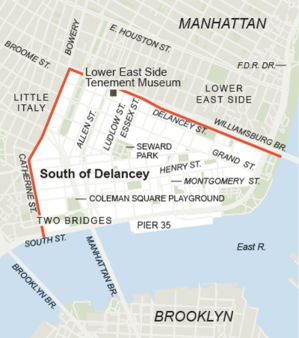
Below Delancey, however, a quieter, more residential atmosphere prevails.
"When you cross south over Delancey you feel your blood pressure go down," said Para Rajparia, a psychologist, who moved into a three-bedroom Grand Street co-op in 2010 with her young family, joining the many other young professionals who have recently put down roots in the area. "I have a sense of safety and comfort."
Although new night-life attractions have begun pushing south down Ludlow Street from Delancey, they do not for the most part extend below Grand, leaving intact, at least for now, a certain low-key authenticity that many residents say they prize.
Like many Rust Belt cities, it is a captive of its rich manufacturing past, when well-paying jobs were plentiful and landing one without a college degree was easy.
Educational attainment lagged as a result, even as it became more critical to success in the national economy. "We were so wealthy for so long that we got complacent," said Jane L. Dockery, associate director of the Center for Urban and Public Affairs at Wright State University here. "We saw the writing on the wall, but we didn't act."
Dayton sits on one side of a growing divide among American cities, in which a small number of metro areas vacuum up a large number of college graduates, and the rest struggle to keep those they have.
The winners are metro areas like Raleigh, N.C., San Francisco and Stamford, Conn., where more than 40 percent of the adult residents have college degrees. The Raleigh area has a booming technology sector and several major research universities; San Francisco has been a magnet for college graduates for decades; and metropolitan Stamford draws highly educated workers from white-collar professions in New York like finance.
Metro areas like Bakersfield, Calif., Lakeland, Fla., and Youngstown, Ohio, where less than a fifth of the adult residents have college degrees, are being left behind. The divide shows signs of widening as college graduates gravitate to places with many other college graduates and the atmosphere that creates.
First, on Jan. 1 the tax wasn't hiked; it was restored to its 2010 level, after a two-year "holiday" that reduced the withholding to 4.2% of employees wages (up to wages of $101,800 in 2011 and $110,100 last year) from the 6.2% level in effect since 1990.
The idea was to deliver stimulus dollars to middle- and working-class families. But the holiday was always a wretched idea, in part because of what everyone knew would happen when the old rate reappeared --people treated it as a pay cut.
The worse flaw was that it was a lousy way to deliver targeted working-class relief. The change replaced the Obama administration's previous Making Work Pay tax credit, which delivered up to $800 to families earning $12,900 to $150,000.
The payroll tax break, by contrast, went only to those who pay into Social Security. So it left out 5.7 million state and local workers (mostly teachers). On the plus side, it fattened the paychecks even of the nation's top earners by a much-needed $2,100 or so.
Assessing students has always been a fraught process, especially 4-year-olds, a mercurial and unpredictable lot by nature, who are vying for increasingly precious seats in kindergarten gifted programs.
In New York, it has now become an endless contest in which administrators seeking authentic measures of intelligence are barely able to keep ahead of companies whose aim is to bring out the genius in every young child.
Hunter, a public school for gifted children that is part of the City University of New York, requires applicants to take the Stanford-Binet V intelligence test, and until last year, families could pick from 1 of 16 psychologists to administer the test. Uncovering who was the "best tester," one who might give children more time to answer, or pose questions different ways, was a popular parlor game among parents.
The city's leading private schools are even considering doing away with the test they have used for decades, popularly known as the E.R.B., after the Educational Records Bureau, the organization that administers the exam, which is written by Pearson.
"It's something the schools know has been corrupted," said Dr. Samuel J. Meisels, an early-childhood education expert who gave a presentation in the fall to private school officials, encouraging them to abandon the test. Excessive test preparation, he said, "invalidates inferences that can be drawn" about children's "learning potential and intellect and achievement."
Last year, the Education Department said it would change one of the tests used for admission to public school gifted kindergarten and first-grade classes in order to focus more on cognitive ability and less on school readiness, which favors children who have more access to preschool and tutoring.
notoriously fuzzy with its definitions. One private bank's "high-net-worth" investor is another's "mass affluent" middle class and yet another's "ultra-high-net-worth."
One group is seeking to add a bit of semantic uniformity: the Investment Management Consultants Association, or IMCA, a Greenwood Village, Colo.-based nonprofit professional and credentialing organization for investment professionals. The group put out its own recommendations last Thursday based on a survey it took of nearly 400 finance professionals. It has offered the Certified Private Wealth Advisor designation since 2007 and also provides a Certified Investment Management Analyst designation, which is accredited by the American National Standards Institute.
The IMCA wanted to assess whether wealth management was a distinct field unto itself, says Sean Walters, CEO of the association, and decided it mandated its own body of knowledge beyond what had been required as part of the certification process.
The IMCA also defined a high-net-worth client: at least $5 million in net worth. According to the survey, 43% of respondents gave that as a minimum figure.
The number makes sense, says Walters, because many of the discussions surrounding tax strategies and estate planning tend to begin at the $5 million threshold.
According to Joseph Rosenberg, a research associate at the Urban-Brookings Tax Policy Center, only about 30 percent of taxpayers itemize, rather than take the standard deduction. And the majority of these itemizers are upper-middle and upper-income households.
Within that privileged category, the people who tend to derive the greatest dollar benefit from the mortgage interest deduction are households earning $100,000 to $500,000 a year.
"About two-thirds of the total benefit go to that group in the 80th through the 99th income percentiles," Mr. Rosenberg said.
The plain facts:
For households in the 15 percent bracket, the tax benefit for every $1,000 of mortgage interest deducted is $150. That benefit rises to $350 for households in the 35 percent tax bracket.
Robert Dietz, an economist for the National Association of Home Builders, which opposes cuts in the deduction, points out that households earning up to $200,000 could still be considered middle class in some parts of the country. Taxpayers who benefit the most from the mortgage deduction tend to be concentrated in high-cost metropolitan areas. So although their income levels sound high relative to the rest of the nation's, the incomes reflect a higher cost of living.
Continue reading "Middle class mortgage holders make $100k to $500k" »
President Obama and the Democratic Party are targeting families earning $250,000 or more for higher taxes and Republicans accuse them of fomenting class warfare.
In the context of that debate, likely voters were asked what income level would make a family wealthy.
For the middle class, wealth begins at $500k or $1 million.
Almost 40 percent of people said that threshold was reached at a minimum $500,000 of annual income. Nineteen percent set the "wealthy" level at $500,000 and 20 percent put the bar above $1 million.
By contrast, 31 percent of people said a family earning $250,000 a year is wealthy, 19 percent said $100,000 was the threshold, and 7 percent said $50,000.
The national debate over wealth intensified last week when Obama challenged Republicans to pass legislation extending Bush-era tax rates only for households earning less than $250,000.
When you have no choice but to cook for yourself every single day, no matter what, it is not a fun, gratifying adventure. It is a chore. On many days, it kind of sucks.
I might have gone to my grave denying this fundamental truth if I hadn't reported a book that had me living and eating off minimum wage (and less). While working at Wal-Mart in Michigan, I stocked up on bulk items, foolishly using middle-class logic ("great unit price!") instead of working-class smarts ("save enough cash for rent plus small emergencies").
I soon ran out of money and found myself hungry and exhausted, staring down a pantry containing little more than flour, coconut flakes, a few scraggly vegetables, and two frozen chicken thighs. There was nothing about this scene that inspired me to cook. The ingredients were boring. There were no friends bringing over bottles of wine. I had left my glossy food magazines in New York.
But there would be no calling Papa John's for pizza or stopping at Trader Joe's for premade lasagna or a selection of fine cheeses; my $8.10 an hour precluded that. I had two choices: consume raw flour and cauliflower, or cook. By dint of my newfound poverty, I had lost the third option--the escape hatch, really--that most middle-class people take for granted: eating without having to cook.
Once subjected to the tyranny of necessity, I found that making my meals from scratch wasn't glamorous at all.
"Before you had a dirty, sweaty little street shop, and that's all there was," said Mr. Guharoy of Roy Morgan Research, referring to the warungs. "Now you can go to a clean, air-conditioned shop and it's a better experience."
To appeal to local tastes in the world's most populous Muslim country, 7-Eleven had to rethink its sales strategy.
The store offers ready-made fried rice, doughnuts and its signature Big Gulp soft drinks and flavored-ice Slurpees. Most outlets also sell beer and wine coolers -- though each new shop conducts neighborhood surveys to get community approval first.
Meals can cost less than 23,000 rupiah, which appeals to families that might once have gone to McDonald's, a close competitor. Novi, a 37-year-old travel agent who, like many Indonesians, goes by only one name, said she liked the comfort of being indoors and the international food options. Her favorite is chicken katsu, a Japanese-style fried cutlet.
"There is a different kind of atmosphere, a different kind of food," she said, in comparing 7-Eleven with the food stalls she used to frequent. "There is air-conditioning here and there are no buskers to bother you."
The store's Big Bite hot dogs and cafe items -- coffee and cappuccino -- bring in the most sales. Small snacks like chips and pillow bread, tiny sandwiches filled with cheese or chocolate, are also popular.
With 69 stores in Indonesia, all of them in Jakarta, 7-Eleven lags behind its closest competitors, including McDonald's, Dunkin' Donuts and KFC, which together have more than 600 outlets.
But 7-Eleven is expanding much faster, having added 36 stores last year alone. In Thailand, 7-Eleven has one store for every 10,000 people. If the same ratio were applied in Jakarta, Mr. Honoris said, the city could see 2,000 outlets.
The swift growth of the middle class shows the enormous potential for expansion. From 2003 to 2010, about 50 million people entered the middle-income bracket, with disposable income of $2 to $20 per day, according to the World Bank. Indonesia's gross domestic product per capita is now more than $3,600, exceeding that of India, the second-largest consumer market in Asia, after China.
Continue reading "Middle class in Indonesia shops at 7 11" »
NY Times: marriage rates determine class; single moms drift downscale. The data, illustrated.
Continue reading "Two classes in America divided by I do " »
But money has diminishing returns -- like just about everything else. Satisfaction rises with income until about $75,000 (or perhaps as high as $120,000). After that, researchers have had trouble proving that more money makes that much of a difference. Other factors -- like marriage quality and health -- become more relatively important than money. It might be the case that richer people use their money to move to richer areas, where they no longer feel rich. Non-economists might chalk this up to the "keeping up with the Jones'" principle.
The swelling middle class in emerging economies is transforming the economic balance of power across the globe. Measuring it, however, is no easy task. There is no widely accepted definition of what constitutes the middle class, and the most common ways of measuring its growth -- through looking at rises in income -- suffer from a number of flaws.
Next: middle class means cars, meat, toothpaste, cell phones, and air-conditioners.
Continue reading "Middle class, hard to define, but includes at least owning a car" »
A new study from the Brookings Institution quantifies that price gap, and the differences between the cost of living near a high-scoring public school and a low-performing one are striking.
The study, by Jonathan Rothwell, a senior research analyst in the Metropolitan Policy Program at Brookings, found that housing costs in the nation's 100 largest metropolitan areas were an average of 2.4 times as high - a difference of $11,000 a year - for homes near schools whose average test scores put them in the top fifth of schools in the area, compared with schools in the bottom fifth.
That means that a family would have to pay more per year to move into a good public school zone than for their children to attend some private schools. Translated into an average home price, the gap works out to an average of $205,000 more for a home near a high-performing school.
"We think of public education as being free, and we think of the main divide in education between public and private schools," Mr. Rothwell said in an interview. "But it turns out that it's actually very expensive to enroll your children in a high- scoring public school." Mr. Rothwell said that in the New York metropolitan area, for example, annual housing costs are $16,000 higher on average in neighborhoods near high-performing schools than in neighborhoods near low-performing schools,
Continue reading "Housing in better school district costs a $11,000 a year " »
California Democrats want to raise taxes even more. Mind you, the November ballot initiative that Mr. Brown is spearheading would primarily hit those whom Democrats call "millionaires" (i.e., people who make more than $250,000 a year). Some Republicans have warned that it will cause a millionaire march out of the state, but Mr. Kotkin says that "people who are at the very high end of the food chain, they're still going to be in Napa. They're still going to be in Silicon Valley. They're still going to be in West L.A."
That said, "It's really going to hit the small business owners and the young family that's trying to accumulate enough to raise a family, maybe send their kids to private school. It'll kick them in the teeth."
A worker in Wichita might not consider those earning $250,000 a year middle class, but "if you're a guy working for a Silicon Valley company and you're married and you're thinking about having your first kid, and your family makes 250-k a year, you can't buy a closet in the Bay Area," Mr. Kotkin says. "But for 250-k a year, you can live pretty damn well in Salt Lake City. And you might be able to send your kids to public schools and own a three-bedroom, four-bath house."
According to Mr. Kotkin, these upwardly mobile families are fleeing in droves. As a result, California is turning into a two-and-a-half-class society. On top are the "entrenched incumbents" who inherited their wealth or came to California early and made their money. Then there's a shrunken middle class of public employees and, miles below, a permanent welfare class. As it stands today, about 40% of Californians don't pay any income tax and a quarter are on Medicaid.
It's "a very scary political dynamic," he says. "One day somebody's going to put on the ballot, let's take every penny over $100,000 a year, and you'll get it through because there's no real restraint. What you've done by exempting people from paying taxes is that they feel no responsibility. That's certainly a big part of it.
And the welfare recipients, he emphasizes, "aren't leaving. Why would they? They get much better benefits in California or New York than if they go to Texas. In Texas the expectation is that people work."
THE WEEKEND INTERVIEW
April 20, 2012, 7:19 p.m. ET
Joel Kotkin: The Great California Exodus
A leading U.S. demographer and 'Truman Democrat' talks about what is driving the middle class out of the Golden State.
"Rich" is a term that gets thrown around a lot in discussions about tax policy and income data, but judging from polling data there's a wide variation in how Americans define the word.Gallup recently released numbers showing $150,000 was the median annual income Americans would have to earn to consider themselves rich. But a closer look at the results reveals how difficult it is to define rich or middle class.
The Gallup data support the notion that the more money you make the higher the threshold considered rich. "According to the U.S. Census Bureau, the median annual household income in the United States is roughly $50,000 per year. The Gallup poll finds those below that level typically saying they would need to earn $100,000 or more in annual income to be rich. Those at or above that level typically report they would need to earn $200,000 a year to be rich, which expands to $250,000 among those well above the U.S. median income ($75,000 or more in annual household income)," writes Gallup's Jeffrey M. Jones.
-- Phil Izzo, Difficulties in Defining 'Rich': Is It $150,000 a Year ?
December 9, 2011 WSJ Real Time Economics
Within President Barack Obama's budget released Monday are proposals to end the 2001 and 2003 tax cuts and limit itemized deductions for households making more than $250,000 a year and individuals making more than $200,000 a year.
Obama has spoken about having the rich pay their fair share, and $250,000 is a lot of money. But to characterize those households that earn that sum as "rich" or middle class depends very much on where they live. Thanks to regional differences on costs, $250,000 does not go so far in places like New York City and Honolulu, compared with cities in Texas or Tennessee.New York
The Council for Community and Economic Research calculates cost of living indexes for U.S. cities based on goods and services bought by households in the top-income quintile, which nationally covers incomes of about $100,000 and above according to U.S. Census data.
What the data show is that the cost of living in Manhattan is 118% higher than the national average. On the other hand, a household in towns like Harlingen, Texas, or Memphis, Tenn., has a cost of living 15% less than the U.S. average.
What the differences do mean is a household earning $250,000 is not nearly as "rich" or has nearly the buying power as a Memphis household bringing home, say, $150,000 a year.
(The C2ER survey doesn't include private school tuition, which recently made headlines in New York by breaking the $40,000 a year ceiling. It also doesn't take into account local taxes, which can be an extremely heavy burden.)
More on middle class.
The modern populists in the Democratic Party have long argued that government has abandoned what their most ardent spokeswoman, Elizabeth Warren, has called the "vanishing middle class." They insist that a government owned by corporations is now skewed toward subsidizing the rich, while the middle class, a squishy term that in this case generally denotes families making something like $50,000 or less.
the mirror image of the Tea Party case. According to both ideological briefs, the middle class is being underserved. But in the Tea Party gospel, it's the poor who are absconding with a disproportionate share of the tax dollar, while in the left's, it's the wealthy. It just can't be that government is being generous with the guy earning $40,000 when that guy is a Tea Party sympathizer, but somehow it's behaving with negligent indifference when that same $40,000 earner is a union member.
-- Matt Bai
The area has long been populated by members of the working and creative classes, joined recently by professionals.
Doug Bowen, a resident and senior vice president of CORE real estate, said the average house price last year was $975,000 or $395 per square foot, virtually unchanged from 2010. Andrea Yarrington, a vice president of the Corcoran Group, said houses took an average of 136 days to sell, versus 347 in 2010.
Ms. Yarrington added that 15 condos sold in 2011, for an average of $452 per square foot. A search on Streeteasy.com showed four co-ops, three condos and three town houses on the market.
Financial benchmarks in this area can differ radically from those in places where more people are struggling to put food on the table. Many of Nassau's affluent families think of themselves as practically middle class, saying that property values and taxes are so high that $380,000 does not go very far.
"On Long Island, it's barely a living," said Steven R. Schlesinger, a lawyer and professional poker player. "In Plano, it's a living."
The cutoff for the 1 percent varies depending on how income is calculated. On the low end, an analysis of census data puts the cutoff at $380,000 for a household and provides a wealth of demographic characteristics that were used in this article. On the high end, the Federal Reserve's Survey of Consumer Finances, which uses a broader measure of income that includes capital gains, yielded a cutoff of $690,000 in 2007, the most recent year of data available. The Tax Policy Center, a nonpartisan group, makes projections based on Internal Revenue Service data and adjusts for people who do not file taxes. It puts the cutoff at $530,000 per tax return in 2011. Even by that gauge, though, $380,000 would still put a family well above the 95th percentile. There is little current data that would allow a measurement of the 1 percent by wealth.
Continue reading "$380,000 is middle class on Long Island, NY" »
The first challenge was figuring out who exactly is "rich." The Occupy Wall Street movement claimed to represent the bottom 99 percent of the population. The remaining 1 percent, according to the Internal Revenue Service, earn $506,000 or more. President Obama, meanwhile, has set the dividing line at $250,000. Under $250,000, you're middle class; anything over $250,000 and you're wealthy so you should pay higher taxes. Only 2 percent of households in the nation make more than $250,000, according to the IRS, so that seemed like a decent cutoff.
I then asked researchers at Experian Automotive, a unit of the well-known credit information service, to dig into their database of more than 600 million vehicles in the United States and Canada for insights.
Experian looked to see which brands were favored by people in three different income groups: $250,000 or above; $100,000 to $249,000, and less than $100,000. Not surprisingly, the richest people were the most likely to buy luxury brands (39 percent for people with household income above $250,000 vs. 8 percent for people who earn less than $100,000 a year).
But what that analysis also told me was that 61 percent of people who earn $250,000 or more aren't buying luxury brands at all. They're buying the same Toyotas, Hondas and Fords as the rest of us. So what cars are preferred by the rich?
Luxury models led the list of the 10 most popular cars for people earning over $250,000: The Mercedes E-class, Lexus RX 350, BMW 5 Series and 3 Series had the top four spots. But most surprising is the cars that rounded out the top 10: Three Hondas, a Toyota, an Acura and a Volkswagen. Not a single domestic vehicle in the bunch, though Cadillac has at least grown in popularity among the rich for the past two years.
Continue reading "Forbes: middle class ! Rich starts at 500k" »
An agenda for the middle class ?
RAISING TAXES, REDUCING THE DEFICIT Tax reform is essential. But there is no way to build public consensus for broad reform without first reversing the lavish tax breaks for the rich. In addition to letting the high-end Bush-era tax cuts expire at the end of 2012, Mr. Obama could call for all forms of income to be taxed at the same rates, rather than allowing lower rates for investment income, which flows mostly to wealthy Americans. Income tax rates also need to be adjusted at the top of the scale, so that the affluent, say, couples with taxable income of $400,000 a year, are not paying the same top rate as multimillionaires.
Is the judiciary a middle class vocation ?
Indeed, in a series of interviews, judges acknowledged that it could be difficult to make the case for a judicial pay raise in hard economic times. Justices of New York's highest-level trial court, the State Supreme Court, make $136,700. The chief judge of the state makes $156,000. Across the country, "there is a devaluing of the job that judges do," so there is little pressure to pay them well, said Seth S. Andersen, the executive director of the American Judicature Society in Des Moines, which studies and evaluates judicial systems.
Current and former judges described the pressures they felt in fending off offers and trying to pay for mortgages and tuition bills. Mr. Spolzino, 52, said he had expected that he would remain until retirement, as judges did in the past. "It's very heady when you walk into a room and everybody rises, people laugh at your jokes," he said.
Emily Jane Goodman, a State Supreme Court justice in Manhattan, said the practical effect of her stalled pay was that she had to sell a summer home in the Hamptons and was having trouble paying for increasing fees on her two-bedroom apartment in the city.
"Here I am," Appellate Division on Madison Avenue, Justice McGuire said, "in a position where I'm working to achieve justice for other people and I don't feel that I'm experiencing justice."
"I tormented myself for the longest period of time about whether I should go, because I love the work," he said. "And then I realized, 'I've got no choice. The only responsible thing for my family is to go.' " Justice McGuire, 57, has two children, ages 5 and 3.
Continue reading "Justice for professional class includes a home in the Hamptons" »
Do middle class apartments cost up to $10,000 per year ?
On the Upper East and West Sides, he said, there is strong interest from families for apartments with several bedrooms. His downtown clients, who typically work in the creative industries, tend to value location and design over space and even amenities, he said, and expect Sub-Zero or Viking appliances and remote-controlled sound systems and window coverings.
Other five-figure rentals offer a number of amenities. At 15 Broad Street in the financial district, James Cox of Prudential Douglas Elliman is marketing an apartment he described as being at the "low end of the high-end rental." At $12,000 a month, the two-bedroom apartment has almost 1,900 square feet of interior space, but its real draw is the 1,200-square-foot terrace with sweeping views of Lower Manhattan, Midtown and beyond. That, and the building's extras, like a single-lane bowling alley, basketball court, gym and pool in the basement and a billiards room, party space and parklike common terrace on the seventh floor that offers a full-frontal view of the frieze over the New York Stock Exchange.
As prices rise, so do the expectations, said Dennis R. Hughes, a senior vice president at Corcoran Group Real Estate. For about $20,000, he said, he was able to find one client, a divorced businesswoman moving from a town house, a 2,300-square-foot, three-bedroom apartment in TriBeCa with outdoor space and views of the Hudson River. For $45,000, a renter could have a 4,500-square-foot, five-bedroom apartment in a prewar doorman building on Fifth Avenue with a spa in the basement.
And for $85,000, Prudential Douglas Elliman is marketing a full-floor loft at 25 Bond Street with 7,326 square feet inside, five bedrooms, six and a half baths, fireplaces and terraces. It even comes with a movie star, Will Smith, staying just below.
Continue reading "Upper class rent starts at $10,000 per month" »
famous Prius owners just like driving a 50 m.p.g. hybrid even if they could commute via yacht and helipad. And even for many middle-class converts, the Prius's $26,000 median price is hardly a burden: Toyota figures the average Prius household pulls in nearly $83,000 a year, which is rather high for an economy car.
Those figures help to illuminate Toyota's logic behind the 2011 Lexus CT 200h. Is this deluxe hybrid hatchback a better car than the Prius? You bet. Is it really worth an extra $7,000 or $8,000? For a bargain hunter, no. But for a certain well-heeled, light-footed buyer, the Lexus should be a painless stretch.
The CT 200h won't quite match the Prius's mileage, but at a robust 44 miles per gallon in my own combined city and highway driving, it's close enough. And despite its pokey Prius-based hybrid system, the Lexus gives people good reasons to move up.
The CT is more luxurious, more quiet and feels more solidly put together. And its distinctive design, inside and out, may attract two types of customers: bored Prius owners who want something new, and people who crave high mileage but wouldn't be caught dead in a Prius, for either its econobox vibe or its granola image.
Continue reading "Middle class economy car: make less than $85k, drive an economy car" »
A Georgetown University study of the class of 2010 at the country's 193 most selective colleges. As entering freshmen,
Only 15 percent of students came from the bottom half of the income distribution.
Sixty-seven percent came from the highest-earning fourth of the distribution.
These statistics mean that on many campuses affluent students outnumber middle-class students.
"We claim to be part of the American dream and of a system based on merit and opportunity and talent," Mr. Marx says. "Yet if at the top places, two-thirds of the students come from the top quartile and only 5 percent come from the bottom quartile, then we are actually part of the problem of the growing economic divide rather than part of the solution."
-- Anthony Marx, a 44-year-old political scientist, and outgoing president of Amherst College, in western Massachusetts,