April 14, 2016
August 30, 2015
Was user input received ? Echo back
Move your mouse straight to Transmit and click on it
Ah! That's the thing: I always TAB off input fields after modifying them before doing anything else, so I guess that's why I never experienced what you're describing. Maybe it's because I was a programmer first, that I have such habits of not trusting anything...
February 2, 2014
ConvergEx took no principal risk, didn't make markets, didn't hang on to shares, etc.: there's no actual trading profit here. It's just gouging profit.
ConvergEx took no principal risk, didn't make markets, didn't hang on to shares, etc.: there's no actual trading profit here. It's just gouging profit.
The Securities and Exchange Commission settled fraud accusations on Wednesday against ConvergEx, a group of brokers that, in the SEC's words, "held themselves out to the public as a unified conflict-free agency broker that charged explicit commissions for equity order execution." Surprise! Most of those words were false!
The basic deal was that you hired ConvergEx to do some pretty boring but big equity trades,1 and ConvergEx would do your trades for you on a purely agency basis and charge you a fixed stated commission. So you'd be like, "buy a million shares of Facebook," and ConvergEx would go buy a million shares of Facebook for your account and say, "okay we filled you at $55.05" or whatever and then charge you a penny a share for their trouble.
But in fact what would happen is that ConvergEx would secretly use a Bermuda affiliate broker-dealer (ConvergEx Global Markets Limited, or CGM), which would buy the shares at, say, $55.02, and then sell them on to the client-facing ConvergEx entity at $55.05, and ConvergEx would go to the client and say "okay we filled you at $55.05, so pay us $55.06 with the commission, thanks." ConvergEx called the extra three cents "trading profits," which is a little euphemistic,2 or "TP," which is not. "It was not uncommon for the amount of TP to be several times the amount of commission that the customer had paid," says the SEC.
November 3, 2013
Portfolioprobe's investment performance measurement vs calculation
Measurement as a call to action.
I said "measurement". My dialogist heard "calculation" but wanted "measurement". We went dizzy in the chase.
A calculation is what computers do.
A measurement is an assessment. It is a comparison with an ulterior motive.
I'm not going to weigh myself unless there is the possibility of a change in behavior. If there is no value of my weight that is going to affect the way that I act, then weighing is pointless -- the scale does the calculation but there is not actually a measurement.
Look at these on 4 schemes:
a performance statistic relative to a benchmark
a peer group
a performance statistic relative to no trading
random portfolios
May 12, 2013
Option pit
Optionpit blog seeks volatility for options traders.
May 7, 2013
Vix Central
Vixcentral is a great dashboard for volatility trading.
April 1, 2013
Tradelog Software for tax preparation
Tradelog Software does all the obvious things for traders' taxes; which is nice, because the IRS does not.
Broker 1099-B reports are often useless for tax reporting since the IRS has different rules for taxpayers than they do for brokerages. No, you did not read that wrong! Let me say that again: The IRS has different reporting rules for taxpayers than they do for brokerage 1099s. And in many cases (maybe as high as 90%) your brokerage 1099-B will not match with what you, the taxpayer, are required to report on Schedule D Form 8949.
Greene recommends it:
We frequently find errors in other programs and solutions on wash sales, tax treatment and more. Many of these programs or solutions are geared toward the needs of brokerage firms, and IRS rules for broker-issued securities 1099-Bs are materially different from what taxpayers need to report on their Form 8949/Schedule D. Brokers are permitted to report potential wash sales based on "identical positions," whereas taxpayers must report actual wash sales based on "substantially identical positions" (between stocks and stock options based on the same symbol). Many tax preparers get lazy and import broker-issued securities 1099-Bs into their tax preparation software which is a huge mistake, because it will either overstate or understate trading gains and losses
June 3, 2012
Recover the trade, do not get stopped out
From offices on the 58th floor of the Chrysler Building in Midtown Manhattan, Mr. Weinstein runs a $5.5 billion hedge fund firm called Saba Capital Management. ("Saba" is Hebrew for "grandfatherly wisdom," a nod to his Israeli roots.) It was there, last autumn, that he noticed an aberration in the market for credit derivatives. He knew from experience what it was like to lose a lot of money at a big bank. Before starting Saba, he was responsible for a team that lost nearly $2 billion, in the depths of the financial crisis, at Deutsche Bank. Others lost even more. Last November, however, he saw that a certain index seemed to be trading out of line with the market it was supposed to track. He and his team pored through reams of data, trying to make sense of it.
It was his pick for the "best" investment idea of the moment. Mr. Weinstein recommended buying the Investment Grade Series 9 10-year Index CDS -- the same index that Mr. Iksil was shorting.
Continue reading "Recover the trade, do not get stopped out" »
May 27, 2012
Facebook IPO aftermath $FB
Zuckerberg's torture-by-attorney didn't start in the past twenty-four hours, when law firms in New York and California initiated the first of what is sure to be a slew of lawsuits related to last week's controversial I.P.O. Ever since February, when Facebook filed its initial investment prospectus, the youthful C.E.O. has had to check with his own lawyers before saying virtually anything publicly--a requirement imposed as part of the S.E.C.'s pre-I.P.O. "quiet period," which applies to any company preparing to issue stock.
May 12, 2012
Position: open to enter, exit to close
Four things to understand before adding risk via options:
1. Understand the Cause of Volatility in your instrument
2. What is ATM Implied Volatility
3. What is the Curvature of the Skew (how pricy are calls and puts)
4. What is the current Term Structure
-- OptionPit
April 23, 2012
$VXX goes down 80 percent of time
"Everyone knows" that US residential real estate is a bad investment, with the Case Shiller Home Price Index having dropped by about 32 per cent since its 2005 peak. At the end of last week, the iPath S&P 500 Vix Short Term Futures Exchange Traded Note had lost that much in one month. Not seven years. One month. Over the previous six months, the vehicle had lost more than 69 per cent of its value. The managers didn't do anything other than rigorously follow their charter, and their strategy has been fully disclosed, along with the trading history.
The reaction of some investors to this record is interesting: they have been doubling down. There has been a spurt of option buying on the ProShares Ultra Vix Short Term Futures Fund, which aims for twice the daily return for the Short Term Vix Futures Index.
Vix futures or options, you are not actually buying "volatility". Those products are based on the prices of forward start variance swaps. If you don't know what that means, don't buy Vix products.
April 10, 2012
Risk Reward numeraire, R
The higher the risk/reward ratio you have on your trades, the fewer times you have to be right, and still make money. The total amount you are willing to risk per trade is expressed as 1R. If you only take trades that have a 1:3 risk/reward ratio, and you are correct just 50% of the time, you will have a 10R profit on ten trades.
Understanding how to use risk/return and position sizing allows you to make sure you are never over extended on a trade and allows you to always return to fight another day.
January 10, 2012
Inverse volatility: XIV, not VIX
VelocityShares Inverse VIX ETN (XIV)
This ETN offers daily inverse exposure to an index comprised of investments in short-term VIX futures contracts-a strategy that has struggled mightily in 2011 thanks to heightened volatility and backwardated markets. Though XIV has lost more than 40% of its value in 2011, there is reason to be optimistic that at least the beginning of 2012 will be more favorable. The VIX, a measure of expected equity market volatility, has declined considerably in recent weeks as optimism over the global economy has returned. And more importantly for XIV, contango in VIX futures markets has also returned; the futures curve now has a steep upward slope, a condition that can give a nice boost to the strategy employed by XIV [see also Low Volatility ETFs Attracting Big Inflows].
Given that XIV utilizes a futures-based strategy to deliver inverse exposure, this ETN probably isn't appropriate for risk-averse investors who aren't willing or able to regularly monitor their positions. But for those who grasp the complexities associated with XIV, the current environment might just be perfect for this ETN. XIV might not be a good ETN to own throughout 2012, but it certainly seems to be positioned nicely for a strong start to the year.
June 27, 2011
Dispersion trade: short correlation, long volatility
Dispersion trades are a way of betting on an end to the historically high market correlation that began during 2008, when shares of companies in various industries all rose and fell together, frustrating money managers who earned their keep by researching and picking individual companies.
In a dispersion trade, managers sell put and call options on an index such as the S&P 100 during market declines, when demand is heavy among investors who want to protect themselves from losses. They use the rich premiums received for the index options to buy put and call options on some or all of the stocks comprising the index.
SocGen has one take on this idea called Symphony - which is short correlation, long vega. Och Ziff seems to have bitten hard on this idea. It seems to add up as improvements in liquidity make the premise of the trade more compelling.
May 9, 2011
Wait for the setup before you trade
One of the reasons so many traders get killed in this business is their inability to sit on their hands. Deep inside they crave the action. When the markets are not conducive to trading aggressively or do not warrant having more than average exposure you absolutely have to respect that and stay on the sidelines. If you trade although your trading skills do not match the current trading environment, or put another way, if you have no edge in a certain market environment or your strength requires specific set-ups that aren't there, odds are not in your favour. If odds are not in your favour the smart thing to do is to wait for these external factors to set up again.
April 16, 2011
Sites we are reading
Time to review the investing blogroll, 2010.
24/7 Wall St.
A Dash of Insight /Jeff Miller
Abnormal Returns
Barron's
Berkshire Hathaway Annual Letters
Bloomberg
Briefing.com
CNBC
Crossing Wall Street
DealBreaker
Drudge
Footnoted
HedgeFolios
Information Arbitrage
Jeff Saut
Muniwiseguy
ProQuest
Random Roger
Reuters
Sonders
Take A Report
The Big Picture
The Kirk Report / Charles E. Kirk / 12 steps to GTD
TheStreet.com
Trader Mike
TraderFeed
WallStCheatSheet
Wall Street Window
Wikinvest
World Beta
May 15, 2010
High Frequency Traders (HFT) Driven by Spread Squeeze
For decades an order to buy or sell a security went to a person in a trader's jacket standing on the floor of an exchange, often at the NYSE in Lower Manhattan. If you wanted to sell stock in General Electric, for instance, these so-called specialists would find a buyer. If they couldn't find one, they bought it themselves.
In exchange for their services, the specialists pocketed some of the difference between the price at which you were willing to buy and the price at which a GE holder was willing to sell.
This system came under attack in the early 1980s from Nasdaq, a rival marketplace for stocks, which began using computers to make trades. The pitch was it could match buyers and sellers faster than humans, and for less money.
Then, starting in the late '90s, the NYSE specialists got hit again, this time with a series of blows: new rules encouraging computer matching of buyers and sellers, a shift to quote stock prices in minute increments of decimals instead of fractions, and a decision to cut the minimum spread that specialists or other middlemen could grab for themselves from 6.25 cents per share to a penny.
''It used to be an oligopoly, an old boy's club,'' said Irene Aldridge, head of an HFT shop called Able Alpha Trading and author of ''High-Frequency Trading.'' ''But now it's a completely level field.''
Critics of high-frequency trading say all this talk about narrowing spreads for ordinary investors distracts from a key problem: Split-second trading without human supervision is a recipe for disaster
Continue reading "High Frequency Traders (HFT) Driven by Spread Squeeze" »
May 13, 2010
Survived the crash of 2:45pm ?
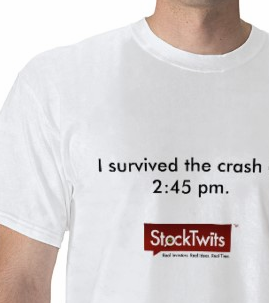
I survived the crash of 2:45pm t-shirts, $20, memorializes on day's trading position.