CitiBike share bikeshare data
Rides, when, where. Citibike shares bikeshare data for NYC.
Rides, when, where. Citibike shares bikeshare data for NYC.
"The Downward Spiral," Mr. Reznor's 1994 masterpiece that contemplated self-destruction and suicide during a period of personal and career turmoil; it became Nine Inch Nails' musical and commercial breakthrough.
"Hesitation Marks" was a year of patient effort. Mr. Reznor composed music on his laptop, using it largely as a drum machine and coming up with austere, brittle, sneakily evolving grooves. "It feels sparse, and it feels minimal," he said. "It's hard for me to do that. I've realized over the years that if I have 100 tracks, I'll use 110 tracks. This was really about economy. It was just a weird puzzle of grooves."
And in the context of the Nine Inch Nails catalog, where a whisper tends to lead, sooner or later, to a scream, Mr. Reznor found himself following other impulses. "It didn't dawn on me until I was almost done with the record that I don't really even raise my voice on this album that much," Mr. Reznor added. "The mechanism of screaming choruses doesn't exist here. And that wasn't by design."
He said: "I don't think it's a gentle record. I do think it's more subversive in how it gets you. It's not about everything being at 11 and the pyrotechnics of sound and scare tactics, which I've definitely used in the past. But it doesn't feel like the middle-aged, I've-given-up record either."
-- Jon Pareles
Molly still feels like a more respectable substance than others.
"I think people are much more aware of where coke comes from and what it does in those countries," said Sarah Nicole Prickett, 27, a writer for Vice and The New Inquiry, a culture and commentary site, who called cocaine a "blood drug." "Molly, if it's pure, it feels good and fun." (Much of it comes from Canada and the Netherlands, Mr. Payne said.)
Ms. Prickett, who moved to New York from Toronto last year, added that she could see why the drug might be taking hold in her new habitat.
"My impression of New York was that everyone just did drugs for work, that everyone was on speed," she said. "Molly makes you feel unplanned, and that's not a common feeling in New York, where everyone knows where they're going all the time and they're going very, very fast."
Rick Doblin, the founder of the Multidisciplinary Association for Psychedelic Studies, which has helped finance MDMA studies since the drug first entered the club scene, put Molly in the context of past drug trends: in the 1960s, he suggested, people searched for deeper spirituality and found LSD; in the '70s, as hippie culture became mainstream, marijuana entered the suburban household; in the '80s, cocaine complemented the extravagance and selfishness of the greed decade; and by the early '90s, youths dropped out of reality, dancing all night on Ecstasy or slumping in the corner on heroin. MDMA, which in addition to acting as a stimulant also promotes feelings of bonding and human connection, just might be what people are looking for right now.
"As we move more and more electronic, people are extremely hungry for the opposite: human interaction on a deeper level where you're not rushing around," Mr. Doblin said. "The rise of Molly is in tune with how people are feeling emotionally."
Correction: June 13, 2013
Due to an editing error, a summary with an earlier version of this article referred incorrectly to Michael Diamond's status with the Beastie Boys. He is a current member, not a former.
Though they came here with "a specific mission," as Shaiba put it, to meet with their supporters and recruit new ones, Pussy Riot were surprised by the volume and warmth of the reception.
"We came specially to meet with these people, but we didn't expect that there would be so many," Fara said.
"That they are so nice and generous!" Shaiba added.
"That we're all on the same wavelength," Fara concluded.
They met with organizers at the Willie Mae Rock Camp for Girls, a music-mentoring program based in Brooklyn, but they were quick to note that, though they have released a single and are often described as a punk act, Pussy Riot is not, strictly speaking, a band.
"It's an art group, not a musical group -- this is very important," Fara said. They are multimedia, site-specific, activist performers. "We work from the space or the problem," she explained.
At the moment, though, Pussy Riot is not able to extend its oeuvre: After the arrests, the Russian government drafted laws banning the wearing of masks and imposing hefty fines for unauthorized demonstrations. Pussy Riot's videos were labeled extremist and ordered removed from Russian-hosted Internet sites (though they are still available on YouTube).
"For anybody that wants to follow in our footsteps, this is a direct disruption of freedom of speech, this is like a muzzle," Fara said, adding that they will keep fighting the ruling.
Performance is not much on their minds, anyway.
Continue reading "Pussy Riot not able to extend its oeuvr" »
Q: Can you tell us a little about yourself?
A: My name is MJ Choi. I am the director and instructor of I LOVE DANCE. I started dancing late in my life and after a couple of years of dance training, I founded I LOVE DANCE in 2006.

Q: What prompted you to start I Love Dance and teach K-Pop classes?
A: I originally started teaching Hip-Hop classes in NYC in 2006 thinking that I wanted to help beginner to learn how to dance. Back then, K-POP really wasn't as popular as it is now. In fact, I don't think we even used the term K-POP much. When I first started, I had a small group of Korean students who were interested in taking Hip-Hop classes. But as you know, we've had this explosion of K-POP popularity in the past few years. So my classes somewhat naturally transitioned into K-POP Dance as more and more students showed growing interest.
-- Asian in NY's i-love-dance-third-annual-student-showcase-2013.
Electronic musicians have scored movies for years. Recent examples include the Chemical Brothers for "Hanna" in 2011, Daft Punk for "Tron: Legacy" in 2010 (also directed by Mr. Kosinski) and Trent Reznor and Atticus Ross for "The Social Network," for which they won an Academy Award. However, artists like Skrillex, Kaskade and M83 have more trendy momentum than their predecessors did during their projects. By including them, the movies get a quick infusion of youthful relevance, while the musicians court a broader mainstream audience and receive a significant salary.
Skrillex, whose real name is Sonny Moore, composed his score for "Spring Breakers" while on tour, using his laptop, much as he does for his albums. He said he watched early cuts of scenes from the movie before creating the score; his initial reaction to the film was that "it has a lot of tension, so there's a lot of that mixed with the melody," he said. He used live guitars and vocals performed by his girlfriend, the British pop singer Ellie Goulding, and he described the score -- which he declined to play because he had not finished it -- as a distilled version of his dance music, which took out all the upbeat parts, emphasizing melody, "leaving the pretty parts, leaving the sad parts."
Continue reading "Electronic danse music (EDM) invades Hollywood scores and soundtracks" »
The name helps. It's its own form of culture jam, a savvy reference to feminist and musical history -- riot grrrl and Susie Bright, as well as a wink to women's appropriation of sexual agency and bodily power. Madonna has worn Pussy Riot's name on her bare skin, a statement both of her support and of her own rebelliousness. (She still knows how to flaunt it.)

The inevitable aesthetic judgment has found these girls, as they sometimes refer to themselves, on the right side of cool. For women identified with rock 'n' roll -- and for fans, especially in the West -- Pussy Riot is expertly constructed, perfectly charged. Plus, it's fun to say -- unless you're in American network news, which has been demurely referring to the group as an all-female punk band.
But for artists and activists around the world the recent travails of Pussy Riot, founded in 2011, have become a cause célèbre. When its members, Maria Alyokhina, Yekaterina Samutsevich and Nadezhda Tolokonnikova, were sentenced on Aug. 17 to two years each in a prison camp for staging a flash protest against President Vladimir V. Putin in Moscow's main Orthodox cathedral in February, it served as another rallying point, at a time when many are concerned with government malfeasance, economic and social equality, and, not incidentally, women's rights. The ladies of Pussy Riot are of-the-moment renegades.
That the group is so digestible to Western audiences has been much noted. Yes, the choppy performance that got its members arrested could have just as easily taken place at an undergrad art school, where the corresponding video might've been mocked for its low production value (or turned up in a flashback episode of HBO's "Girls"). Instead, when it made the rounds online, it found eager and sympathetic spectators and an instant distribution channel aided by social media. Punk was never shy about being amateur; DIY spread wide is its hallmark. And in a country where public dissent is at a neophyte stage, Pussy Riot's "Punk Prayer," a 40-second lip sync, only served to highlight the discordantly severe punishment its members received. Supporters -- like the hundreds who gathered at a reading in New York on the eve of the sentencing -- viewed the group members as unfairly judged, less creatively shackled musicians than oppressed symbols of heroism.
Top Forty radio was invented by Todd Storz and Bill Stewart, the operator and program director, respectively, of KOWH, an AM station in Omaha, Nebraska, in the early fifties. Like most music programmers of the day, Storz and Stewart provided a little something for everyone. As Marc Fisher writes in his book "Something in the Air" (2007), "The gospel in radio in those days was that no tune ought to be repeated within twenty-four hours of its broadcast--surely listeners would resent having to hear the same song twice in one day."
The eureka moment, as Ben Fong-Torres describes it in "The Hits Just Keep on Coming" (1998), occurred in a restaurant across from the station, where Storz and Stewart would often wait for Storz's girlfriend, a waitress, to get off work. They noticed that even though the waitresses listened to the same handful of songs on the jukebox all day long, played by different customers, when the place finally cleared out and the staff had the jukebox to themselves they played the very same songs. The men asked the waitresses to identify the most popular tunes on the jukebox, and they went back to the station and started playing them, in heavy rotation. Ratings soared.
Read more at the NewYorker.
Purity Ring is the duo of Megan James and Corin Roddick from Gobble Gobble; they have nothing to do with the Jonas Brothers. Their song "Ungirthed" is a hyper-addictive pop-dubstep sort of affair that sounds channeled from a sweetly futuristic broadcast originating lightyears away... a future in which actual purity rings have long been smelted away from memory.
The Ungirthed 7″ is out now on Transparent records.
Beats have redefined the lowly headphone, as well as how much people are willing to pay for a pair of them. A typical pair of Beats sell for about $300 -- nearly 10 times the price of ear buds that come with iPods. And, despite these lean economic times, they are selling surprisingly fast.
Whether Beats are worth the money is open to debate. Reviews are mixed, but many people love them. The headphones are sleekly Apple-esque, which is no surprise, since they were created by a former designer at Apple. Beats also offer a celebrity vibe and a lot of boom-a-chick-a-boom bass.
So much bass, in fact, that some audio experts say that Beats distort the sound of the music.
"In terms of sound performance, they are among the worst you can buy," says Tyll Hertsens, editor in chief of InnerFidelity.com, a site for audiophiles. "They are absolutely, extraordinarily bad."
Time was, manufacturers marketed high-priced audio equipment by emphasizing technical merits like frequency response, optimum impedance, ambient noise attenuation and so on. The audience was mostly a small cadre of audiophiles tuned to the finer points of sound quality.
But, three years ago, Beats by Dr. Dre set out to change all that by appealing to more primal desires: good looks, celebrity and bone-rattling bass. Annual sales are approaching $500 million, and Beats have transformed headphones into a fashion accessory.
Continue reading "Beats: Dr Dre's fashion accessory for dofus" »
He wrestled with the question of how to portray what happens in the private chambers. "Sex scenes in a brothel are so expected that they could be very boring," he said. "I went much more into theater, fetishism, a kind of play." Masks and mirrors are ubiquitous; one prostitute mimics a marionette, while another dresses as a geisha and speaks pidgin Japanese. "These things can tell you more about power relationships than a faked sex scene," he added.
Extending the metaphor of brothel as theater, he likened the madam in "House of Pleasures" to a director committed to putting on a nightly show and consumed by the logistics and economics of doing so. (She is played by the director and actress Noémie Lvovsky, and many of the customers are also played by filmmaker friends, including Xavier Beauvois and Jacques Nolot.)
Mango still offers everything that Windows Phone already had going for it: a terrific onscreen keyboard with smart auto-suggestions. Integration with your Xbox account. Microsoft's Zune music service ($15 a month for all the music you want to hear). A GPS app that now speaks your directions, turn by turn.
Now, if this phone had arrived before the iPhone, people would have been sacrificing small animals to it.
But Microsoft's three-year lag behind its rivals is going to be very tough to overcome.
Windows Phone is considered a weird outlier. Unlike with the iPhone, there's no teeming universe of alarm clocks, chargers, accessories and cars that fit these phones.
Similarly, Windows Phone's app store has 30,000 apps, which is an achievement -- but Android offers 10 times as many, and the iPhone store has 16 times as many.
Microsoft says that it's quality, not quantity, and that all the important apps are there. Unfortunately, a long list of essentials are still unavailable: Pandora radio, Dragon dictation, Line2, Flight Track Pro, Ocarina, Instagram, Hipstamatic. You should note, too, that Microsoft's schoolyard grudge against Google manifests itself in several disappointing ways: you can't export your videos to YouTube, and you can't search with Google.
In other words, Microsoft may face quite a Catch-22, no matter how superb its work: Windows Phone isn't popular because it isn't popular.
Today's fuzzy downtempo:
Lady Gaga is the pulse of current feminist thought, though Gaga isn't actually a genuine representation of feminism.
Sartre thought about the issue. But Sartre is cooky and nobody buys his dualism anymore. So, we still have an open question; back to square one ? Beauvoir can un-muddy the waters.
-- Nancy Bauer
The relationship between Mr. Rapino and artists is complicated. On the one hand, he must be deferential and accommodating, because without a regular caravan of acts, he has nothing but empty seats and red ink. At the same time, some artists are exasperating, though Mr. Rapino is far too diplomatic to say so.
Instead, he'll simply note that artists -- at least the famous ones -- are in a position these days to define their own destiny. And without question, that destiny includes higher ticket prices. The average price of a ticket to one of the top 100 tours soared to $62.57 last year from $25.81 in 1996, according to Pollstar, far outpacing inflation. The interesting question is why.
Mr. Rapino's theory is that musicians are just benefiting from the same trends that have enriched other superstars, like athletes and actors.
"The ticket was underpriced 40 years ago," he says.
Rival promoters see another culprit in high ticket prices: Live Nation. The company, they say, represents a consolidation of regional promoters that didn't just coincide with rising ticket prices but also helped cause them. Ticket prices, in this telling, have gone up because the largest promoter has been paying whatever-it-takes sums to get bands in the door -- both to drive out competitors and to bring in desperately needed revenue to cover fixed overhead costs and to fill up seats. The company's biggest outlays include "360 deals" with Jay-Z, Madonna, U2 and others, giving the company a stake in tours, recording and merchandise profits in exchange for nine-figure paydays. Jay-Z's deal was reportedly worth more than $150 million.
"Look at what has happened to ticket prices, and the price of everything else at a concert, over the last 10 years, right when consolidation was happening," says John Scher, who books shows in Madison Square Garden, at Radio City Music Hall and elsewhere in New York. "I talk to college kids all the time and they tell me that going to a show at an arena or an amphitheater is just beyond what they can afford. And it's because Live Nation has been paying the acts these outrageous sums, which is just alienating the fan base."
Mr. Rapino denies overpaying for bands, and says that the price of tickets often triples when they're sold by scalpers, which suggests that they were actually underpriced.
Then again, when Mr. Rapino was describing the parlous condition of the concert business in front of Congress last year, he noted that 40 percent of concert tickets go unsold, a statistic that he offered as a symptom of an industry in distress but that might just be evidence that Live Nation and its rivals don't know how to price and sell their products. Today, as high as ticket prices are, Live Nation earns none of its profit from ticket revenue. The artists get nearly all of that. Live Nation's earnings come from stuff sold on site, like beer, parking and advertising.
Continue reading "Pricing concert tickets understates inflation: Ticketmaster, LiveNation" »
This is what I call "dude music." To clarify, just because music is made by men doesn't mean it's dude music. And just because music is made by women doesn't mean it's not dude music.
No, dude music is music that prioritizes the status quo, that prioritize men's voices, men's experiences, and the experiences of people in power and who benefit from the current power structures in our society. Dude music is music that can ever be described as "noodling." Dude music is post-rock, and prog-rock, and rock that exists not to say anything, but to showcase how awesome the men in the band are at playing guitar.
Dude music is music that has nothing to offer people who are disenfranchised or oppressed, because it either is totally uninterested in their disenfranchisement/oppression, or actively profits from it. Dude music is "I went to your concert and I didn't feel anything." Because it is made by men, for men to enjoy, for men to profit from.
Women have three roles: 1) to serve as inspirations for songs; 2) to be sex objects who, hopefully, also make music men feel good about Their Art; 3) to be someone who is dangerously standing in the way of men acheiving greatness (see, e.g., Yoko Ono and Nancy Spungen, Sid Vicious' girlfriend). Women do not make the music. Hopefully they buy the music, but not too many of them because then your music is Not Serious.
The Kurayamino variation of this Clubbed to Death is significantly better known than the first one due to its appearance in the film The Matrix. Therefore, this version is now known simply as Clubbed to Death, and the first one as the First Mix.
Roman Flugel & Delano & Crockett - Gehts Noch - Walking on the moon (transition at 33 seconds).
Excellent sampling and mixing.
Alison Moyet and Yaz have some soulful songs.
Also acclaimed, Peaches, the Velvet Underground's Pale Blue Eyes and The Smiths' There is a Light That Never Goes Out
Not your average teenage pop lovesongs.
gorillavsbear finds new music before it hits SXSW or Sirius; also uses nifty Yahoo flash mp3 player. Example: frankie knuckles x animal collective :: your love my girls mix.
Summer music festivals go posh, report from Europe, via WSJ:
Summer rock music festivals, long the preserve of teens and twentysomethings, are increasingly becoming familiar territory for a generation that still remembers the hits of the 1970s and '80s even as it keeps up with current stars. Concert promoters are starting to cater to the needs of this older crowd of festival-goers, many of whom are looking for something more than mosh pits, fast food and porta-potties -- and who can afford multiday tickets costing between €150 and €250.
"They still want to experience the buzz of the festival, they still want to have the excitement of the festival, but they don't want to sleep in a two-person tent anymore," says Melvin Benn, managing director of Festival Republic, which promotes the Leeds, Reading and Glastonbury festivals in the U.K. "They don't want to rough it in quite the same way."
A Grown-Up's Guide To Summer Rock Festivals
By GABRIELE STEINHAUSER, 2008 July 10
An opposing take says concerts are offering cheap tickets as they have difficulty filling venues-- Barry Ritholtz / Big Picture in 2008; and in 2005.
Matmos as high culture or difficult music ?
SOMA FM streams beloved CliqHop and delightful Groove Salad.
Security is silky here, when it’s noticeable at all.
There’s not much to secure. This is an indie-rock
festival — a gathering of property-owners,
memoir-writers, biochem majors, workshop-takers, etc.
-- Coachella 2007.
The reason why I am so bummed out about MySpace now is
because recently they have been cutting down our freedom
and taking away our rights slowly.
MySpace will now only allow you to use ‘MySpace’ things.
-- Tila Tequila, a singer who is one of MySpace’s most popular and visible users.
Berliner Trance - Paul van Dyk (Goog video)
With Dr. Motte of Love Parade,
Dance music: from Acid house to Drum and Bass,
antecedants to today's
Tiesto, van Buuren, Corsten, DJ Dan, Carl Cox.
Top Tracks:
Cited: Vernon's Wonderland
progressive house of Digweed and Sasha, previously known for
mid-1990s trance anthems Heaven Scent and Xpander.
Cited b
There's an ulnimited supply
And there is no reason why
I tell you it was all a frame
They only did it cos the fame !
Who ?
E.M.I.
Too many people had the suss
Too many people support us
An unlimited amount
Too many out lets in and out
Who ?
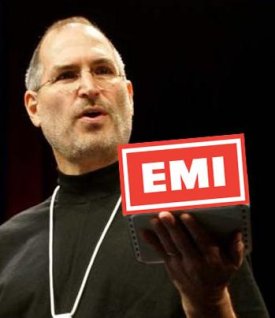
Apple and EMI just announced that they will be selling DRM-free
Apple songs through the iTunes Music Store. The songs will cost
130 percent of the price of the existing crippled songs, and you'll
get to choose. Weirdly, Apple seems to have sold this move to
EMI by saying that the DRM-free version will be a "premium"
offering for audiophiles who want higher-quality music.
I think that audiophiles are probably the people who have
the least trouble keeping up with the latest tips for efficiently
ripping the DRM off of their music -- the people who really
need DRM-free music are the punters who can't even spell DRM.
MeFi says the CBC mothercorp finally kills off its treasure, Brave New Waves.
See also radiofreecanuckistan, insidethecbc, cleverlazy, zoilus, Discorder, Canada.com, StilePost.
East Indian blogging by sepiamutiny, example.
Campaign for quiet passengers and quiet electronics
(cel phone ring tones, iPod, walman headphones).
Music ban strikes a chord.
-- Headline that could have been used.
Stylish Coloradoan VodkaPundit's serious thinking or linking.
Bonus points for recommending I’m An Adult Now by
The Pursuit of Happiness.
--
If you like TPOH, you'd like Jerry Jerry & Sons Of Rhythm Orchestra's
Battle Hymn of the Apartment.
Satelite Radio: Sirius and XM discussion at satelliteguys.us.
Toronto's alternative-rock scene is a place where the sweetly
familial and weirdly collective rub up against the traditional
markers of stardom. BSS is the largest and the most media-ready
of the Toronto bands, but it is far from the only band committed
to a Toronto-bred arty idealism, known to some as Torontopia.
Jonny Dovercourt, a 32-year-old local rock musician and impresario,
and his friend Steven Kado, a musician with an interest in hipsterish
pursuits like urban planning, coined the term in 2002 to help give
utopian ballast to the city's sprawling but idealistic music community.
Dovercourt is so committed to Toronto that he adopted one of its
street names, Dovercourt, as his last name; his real name is Jonathan
Bunce.
iTunes Music Store (IMS) sadly lacks content from
Les Rita Mitsouko and their Nina Hagen collection
is woefully thin.
No New York, New York.
I create ecstacy in my world
I know who I am
And I am willing to declare myself to the world
I am a star!
In New York
Whosoever with me
No Smack Jack.
You've never could have thought or guessed
That things could get so far out of hand hahahahaha
I'm gonna see you coming down in a cold sweat running
It's gonna be a different tune that you will soon be humming.
An Experiment in A New Kind of Music: WolframTones.
Program and diagram your own ringtones, and more, systematically.
Cornershop, as explained by Mr GrumpyGus.
There’s Dancing Behind Movie Scenes
behind The Movie Scenes, Sadi Rani
she’s The One That Keeps The Dream Alive
from The Morning Past The Evening
to The End Of The Light
Brimful Of Asha On The 45
well, It’s A Brimful Of Asha On The 45
"If you are an old fan and it doesn't fit what you need, don't buy the
disc." she said with firmness, but no rancor.
Update 2006 May: Electro 145 Techno class notes.
Why does relatively obscure electronic music seem to
appeal to mainstream advertisers? How does the music
communicate to an audience unaware of who the artist
style might be, or even unaware that they are listening
to music? Why would electronic music make for the
"sonic wallpaper" of choice?
Is there anything radically different between the mashup
aesthetic and previous sample-based styles? In what ways
does the mashup emerge from pre-existing practices?
What distinguishes a mashup from a remix? How do
mashups derive their affective force? Is irony a necessary
dimension of a mashup's power?
Required Texts:
* Peter Shapiro and Iara Lee, ed. Modulations: A History of
Electronic Music. Caipirinha Productions: 2000.
* Cox and Warner, eds. Audio Culture: Readings in Modern Music.
Continuum: 2004.
* Simon Reynolds. Generation Ecstasy: Into the World of Techno
and Rave Culture. Routledge: 1999.
A rockist isn't just someone who loves rock 'n' roll, who goes on and
on about Bruce Springsteen, who champions ragged-voiced
singer-songwriters no one has ever heard of. A rockist is someone who
reduces rock 'n' roll to a caricature, then uses that caricature as a
weapon. Rockism means idolizing the authentic old legend (or
underground hero) while mocking the latest pop star; lionizing punk
while barely tolerating disco; loving the live show and hating the
music video; extolling the growling performer while hating the
lip-syncher.