Main

August 26, 2009

verdes Vadera, green shoots, he scores

The popularity of the term "green shoots" shows the kind of social epidemic underlying our changing thinking. The phrase was propelled in Britain by Shriti Vadera, the business minister, in January, and mutated into a more contagious form after Ben Bernanke, the Federal Reserve chairman, used it on "60 Minutes" on March 15.

The news media didn't need to change the term for different cultures around the world. With nothing more than a quick translation -- brotes verdes, pousses vertes, grüne Sprösslinge, etc. -- it is now recognized as a symbol of a revival coming soon.

All of this suggests that a social epidemic is supporting renewed confidence. This confidence can keep growing by contagion, as a kind of self-fulfilling prophecy, and we may see the markets and the economy recover further.

Continue reading "verdes Vadera, green shoots, he scores" »

August 13, 2009

supplicants

But there are limits. Without an endless budget, the N.H.S. does have to ration care, by deciding, for instance, whether drugs that might add a few months to the life of a terminal cancer patient are worth the money. Its hospitals are not always clean. It is bureaucratic. Its doctors and nurses are overworked. Patients sometimes are treated as if they were supplicants (petitioners) rather than consumers. Women in labor are advised to bring their own infant's diapers and their own cleaning products to the hospital. Sick people routinely have to wait for tests or for treatment.

Continue reading "supplicants " »

July 5, 2009

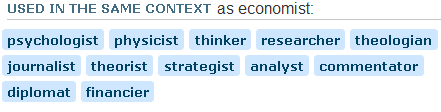
Wordnik superdictionary

Wordnik promises to be a super dictionary, with web search driven updates of how words are used (But what does it mean to say the tool is used once per month ?) .

Better filtering tha UrbanDictionary, better page layout than most web dictionaries.

Update 2009 July 19: now with more context

wordnik_economist_context.png

April 16, 2009

Dennis the dentist, 3

The most astonishing change concerns the ending of boys' names. In 1880, most boys' names ended in the letters E, N, D and S. In 1956, the chart of final letters looked pretty much the same, with more names ending in Y. Today's chart looks nothing like the charts of the past century. In 2006, a huge (and I mean huge) percentage of boys' names ended in the letter N. Or as Wattenberg put it, "Ladies and gentlemen, that is a baby-naming revolution."

Wattenberg observes a new formality sweeping nursery schools. Thirty years ago there would have been a lot of Nicks, Toms and Bills on the playground. Now they are Nicholas, Thomas and William. In 1898, the name Dewey had its moment (you should be able to figure out why). Today, antique-sounding names are in vogue: Hannah, Abigail, Madeline, Caleb and Oliver.

In the late 19th century, parents sometimes named their kids after prestigious jobs, like King, Lawyer, Author and Admiral. Now, children are more likely to bear the names of obsolete proletarian professions, Cooper, Carter, Tyler and Mason.

Wattenberg uses her blog to raise vital questions, such as should you give your child an unusual name that is Googleable, or a conventional one that is harder to track? But what's most striking is the sheer variability of the trends she describes.

Naming fashion doesn't just move a little. It swings back and forth. People who haven't spent a nanosecond thinking about the letter K get swept up in a social contagion and suddenly they've got a Keisha and a Kody. They may think they're making an individual statement, but in fact their choices are shaped by the networks around them.

Furthermore, if you just looked at names, you would conclude that American culture once had a definable core -- signified by all those Anglo names like Mary, Robert, John and William. But over the past few decades, that Anglo core is harder to find. In the world of niche naming, there is no clearly identifiable mainstream.

Continue reading "Dennis the dentist, 3" »

April 6, 2009

Dennis the dentist rules

Still, the couple, like many others, is vulnerable to falling behind again as home prices decline further. But Robert M. Lawless, a law professor at the University of Illinois who favors cram-downs, said success should not be viewed simply "in terms of dollars and cents."

-- Lawless law professor on cramdowns.

Explanation of the Dennis the dentist rule.

November 9, 2008

Header teasers: unuseful

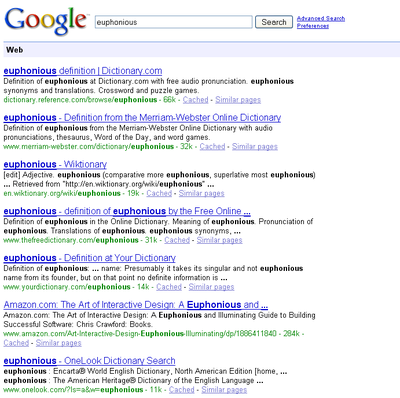
The lack of specific content in the cached header teasers of major dictionary sites is very annoying.
Better would be to show some information about the word and dictionary sites would compete on quality of definitions.

dictionary_teasers.png

September 14, 2006

Urban Dictionary

urbandictionary is looking good.

Collaborative nature compels user contributions
and feedback, thumbsupping or thumbsdowning
competing definitions on clarity, detail, and
plausibility (for the zero information set) or
accuracy (for those in the know.

The freshness of the content poses a challenge
o the traditional dictionary.

Its information architecture lists adjacent and
related words, and offers endless serendipity.

Example: garaigo.

Continue reading "Urban Dictionary" »

September 7, 2006

Dictionary with completion by ObjectGraph

Dictionary with completion as you type, by ObjectGraph.
-- updates.

July 30, 2006

wordspy jargon

Word Spy explicates jargon, lingo, vocabulary lexpionage.
Example: Drink the Kool Aid.

March 24, 2006

perspicacious

Mr. Krensavage has published his share of sells over the years.
Right now he has underperform ratings on 3 of the 16
companies he follows: Bentley, Teva Pharmaceutical Industries
and Eli Lilly. Over the years he has had sells on Merck and
Johnson & Johnson. "The companies pretty much have
behaved well," he said, adding that the more a company
complains about his assessment, the more perspicacious
he believes it is.

Continue reading "perspicacious" »

January 7, 2006

Sanctimony

In the end, appearance may be all that matters. Take the Prius.
The hybrid uses less fuel than a gasoline-powered car. But the
Prius comes at a higher price that is rarely offset by the savings
in fuel. The Prius is a feel-good car that runs on sanctimony as
much as on its battery power. Much of its value is that everyone
can see you driving that little Earth saver.

Continue reading "Sanctimony" »

August 7, 2005

valence

The news media have also become more sensational, more prone to
scandal and possibly less accurate. But note the tension between sensationalism and polarization: the trial of Michael Jackson
got tremendous coverage, displacing a lot of political coverage,
but it had no political valence.

Continue reading "valence" »

August 5, 2005

rancor

"If you are an old fan and it doesn't fit what you need, don't buy the
disc." she said with firmness, but no rancor.

Continue reading "rancor" »

August 1, 2005

adroit

Most pro-life voters aren't looking for 'evolving' views among
candidates. They're hungry for principled positions based on immovable
morals - something that doesn't come from a veto and an op-ed.

-- Carrie Gordon Earll, senior policy analyst for bioethics
for Focus on the Family.

Supporters say Mr. Romney is simply being adroit.

Continue reading "adroit" »

July 2, 2005

V&V: Verification, Validation

Verification: testing against specifications.
Validation: testing against operating goals.

Continue reading "V&V: Verification, Validation" »

May 5, 2005

Man Date

Dinner with a friend has not always been so fraught. Before women
were considered men's equals, some gender historians say, men routinely
confided in and sought advice from one another in ways they did not
do with women, even their wives. Then, these scholars say, two
things changed during the last century: an increased public awareness
of homosexuality created a stigma around male intimacy, and at the
same time women began encroaching on traditionally male spheres,
causing men to become more defensive about notions of masculinity.

-- 8.

And so, man date joins the lexicon.

Continue reading "Man Date" »

January 18, 2005

metastasize

That he and Mr. Begala would be allowed to lob softballs at a man who
may have been a cog in illegal government wrongdoing, on a show produced
by television's self-proclaimed "most trusted" news network, is bad
enough. That almost no one would notice, let alone protest, is a
snapshot of our cultural moment, in which hidden agendas in the
presentation of "news" metastasize daily into a Kafkaesque hall of
mirrors that could drive even the most earnest American into abject
cynicism. But the ugly bigger picture reaches well beyond "Crossfire"
and CNN.

Continue reading "metastasize" »