Main

June 23, 2009

Trade in clunkers ?

Do new-car buyers even drive clunkers ?

Am I driving a clunker because I cannot afford a 4 year old car ?
Will an extra $1000 trade in afford me a new car (or 14 month olf d car) ?

Update 2009 June 30:

"It has to be worth not very much and it also has to get very poor E.P.A. fuel economy," said Jack R. Nerad, the executive editorial director and market analyst for Kelley Blue Book. "It's a fairly narrow profile. You're talking about people who are probably economically challenged to begin with and they have to be able to qualify for a new car purchase in the midst of a deep recession. Those are some difficult parameters."

The case of the sad SAAB, junked with a work badge.

sad_saab_27clunkersE_large.jpg

Continue reading "Trade in clunkers ?" »

June 8, 2009

Costs, benefits of Cass Sunstein

n academic writings, Mr. Sunstein has advocated requiring agencies to demonstrate that new regulations' benefits clearly outweigh their costs, a policy long advocated by conservatives but viewed with suspicion by liberals who have seen it as a way to kill or weaken rules.

Mr. Sunstein said that relative to the Bush administration's heavy reliance on cost-benefit analysis, his approach would be "inclusive and humanized" and give more weight to moral concerns and other "soft variables."

But Mr. Sunstein also said he favors requiring agencies to explain why they are imposing rules that aren't justified by a cost-benefit analysis. And he said he would seek to maintain OIRA's central position in reviewing new regulations.

Continue reading "Costs, benefits of Cass Sunstein " »

June 3, 2009

Health Care: Coverage vs Cost

During the campaign, Obama talked about the need to control medical costs and mentioned a few ideas for doing so, but he rarely lingered on the topic. He spent more time talking about expanding health-insurance coverage, which would raise the government's bill. After the election, however, when time came to name a budget director, Obama sent a different message. He appointed Peter Orszag, who over the last two years has become one of the country's leading experts on the looming budget mess that is health care.

Their argument happens to be supported by a rich body of economic literature that didn't even make it into the book. More-educated people are healthier, live longer and, of course, make more money. Countries that educate more of their citizens tend to grow faster than similar countries that do not. The same is true of states and regions within this country. Crucially, the income gains tend to come after the education gains. What distinguishes thriving Boston from the other struggling cities of New England? Part of the answer is the relative share of children who graduate from college. The two most affluent immigrant groups in modern America -- Asian-Americans and Jews -- are also the most educated. In recent decades, as the educational attainment of men has stagnated, so have their wages. The median male worker is roughly as educated as he was 30 years ago and makes roughly the same in hourly pay. The median female worker is far more educated than she was 30 years ago and makes 30 percent more than she did then.

Continue reading "Health Care: Coverage vs Cost" »

June 1, 2009

Overcomingbias: what's wrong with 'cuteonomics'

If an abstract model is supposed to be a model of the real world (and not just a mathematical construct), then we should test its assumptions and predictions against the real world. But the real world, in all its boisterous glory, is far from the serene desert landscape of an abstract model. So we must cleverly search out "natural experiments"--real-world circumstances that happen to conform to enough assumptions of a model to provide a relatively direct test of its predictions--and then apply advanced statistical techniques to isolate the effect of the variables we want to study. The result of such tests can lead to tweaks in abstract theories that improve their predictive power and utility.

Overcoming bias.


Continue reading "Overcomingbias: what's wrong with 'cuteonomics'" »

May 24, 2009

Sam Kazman Debates Obama's Car Mileage Regulations

Sam Kazman on the 'benefits' on mandated change:

Continue reading "Sam Kazman Debates Obama's Car Mileage Regulations" »

May 19, 2009

Why is planning not 'stimulus' ?

Unexplained is why wages earned in construction are 'stimulus' and wages eared drawing blueprints are not.

The requirement that the money be spent quickly, in order to get it coursing through the parched economy, means that many ambitious projects that require more planning will have to give way to smaller ones considered "shovel ready."

U.S. / POLITICS
House Plan for Infrastructure Disappoints Advocates for Major Projects
By MICHAEL COOPER
Published: January 20, 2009
As the details of Barack Obama's public works plan come into focus, big transformative building projects seem unlikely.

May 17, 2009

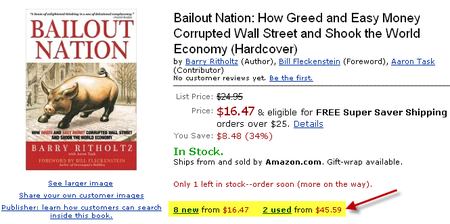
Bailout Nation, Amazon Used price

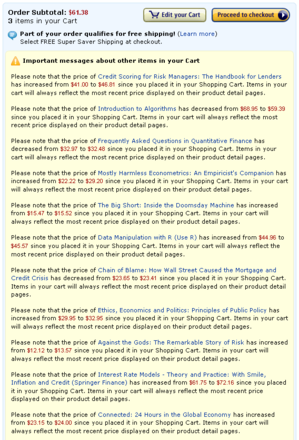
Barry's scolding Bailout Nation is out. Note the used price is three times greater than the new price.
(We blogrolled Barry Ritholtz' Big Picture years ago).


amazon_barry_bailout_new_used_.png

May 11, 2009

MEW: mortgage equity withdrawl

From 2004 to 2006, Americans took almost $700 billion per annum of net equity out of their homes through borrowing and spent as much as 50% of it on consumables. The most highly regarded study on mortgage equity withdrawals (MEW) is "Estimates of Home Mortgage Originations, Repayments, and Debt On One-to-Four-Family Residences," by Prof. James Kennedy and none other than Alan Greenspan (Federal Reserve Board FEDS working paper No. 2005-41); Kennedy has been updating his numbers.

Also: The Rise of A New Asset Class


Without MEW, we would have had 2 years, 2001 and 2002, with negative GDP growth. We're not going to go get those levels of mortgage equity withdrawals today - not in this environment. We're still seeing some cash-out borrowing, but it's getting more and more difficult; as home values drop, there are going to be fewer and fewer people pulling less and less money out of the "home ATMs." As Paul McCulley says, your home ATM is starting to spit out negative twenty-dollar bills

April 25, 2009

Positional goods abound in New York

The compulsion to upgrade (and seeking positional goods and services) is most glaring in cities -- particularly New York and Los Angeles -- which are filled with the upwardly mobile who relocate in search of upgraded opportunities surrounded by savvier, richer, trendier people. These transplants are constantly trading up not just their jobs but their group of friends. Everyone in New York and L.A. has had this experience: you make a plan for dinner with a buddy, which he cancels with a lame, last minute excuse ("I'm just exhausted"). What you both know is that he got a late-breaking better offer. He upgraded his dinner.

Continue reading "Positional goods abound in New York" »

April 13, 2009

Middle class by tax bracket in Westchester County, NY: $300k

NY State's legislative leaders agreed last week to raise tens of millions of dollars in fees and impose taxes on individuals earning more than $200,000 and couples earning more than $300,000.

The tax increases and elimination of the property tax rebate program prompted an outcry among local officials in Westchester, which has towns with some of the highest property tax rates in the country.

...

Eliminating the property tax rebate will save the state $1.5 billion, while new income tax brackets for the highest earners will bring in $4 billion. Because Westchester has a high concentration of families with high incomes, its residents will feel the impact of the income tax increases more than most, officials said.

"We expect to see a disproportionate impact on New Yorkers in the region, and in particular Westchester," said Stephen J. Acquario, executive director of the New York State Association of Counties.

Continue reading "Middle class by tax bracket in Westchester County, NY: $300k" »

April 7, 2009

Middle more than 100k in Silicon Valley

Over $100,000 income is the biggest group.


"This is a statement that the system is broken, and that inaction will lead to ruin," said Russell Hancock, chief executive and president of Joint Venture. "It's time to start over."

The report also showed that the gap between the wealthiest and the poorest residents continued to grow. The percentage of households earning more than $100,000 a year rose to 42 percent in 2008, from 35 percent in 2002, while the number of households earning $35,000 or less rose to 20 percent, from 19 percent in the same period.

During that period, the number of immigrants to Silicon Valley grew 9 percent.

Continue reading "Middle more than 100k in Silicon Valley" »

April 1, 2009

Middle class, social security, FICA taxes

A hypothetical on the middle class tax cut, or tax hike ?

You favor eliminating the cap on earnings subject to the 12.4 percent Social Security tax, which now covers only the first $102,000. A Chicago police officer married to a Chicago public-school teacher, each with 20 years on the job, have a household income of $147,501, so you would take another $5,642 from them. Are they undertaxed? Are they rich?

March 27, 2009

How to spend an hour on FaceBook

As an example of a 'free service' as it is now (temporarily) being used, please feel free to go to FaceBook, take a

"23 Random Things About My Toes" quiz and forward it to 230 friends, accidentally click on the picture of a hot chick and get taken to a different website, then find your way back and accept a cause invitation to get rid of wobbly shopping carts, an event for people with last names starting with J, a zombie invitation, and a 'click here to find out who has a mad crush on you!'

Continue reading "How to spend an hour on FaceBook" »

March 25, 2009

Middle class is in the middle

Using consumption (Veblen goods, Giffen goods) to distinguish ones class leaves middle class citizens in the middle.

Individual demands are heavily shaped by the social environment. As the economist Richard Layard has written, for example, "In a poor society a man proves to his wife that he loves her by giving her a rose, but in a rich society he must give a dozen roses." For the last three decades, virtually all income gains in the United States have gone to top earners. Recipients have spent most of their extra income on positional goods, things whose value depends heavily on how they compare with similar things bought by others. Like mutually offsetting weapons in a military arms race, consumption of this sort is largely wasteful. Many of the most spectacular increases in high-end consumption in recent years appear to have been driven almost entirely by positional forces. If people acted in tandem, resources could be diverted from positional consumption at little sacrifice.

Although there is scant evidence that middle-income families in America resent the spending of top earners, they are nonetheless affected by it in tangible ways. Additional spending by the rich shifts the frame of reference that defines what the near rich consider necessary or desirable, so they too spend more. In turn, this shifts the frame of reference for those just below the near rich, and so on, all the way down the income ladder. Such expenditure cascades help explain why the median new house built in the U.S. is now about 50 percent larger than its counterpart from 30 years ago, even though the median real wage has risen little since then.

Higher spending by middle-income families is driven less by a desire to keep up with the Joneses than by the simple fact that the ability to achieve important goals often depends on relative spending. Because of the link between housing prices and neighborhood school quality, for example, the median family would have to send its children to below-average schools if it failed to match the spending of its peers on housing. Instead, middle-income families have opted to save less, borrow more, work longer hours, and commute longer distances than ever before, all in an effort to keep pace with escalating consumption standards.

Robert H. Frank

March 22, 2009

Goldman Sachs Managing Director Partners 2009

Goldman Sachs name new MD (Managing Director Partners) for 2009.

Included was Jan Hatzius, economist known for real estate commentary.

Continue reading "Goldman Sachs Managing Director Partners 2009" »

March 7, 2009

Stimulus 1.0 too small ?

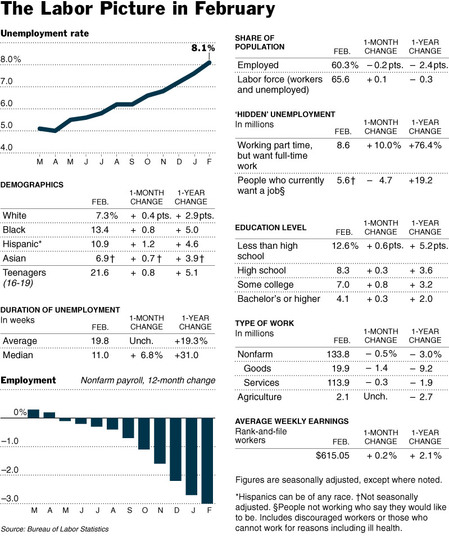
Was the Obama stimulus plan built to solve a recession where unemployment peaked at 8.1 percent ? Now that unemployment has hit 8.1 %, should the $787 billion stimulus package be revised and embiggened ?

unemploy_8.1_0307-biz-webECON.jpg

Continue reading "Stimulus 1.0 too small ?" »

February 17, 2009

Without waiting for evidence, Roubini's luck guy feel comes up big

Faith based economics ?

First, the standard analytical explanation: Roubini said that he studied a chart in economist Robert J. Shiller's book "Irrational Exuberance." It showed that U.S. housing prices, adjusted for inflation, had remained essentially flat for a century, until the mid-1990s, when they began to shoot up. What's more, Roubini saw that the most recent housing correction in the late 1980s had a severe effect on the financial system -- leading ultimately to the collapse of the savings and loan industry.

So Roubini knew two things: Housing prices wouldn't keep going up forever, and when they went down, they would take a big piece of the financial system with them. From then on, it was a matter of watching the data.

But everyone else had those same numbers. Why did Roubini act? The answer is that he decided to trust his gut, which told him there was trouble ahead, rather than Wall Street's "wisdom of the crowd," which -- as reflected in stock prices -- said everything was rosy. He concluded that the markets were not pricing in the degree of risk that was actually present in housing.

"The rational man theory of economics has not worked," Roubini said last month at a session of the World Economic Forum at Davos. That's why he and other prominent economists are paying more attention to behavioral economics, which starts from the premise that economic decisions, like other aspects of human behavior, are influenced by irrational psychological factors.

The most compelling rebuttal of the rational model, paradoxically, was delivered by the ultimate rationalist, Alan Greenspan. "I made a mistake in presuming that the self-interests of organizations, specifically banks and others, were such that they were best capable of protecting their own shareholders," the former Fed chairman told Congress last October.

Continue reading "Without waiting for evidence, Roubini's luck guy feel comes up big" »

February 4, 2009

Austrian Economists

austrianeconomists considers various matters

Example: on failure:

When Dave Prychitko and I were students of Kenneth Boulding, Mr. Boulding told us both once that if economists really wanted to learn we would study the waste baskets of our peers not what gets published in the journals. Like most "bouldingisms", his statement while odd upon first hearing is actually profoundly true once you think abit about what he is getting at. We learn much more from our failures than we learn from our successes if we open ourselves on the lesson to be learned.

Contrast 37 Signals's Signal vs Noise SvN's take:

I don't understand the cultural fascination with failure being the source of great lessons to be learned. What did you learn? You learned what didn't work. Now you won't make the same mistake twice, but you're just as likely to make a different mistake next time. You might know what won't work, but you still don't know what will work. That's not much of a lesson.

February 3, 2009

Stimulus scuffle -- jobs, earmarks, pork, stimulus, or what.

Stimulus scuffle -- it will be really difficult to re-contextualize such discussions by year 2020.

But with public opinion quickly turning against the bill, and the House Republicans claiming the moral high ground as they held formation to oppose him, how could Obama be distanced from responsibility for elements of the bill under GOP attack and remain above the fray? That seemed to be the locus of White House concern, and according to those familiar with what happened, the "polarizing" Nancy Pelosi was designated to take the fall.

Rather than define the bill by its substance and make its opponents attack jobs creation, the strategy was to talk about process -- how everyone's ideas on both sides of the aisle would be welcome and that this bill would represent the best bipartisan thinking about how to face the current economic crisis. That left the door wide open for Republicans to step through and caterwaul that their ideas weren't being respected in this new halcyon world of bipartisanship, and somebody had to take the blame. Nancy Pelosi, come on down!

-- Jane Hamsher @ FDL

February 2, 2009

Krugman and Clinton: middle class up to $250,000 in 1993

Middle class faded out above $140,000 to $250,000 per year, back in 1993.

Paul Krugman, 1993 on Bill 'Middle Class Tax Cut' Clinton's tax plan:

Bill Clinton's economic program: higher income taxes for wealthy Americans. Families with taxable incomes above $ 140,000 currently pay a tax rate of 31 percent. The Clinton plan will raise that rate to 36 percent, and families with taxable income over $ 250,000 will pay 39.6 percent.

...
Suppose a couple earning $ 200,000 a year has a $ 600,000 mortgage, two children in expensive colleges, large car payments and lavish tastes.

Continue reading "Krugman and Clinton: middle class up to $250,000 in 1993" »

February 1, 2009

Stimulus Prototype: walking around money

The stimulus efforts could focus on public goods and durable infrastructure, taking advantage of a lull in private investment to deploy underutilized resources without
crowding out much private investment.

Or, the stimulus could just be a lot of walking around money.

Some street money comes from party fundraisers, like the Philadelphia Democratic Party's biannual Jefferson-Jackson dinner. But most of it comes directly from the candidates. Everyone from the presidential nominee to congressmen and state representatives are expected to chip in. (The top of the ticket usually contributes the most.) In Philadelphia, the candidate sends a check to the chairman of the city's Democratic Party, who then divides the money up among the 69 ward leaders, who in turn divvy up their cash among the 50 or so committee people in each ward. In 2004, John Kerry spent hundreds of thousands of dollars on Philadelphia street money, and ward leaders received checks for as much as $8,000. Individual volunteers can generally expect anywhe
re from $10 to $200, depending on the location and the type of work they're doing.

January 19, 2009

Stable jobs available ? Dismal science answers.

The companies doing the least hiring right now are very often the companies that offer the safest jobs.

-- Susan Houseman, a senior economist and labor expert at the Upjohn Institute, a research group in Michigan.

With employers shedding half a million jobs a month, some economists, like Nancy Folbre of the University of Massachusetts in Amherst, liken safe jobs to high ground amid the turbulent flood waters of lost employment.

"There is a danger in using the term 'safe jobs' for this perch," Ms. Folbre said. "That makes them sound like sinecures, and they are not."

Continue reading "Stable jobs available ? Dismal science answers." »

January 15, 2009

The less money your peer group has, the more bling you buy

The less money your peer group has, the more bling you buy, explains Virginia Postrel.

About seven years ago, University of Chicago economists Kerwin Kofi Charles and Erik Hurst were researching the "wealth gap" between black and white Americans when they noticed something striking. African Americans not only had less wealth than whites with similar incomes, they also had significantly more of their assets tied up in cars. The statistic fit a stereotype reinforced by countless bling-filled hip-hop videos: that African Americans spend a lot on cars, clothes, and jewelry--highly visible goods that tell the world the owner has money.

But do they really? And, if so, why?

The two economists, along with Nikolai Roussanov of the University of Pennsylvania, have now attacked those questions. What they found not only provides insight into the economic differences between racial groups, it challenges common assumptions about luxury. Conspicuous consumption, this research suggests, is not an unambiguous signal of personal affluence. It's a sign of belonging to a relatively poor group. Visible luxury thus serves less to establish the owner's positive status as affluent than to fend off the negative perception that the owner is poor. The richer a society or peer group, the less important visible spending becomes.

Russ Alan Prince and Lewis Schiff describe a similar pattern in their book, The Middle-Class Millionaire, which analyzes the spending habits of the 8.4million American households whose wealth is self-made and whose net worth, including their home equity, is between $1 million and $10 million. Aside from a penchant for fancy cars, these millionaires devote their luxury dollars mostly to goods and services outsiders can't see: concierge health care, home renovations, all sorts of personal coaches, and expensive family vacations. They focus less on impressing strangers and more on family- and self-improvement. Even when they invest in traditional luxuries like second homes, jets, or yachts, they prefer fractional ownership. "They're looking for ownership to be converted into a relationship rather than an asset they have to take care of," says Schiff. Their primary luxuries are time and attention.

Continue reading "The less money your peer group has, the more bling you buy" »

January 14, 2009

Environmental impact of environmental events

The New York Times looks at the impact of gathering at Sundance to watch environmental films.

Still, a stroll here this week down Main Street -- where a dozen idling trucks were unloading supplies and equipment, while an oversize band bus, with trailer in tow, spewed fumes outside a soon-to-be-busy party site -- framed the obvious quandary: how can you cram some 46,000 people, roughly equivalent to a fifth of Hollywood's total work force, into a pretty little mountain town without contributing mightily to the problems your films hope to solve?

...

Utility officials said there was no way to determine how much extra wattage was being poured into the valley for the festival's spotlights and the strings of colored bulbs lining Park City's streets. "Pinpointing use for one city," said Margaret Oler, an information officer with Pacificorp, which provides power to the area, "can be pretty difficult."

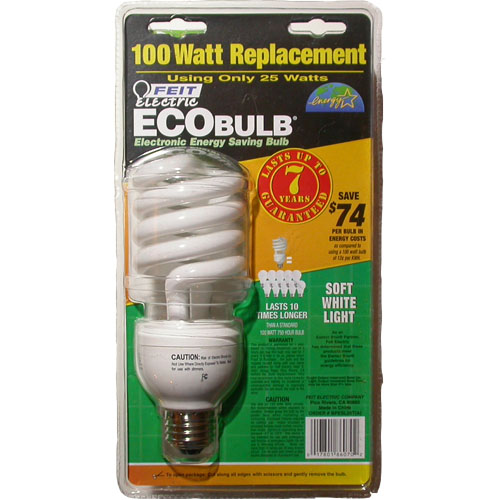
bulb3_100W.jpg

Most electrical implements, bulbs included, have power consumption in Watts printed right on them.

MOVIES
The Films Are Green, but Is Sundance?
By MICHAEL CIEPLY
Published: January 17, 2009
This year's Sundance Film Festival has a schedule that's greener than Fifth Avenue on St. Patrick's Day, but what's the environmental impact of the festival itself?

Continue reading "Environmental impact of environmental events" »

January 6, 2009

Good wage for reading Facebook ads: 90 dollars per hour

Facebook's targeted advertising throws up three very similar adjacent display placements onto one page. Is this evidence of a price searching algorithm, to ween wages too low to be tempting, or too high to be believed (not to mention too high to be actually available) ?

wage_75_99_92.png

$92/hr ?

$75/hr ?

$88/hr ?

December 21, 2008

Today's rich don't exploit the poor they just outcompete them.


Looking at upper-middle-class homes, Lareau describes a parenting style that many of us ridicule but do not renounce. This involves enrolling kids in large numbers of adult-supervised activities and driving them from place to place. Parents are deeply involved in all aspects of their children's lives. They make concerted efforts to provide learning experiences.

Home life involves a lot of talk and verbal jousting. Parents tend to reason with their children, not give them orders. They present "choices" and then subtly influence the decisions their kids make. Kids feel free to pass judgment on adults, express themselves and even tell their siblings they hate them when they're angry.

The pace is exhausting. Fights about homework can be titanic. But children raised in this way know how to navigate the world of organized institutions. They know how to talk casually with adults, how to use words to shape how people view them, how to perform before audiences and look people in the eye to make a good first impression.

Working-class child-rearing is different, Lareau writes. In these homes, there tends to be a much starker boundary between the adult world and the children's world. Parents think that the cares of adulthood will come soon enough and that children should be left alone to organize their own playtime. When a girl asks her mother to help her build a dollhouse out of boxes, the mother says no, "casually and without guilt," because playtime is deemed to be inconsequential -- a child's sphere, not an adult's.

Lareau says working-class children seem more relaxed and vibrant, and have more intimate contact with their extended families. "Whining, which was pervasive in middle-class homes, was rare in working-class and poor ones," she writes.

But these children were not as well prepared for the world of organizations and adulthood. There was much less talk in the working-class homes. Parents were more likely to issue brusque orders, not give explanations. Children, like their parents, were easily intimidated by and pushed around by verbally dexterous teachers and doctors. Middle-class kids felt entitled to individual treatment when entering the wider world, but working-class kids felt constrained and tongue-tied.


David Brooks

Continue reading "Today's rich don't exploit the poor they just outcompete them." »

December 20, 2008

Middle class at $150k

For example, four-in-ten Americans with incomes below $20,000 say they are middle class, as do a third of those with incomes above $150,000. And about the same percentages of blacks (50%), Hispanics (54%) and whites (53%) self-identify as middle class, even though members of minority groups who say they are middle class have far less income and wealth than do whites who say they are middle class./em>

pew_middleclass_793-2gif

Some 53% of adults in America say they are middle class. On key measures of well-being -- income, wealth, health, optimism about the future -- they tend to fall between those who identify with classes above and below them. But within this self-defined middle class, there are notable economic and demographic differences. For example, four-in-ten Americans with incomes below $20,000 say they are middle class, as do a third of those with incomes above $150,000. And about the same percentages of blacks (50%), Hispanics (54%) and whites (53%) self-identify as middle class, even though members of minority groups who say they are middle class have far less income and wealth than do whites who say they are middle class.

Pew, Inside the Middle Class: Bad Times Hit the Good Life (2009 April)

Reason

December 19, 2008

Larry Ribstein, private partnerships have been used as alternatives to solving sticky problems of corporate management

University of Illinois law professor Larry Ribstein has been a pioneer in the study of how private partnerships have been used as alternatives to solving sticky problems of corporate management.

Much of his work has centered on the problem of aligning managers' and owners' interests. He notes that the private partnership model popular in the private equity world might be very useful for Goldman here.

Continue reading "Larry Ribstein, private partnerships have been used as alternatives to solving sticky problems of corporate management" »

December 7, 2008

Build it ready or not

we will create millions of jobs by making the single largest new investment in our national infrastructure since the creation of the federal highway system in the 1950s. We'll invest your precious tax dollars in new and smarter ways, and we'll set a simple rule - use it or lose it. If a state doesn't act quickly to invest in roads and bridges in their communities, they'll lose the money.

-- Obama's Key Parts of the Jobs Plan, 2008 December 6

Would spending on planning, consultants, policy, publicity, media relations, public relations folks create more middle class jobs, before the actual construction began ?

Interestingly, there's nary any talk of building prisons to releive overcrowding.

On airport expansion, Coruscation presents the sorry case of SFO's parallel runway for frequent flyiers.

SFO shelved the runway project in June after $75 million worth of
studies. Airport Director John Martin cited a lack of political will
in pushing the controversial project and the shakiness of the
airport's finances.

64% of County residents support runway expansion, poll reports
Tuesday, December 16, 2003, in the San Mateo County Times


San Francisco International Airport's $75 million effort to expand
its runways focused too heavily on marketing the idea, spent too
lavishly on consultants and failed to give equal weight to
alternatives to paving San Francisco Bay, according to a highly
critical audit of the project released Wednesday.

While the airport was evaluating the controversial -- and now dead --
plan to build new runways in the bay, consultants were billing for
$4,000 flights to the East Coast, $500 hotel rooms and $16,000
computer work stations, according to a sampling of expenses examined
by Harvey Rose, budget analyst for the San Francisco supervisors.

The airport spent money on services that had little to do with
studying the environmental impacts of expanding the airfield, and
items such as public relations and lobbying were sometimes hidden in
contracts for engineering or environmental work, according to the
audit.

Audit criticizes S.F. Airport on runway plan
Lavish spending on consultants cited in report to supervisors

Thursday, May 22, 2003, in the San Jose Mercury News


San Francisco Supervisor Aaron Peskin said he was simply taking away the airport's blank check. In
the past few years, SFO spent about $70 million on the proposed
expansion, including more than $1 million on politically connected
consultants.

"If you want to study the runways, study them with science, not with
politics," Peskin said.

The consultants have included Attorney Karen Skelton, a former deputy
in the Clinton-Gore administration; Brown's campaign strategist Barry
Wyatt; and Jon Rubin, Brown's appointee to the Metropolitan
Transportation Commission. SFO hired Rubin's firm, Bay Relations.

Supervisors gut SFO runway expansion study
$5 million yanked, put into reserve

Tuesday, June 25, 2002, in the San Francisco Chronicle


Specifically, the airport director suspended environmental studies
looking into the viability of a proposal to extend the airport's
runways into San Francisco Bay -- a review that already has taken
four years, cost $75 million and is 80% complete.
...
Executives also have had to contend with a recent audit of the
airport's books that alleged airport officials mismanaged $75
million spent to study the runway extension plan.

The finding prompted San Francisco Supervisor Aaron Peskin, who
requested the report last year, to call airfield development efforts
a boondoggle. The city's Board of Supervisors oversees the airport
and the city treasury receives a portion of revenues each year.

"This [expansion] project had a lot more to do with studying a
political notion than what the impacts of the project would be,"
Peskin said. "The intellectually dishonest way they went about
running the entire effort was going to doom the project to great
legal and political vulnerabilities."

The audit, drafted by city budget analyst Harvey M. Rose, raised
questions about runaway spending by consultants and found that the
Airfield Development Bureau, formed to direct the runway extension
project, kept shoddy records and didn't follow city regulations.

Rose, who relied in part on a random sample of invoices, found that
consultants billed the bureau for unusually high airfare, lodging,
equipment and telephone costs. These included round-trip airfares to
Washington for $4,252, a $799 dinner at the Bacchanal restaurant in
South San Francisco and a $4,686 phone bill for an airport
contractor for one month. Consultants also billed the bureau an
average of $16,646 each for three Dell computer workstations with no
explanation for the high cost, Rose said.

Future Cloudy for San Francisco Airport
Declining passenger traffic and a setback in a project to extend its
runways leave executives with more questions than answers.

Tuesday, June 10, 2003, in the Los Angeles Times

Continue reading "Build it ready or not" »
November 29, 2008

Traditionally, the yakuza have run protection rackets, as well as gambling, sex and other businesses

The Dojinkai is one of the country's 22 crime syndicates, employing some 85,000 members and recognized by the government.

Traditionally, the yakuza have run protection rackets, as well as gambling, sex and other businesses that the authorities believed were a necessary part of any society. By letting the yakuza operate relatively freely, the authorities were able to keep an extremely close watch on them.

Continue reading "Traditionally, the yakuza have run protection rackets, as well as gambling, sex and other businesses" »

November 23, 2008

Vice stocks down in recession ?

One report has 'vice' stocks headed down in a recession.

think about "sin industries", the classic countercyclicals. Until now, that is. Vegas is crashing hard, and not just because of its real estate bubble. Can porn and malt liquor be far behind? Is this the moment that amateur porn has been waiting for--just as people have more dinner parties and less dining out during downturns, will people start making their own, er, fun at home?

See also Socially conscious /ethical investing.

November 14, 2008

Why Squatter Cities Are A Good Thing ?

A TED talk, The Shadow Cities Of The Future and Why Squatter Cities Are A Good Thing by Robert Neuwirth, author, Shadow Cities: A Billion Squatters, A New Urban World, gives a different take on development economics, from mud hut cluster to developed city, with or without debt and property rights.

Video after jump.

Continue reading "Why Squatter Cities Are A Good Thing ?" »

November 12, 2008

Bush in 1978: before playing country cowboy

"Kent Hance was a down-home boy, real homey, and George W. wasn't homey like Kent," recalled Johnnye Davis, a Republican leader in Odessa. "He didn't come across to the voters as well as Kent did, with the little jokes that Kent told."

While Mr. Bush now is sometimes mocked for an ignorance of policy details, back then people thought he had the opposite problem: a tendency to drop references in his speeches that baffled audiences, like a discussion of anti-inflationary economic policy.

"He was quick, a bit too quick, so that people didn't always get it," Mrs. Davis said. "He was so darn intelligent that a lot of what he said went over people's heads. He's learned to explain things a little better since then."

Another problem was that while Mr. Bush never really had a clear campaign strategy, Mr. Hance did: he focused his campaign on emphasizing local ties and on casting Mr. Bush as a carpet-bagger from the East. One of Mr. Hance's most effective radio spots was this one, read by an announcer:

"In 1961, when Kent Hance graduated from Dimmitt High School in the 19th congressional district, his opponent George W. Bush was attending Andover Academy in Massachusetts. In 1965, when Kent Hance graduated from Texas Tech, his opponent was at Yale University. And while Kent Hance graduated from University of Texas Law School, his opponent" -- the announcer's voice plunged -- "get this, folks, was attending Harvard. We don't need someone from the Northeast telling us what our problems are."

Continue reading "Bush in 1978: before playing country cowboy" »

November 8, 2008

Barack's economic rescue

44's Economic transition team to rescue the middle class and offer more stimulus.

Video after break.

Continue reading "Barack's economic rescue" »

November 2, 2008

Worry about relevance, do not deviate from the consensus

The field of social psychology provides a possible answer. In his classic 1972 book, "Groupthink," Irving L. Janis, the Yale psychologist, explained how panels of experts could make colossal mistakes. People on these panels, he said, are forever worrying about their personal relevance and effectiveness, and feel that if they deviate too far from the consensus, they will not be given a serious role. They self-censor personal doubts about the emerging group consensus if they cannot express these doubts in a formal way that conforms with apparent assumptions held by the group.

Continue reading "Worry about relevance, do not deviate from the consensus" »

October 31, 2008

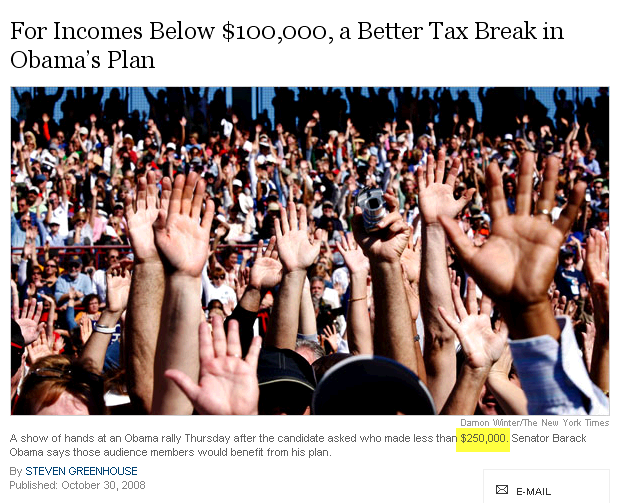
Under $250,000 is middle class: Obama

A show of hands at an Obama rally Thursday after the candidate asked who made less than $250,000. Senator Barack Obama says those audience members would benefit from his plan.

obama_250k_tax.png


Mr. Obama opposes extending President Bush's tax cuts. Instead, he proposes various tax breaks, including a $500 tax credit for each person in a household who works, a larger child care tax credit, a $4,000 tax credit each year for the first two years of college, and eliminating all income taxes for those over 65 with income less than $50,000 a year.

To reduce the deficit and inequality, he would raise the tax rate for single households with incomes of $200,000 or more and for families with incomes over $250,000. He would also raise taxes on capital gains and dividends.

For married couples with incomes of $500,000 with two children and both parents working, the Tax Policy Center found that Mr. Obama would raise income taxes by $3,363, from $110,955 now, while Mr. McCain's plans would leave taxes unchanged. Deloitte found that a $500,000-a-year couple would pay $3,100 more under Mr. Obama, with no change under Mr. McCain.

Mr. McCain also proposes giving many households a $5,000 tax credit when they buy family health insurance, which costs $12,000 nationwide on average.

Previously: Charles Gibson of ABC: $200,000 a year was a middle-class income.

Continue reading "Under $250,000 is middle class: Obama" »

October 20, 2008

Middle class: only up to $250, 000 annual income ?

The definition of middle class is in flux. Many try to quantify and specify it in income terms.

Here's Charles Gibson of ABC (Via Paul Krugman): suggested that $200,000 a year was a middle-class income.

October 11, 2008

Nobel Economics Prize, 2008

Short list of Laureate top candidates for the Nobel Economics Prize, 2008

Eugene F. Fama (WSJ reports Fama is the front runner, given the efficiency of markets to represent all available information, as demonstrated by betting)
Lars P.Hansen
Thomas J. Sargent
Armen A. Alchian and Harold Demsetz
Martin Feldstein
Jean Tirole

Other top contenders:

Robert J. Barro
Jagdish N. Bhagwati (with Avinash K. Dixit)
Eugene F. Fama (with Kenneth R. French)
Oliver D. Hart:
Dale W. Jorgenson:
Paul R. Milgrom

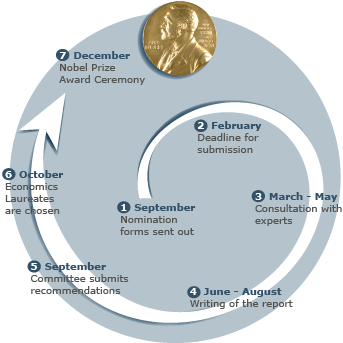
The nominating processes explained:nobelprize.org

nomination_eco.gif


Previously: 2007 Nobel Prize in Economics contenders.

Continue reading "Nobel Economics Prize, 2008" »

September 29, 2008

Greenspan put, Euro Central Bank put

There was a lot of talk about a Greenspan put and whether Bernanke and the FOMC would continue it, or whether they were trying to take it away by holding firm on rates. Whatever the state of that "put" we know now that there is an ECB put for sure, given how quickly the ECB intervened to fend off what it perceived to be a problem. That the ECB flooded the market with liquidity is both interesting, and understandable, given that the ECB doesn't have Lender of Last Resort (LLR) powers.

What should have happened (and this is still a missing piece of information) under the current arrangements within the European system of central banks is that BNP, or any other bank experiencing a liquidity problem, should have had access to its respective central bank's Lombard facility. But the ECB stepped in ahead of the national central banks. The ECB does have the authority to provide liquidity, but doesn't have systemic risk responsibility, except for payments system stability. The event points out how important it is for the ECB to have its LLR powers clearly defined, and there is a need to ensure coordination across the two functions.

-- Robert Eisenbeis, via WSJ.

September 18, 2008

Culture of credit

Overheard on the internet:

I remember working on an ad campaign for MCI-Sprint at my first agency job out of college. It targeted the poorer areas of Philly, Camden, Newark, etc. The point of the campaign was that you did not have to have good credit or have to go through a credit check in order to receive a phone. When it launched the second question the people were asked was "what credit card would you like to use"'. Not one person at corporate could figure out that people with poor credit generally don't have credit cards.

Posted at Brownstoner by: anon at May 30, 2007 12:06 PM

September 1, 2008

Shadow Stats: More on Government Economic Statistics

Shadow Government Statistics promises 'Analysis Behind and Beyond Government Economic Reporting': shadowstats.


August 20, 2008

Creative destruction: another look at Japan's lost decade

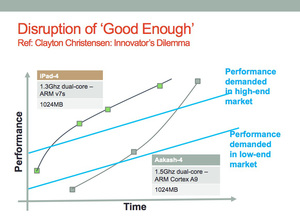
Creative destruction is only half of Schumpeter's message. Far less in vogue is his projection that entrepreneurs will disappear as innovation becomes mechanized in corporate labs - as it has today in Japan - and that ultimately the very success of capitalism will beget socialism. Will creative destruction give way to central planning? Not necessarily, says Harvard's Clayton Christensen. "What happened in Japan is exactly what Schumpeter envisioned," he argues. "But here, folks just leave - they pick up venture capital on the way out, and they start new disruptive corporations." So as long as Washington encourages an infrastructure that supports entrepreneurship, creative destruction can continue after all.

Continue reading "Creative destruction: another look at Japan's lost decade" »

August 7, 2008

Concert Economy: getting bundled and amenity-riden, or getting cheap and amenity-stripped ?

Summer music festivals go posh, report from Europe, via WSJ:

Summer rock music festivals, long the preserve of teens and twentysomethings, are increasingly becoming familiar territory for a generation that still remembers the hits of the 1970s and '80s even as it keeps up with current stars. Concert promoters are starting to cater to the needs of this older crowd of festival-goers, many of whom are looking for something more than mosh pits, fast food and porta-potties -- and who can afford multiday tickets costing between €150 and €250.

"They still want to experience the buzz of the festival, they still want to have the excitement of the festival, but they don't want to sleep in a two-person tent anymore," says Melvin Benn, managing director of Festival Republic, which promotes the Leeds, Reading and Glastonbury festivals in the U.K. "They don't want to rough it in quite the same way."

A Grown-Up's Guide To Summer Rock Festivals
By GABRIELE STEINHAUSER, 2008 July 10

An opposing take says concerts are offering cheap tickets as they have difficulty filling venues-- Barry Ritholtz / Big Picture in 2008; and in 2005.

Continue reading "Concert Economy: getting bundled and amenity-riden, or getting cheap and amenity-stripped ?" »

July 27, 2008

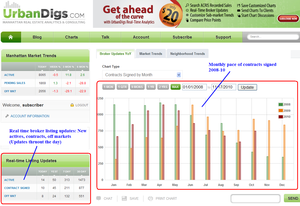
Urban Digs:economics of NYC real estate

urbandigs tracks real estate in NY -- more aimed at investors than at consumers.

July 24, 2008

Frugalness as an American value ?

Megan vs Brooks on frugalness as an American value; an economic history of debt in America.

Popup video: Megan McArdle on debt in America

[Economist video]

July 21, 2008

Opting out of medicare ?

The best option is probably to tie the size of Medicare benefits
to a person's lifetime income, which is relatively easily measured
and hard to game, rather than to one's income or assets in any
current year. In essence, higher earners would receive lower
benefits instead of facing the prospect of higher taxes, as current
trends predict.

-- Tyler Cowen

Economic View
Means Testing, for Medicare
By TYLER COWEN
Published: July 20, 2008
No matter who sits in the Oval Office next year, there won't be many degrees of freedom in the federal budget. The main problem: Medicare.

July 6, 2008

FDIC bank data of loans secured by real estate

The RC-C section in a FDIC CALL report shows loans secured by
real estate. Manually add up the various detail lines in RC-C,
subheading 1, to get the totals.


Total Assets - $2.118B
(RC-C.1) Loans secured by real estate $1.360B ( 64.2% )

Where does one get the RC-C.1 data?

Each bank submits CALL data to the FDIC on a quarterly basis.
The data usually becomes available 15-30 days after the quarter
ends.

Search for banks and download/view as PDF data at the FDIC
Institution Directory
.

[Via CR/Comments]

May 22, 2008

Intergenerational Redistribution is Regressive

Decreasing marginal utility of stuff is an argument against
large current investments in climate change mitigation.
Basically, future generations will (presumably) be richer
than us. So, our sacrificing now to help them amounts
to a regressive intergenerational redistribution.

-- Overheard.

October 14, 2007

Nobel prize in economics ?

Update 2008: Fama and Barro are still contenders.

Who will win the Nobel Prize in economics ?
Coruscation presents the short list:

Eugene Fama
Robert Barro
Jagdish Bhagwati (with Amy Chua)
Oliver Williamson
Sargent and Wallace
Jean Tirole
Lars Hansen
Walter Block and Naomi Klein


See also MR and GM.


September 29, 2007

Transitive efrons dice

Efrons Dice are like Rock Paper Scissors
for the expected utility theorist.

September 23, 2007

Several comments have criticized Krugman

Several comments have criticized Krugman for shifting his position,
but I think what has shifted is the second part. He still knows all the
models, and the models he prefers still work as well as ever. But as
for guessing which applies right now in the face of insufficient
information, all he can do is place a wager. It might be better than
most non-economists can do, but it might not be that much better,
and it might be worse than some people can do out of just happening
to have the right kind of intuition for the current situation--or simply
holding doggedly to the same single bullet theory until it finally
happens.

From Krugman Was An Economist

Update 2007 Sept: What's not to like about Paul Krugman.

July 7, 2007

Digital Money Forum

Digital Money Forum keeps on top of electronic payments.
Example: ATM anniversary.

July 4, 2007

New NBER papers

New Papers at National Bureau of Economic Research (NBER).

June 24, 2007

Payments Watch

Paymentswatch, an early adopter consumer guide to electronic payments.

June 23, 2007

Digital Transactions

digitaltransactions archives on electronic payments.

June 19, 2007

Aneace Haddad, payment transaction enthusiast

Aneace Haddad on interpayments systems, settlements, transactions and
merchant banking.

June 16, 2007

Bank Tech News

banktechnews about payment, transactions and settlements.
Blocking ACH Fraud and debit filters

Continue reading "Bank Tech News" »

June 15, 2007

Bankers Online

bankersonline resource for banking regulation and practices.
Example: HMDA tour (eg Borrower Isn't
Homeowner, HMDA Reportable ? )

Continue reading "Bankers Online" »

June 14, 2007

Payments News

paymentsnews, example of mobile-phone based transactions.
Excellent design.

June 13, 2007

link dump on payments

linkdumponpayments, very Dutch: unknowingly satisfied.

May 24, 2007

Accrued Interest

Accrued Interest aka accruedint, smart about finance and economics.
Why Home Depot should borrow more.

April 23, 2007

Marginal Utility / Tom Bozzo

atbozzo, curmudgeonly economist.

April 22, 2007

Susan Athey, econometrician, wins Clarke Medal

Susan Athey's applied econometrics and heterogeneity of mentorship
wins a Clarke medal, awarded to the most accomplished economist
nearing 40 and is the most distinguished prize short of a Nobel.
Bio.

March 2, 2007

Group health

In a group health plan, the employer typically pays a large
share of the premium, so most employees sign up as
soon as they are eligible, regardless of their health status.

The health plan covers a mix of sick and healthy workers.
By contrast, individuals and independent contractors are
more likely to defer coverage until they need it, so the pool
of people insured is, over all, less healthy. Sick people
consume more health care. As a result, the cost to insure
them is higher.

Janet S. Trautwein, executive vice president of the National Association
of Health Underwriters
, which represents insurance agents and brokers.

February 9, 2007

Economist Free Exchange

economist freeexchange economics and public policy.
Adverse selection in healthcare, about inequality.

January 30, 2007

Dean Baker on economic news

Dean Baker: business reporting is not not leftish enough.

January 25, 2007

Division of Labour / group econ blog

Division of Labour econ blog finds Milton Friedman week,
with market conservative leanings.

January 23, 2007

More Mankiw

Greg Mankiw on behavioural economics.

January 10, 2007

FX UDS EU by Bond Dad

FX: US$ vs Euro, US$ collapsed 2002-2005.
Noted by Bond Dad.

January 1, 2007

Y Tu Mama Tambien, a movie about two economists

Y Tu Mama Tambien (2001).
Why did Alfonso Cuaron return to Mexico to make it?

Because he has something to say about Mexico, obviously,
and also because Jack Valenti and the MPAA have made it
impossible for a movie like this to be produced in America.
It is a perfect illustration of the need for a workable adult
rating: too mature, thoughtful and frank for the R, but
not in any sense pornographic.

Why do serious film people not rise up in rage and tear
down the rating system that infantilizes their work?

-- Roger Ebert.

November 21, 2006

Who's Who: mortgage economists: Frank Nothaft, Freddie Mac

"What really increases the risk of mortgage
default is if you have this payment shock coupled
with a weak economy, because a weak economy
means unemployment,"

"Family incomes are lower. And then if you layer
on top of that a payment shock, that's a trigger
event that may very well lead to a default."

quote, Frank Nothaft, chief economist at Freddie Mac.

Economic commentary, 2003-2005

Continue reading "Who's Who: mortgage economists: Frank Nothaft, Freddie Mac" »

November 1, 2006

Economics Books, Economics Textbooks

Economics Books, Economics texts via Alex and Tyler (MR).

This list lacks empirical, practitioner guidance, such as
Econometric Analysis by William H. Greene.

October 17, 2006

Who's who of Real Estate economics 3: Todd Sinai

We don’t have any house price indexes that get it right
-- Todd Sinai, an associate professor of real estate at the
Wharton School of the University of Pennsylvania. bio, home,

Continue reading "Who's who of Real Estate economics 3: Todd Sinai" »

October 7, 2006

Who's who of Real Estate economics 2: Dave Seiders, National Association of Homebuilders

Once a sales contract is signed, there's no way of recording
the cancellation or putting the home back in inventory.
Builders keep track of gross and net sales; we don't have a
net sales number from Commerce.

-- Dave Seiders, chief economist at
the National Association of Homebuilders in Washington.

The Census Bureau, which is one of the Commerce Department's
statistical agencies, counts an initial new home sale: Sales go
up and the ``for sale'' inventory is reduced. If the sale is
canceled, it isn't reflected in revisions to previous months.
What happens? When the home is ``resold,'' statisticians
ignore that transaction.

We don't double count.
-- Steven Berman, the survey statistician for the residential branch
of the Census Bureau's manufacturing and construction division.

Continue reading "Who's who of Real Estate economics 2: Dave Seiders, National Association of Homebuilders" »

September 20, 2006

Credit Slips

CreditSlips covers consumer lending from an
aspiring consumer protectionist regulator perspective.

Generally well informed and level headed:
debt trading,

Consuming is where consumers feel in control
(compare to John Fiske, "Shopping for Pleasure: Malls, Power & Resistance").

Innumerate: one number represents the whole population ?

August 8, 2006

Rent to mortgage payment ratio

Rent to mortgage payment ratio.

Mortgage payments are senitive to interest rates.
Are rents less sensitive to interest rates ?

Then why would we exprect a constant
mortgage payment to rent ratio ?

July 27, 2006

Ben Stein

Invest in foreign emerging market ETFs.

Debt to foreigners and medicare costs will crush baby boomer
Americans during their retirement age.

-- Ben Stein.

And his criticts: BusMovie, on options backdating.

Continue reading "Ben Stein" »

July 11, 2006

Macroeconomic gods

The heretic J. Bradford DeLong must confess his sins to St Maynard.
You know perfectly well that you have been fascninated by the
Heyekian model since you were an undergraduate. Your effort
to accuse Paul Krugman of the Hayekian/Arian Heresy based
on the claim that not all capital is Homoosian is pure projection.

Arian refers to Arius a theologian who disagreed with the
Nicean crede and not to any alleged race. Homoosian means
"of the same substance," the Nicean crede holds that God the
son and God the father(and the holy spirit) are homoosian.
However, I now realise that the Solovian doctrine that capital
is schmoo is fundamentally Nicean and that the Hayekian
Heresy is similar to the Arian Heresy.

I am shocked that even Paul Krugman has feet of clay
(I thought he had feet of putty).

-- RJ Waldmann, 2005 May 27.

July 3, 2006

Interns. Underpaid ?

Are interns underpaid and exploted ?
Yes: Anya Kamenetz, Cokie Roberts (NYT)

It's something that really makes me nuts. By setting up unpaid
internship programs, it seems to me that without completely
recognizing it, it sets up a system where you are making it ever
more difficult for people who don't have economic advantages
to catch up.

-- Cokie Roberts, an ABC News correspondent at a gathering
of Congressional interns.

No: Will Wilkinson, VoxBaby, TheStalwart, Daniel Gross.

Maybe: The Prospect.

May 10, 2006

Mortgage Payment Reset: only a 1% problem

Mortgage Payment Reset: The Rumor and the Reality.

Our nation is a $10 trillion-per-year economy currently possessing
$19 trillion in household asset value and $11 trillion in homeowner’s
equity. Losses of $110 billion – spread over several years – would
come to only about one percent of the total national homeowners’
equity.

Currently the economy is growing at about 3 percent per year,
adding about $300 billion per year to our national income. Losses
of $30 billion in a year would consume only one-tenth of this
increase, the equivalent of slowing the growth rate from 3% to 2.7%.
According to the Mortgage Bankers Association of America, mortgage
lending totals from $2 trillion to $3 trillion per year. The yearly reset
losses anticipated by this paper would constitute only about one
percent of the total annual lending amount.

Christopher Cagan, director for research and analytics at
First American Real Estate Solutions. PDF
[via NYT]

May 9, 2006

Graham and Dodd breed optimism

Stephen Roach of Morgan Stanley New York revisits value analysis by Graham and Dodd.
Optimistic ?

Refs: Security Analysis by Benjamin Graham and David Dodd.

May 4, 2006

Mortgage refinancing, optimized

Mortgage Valuation and Optimal Refinancing, Pliska (2006)

Landholders, Residential Land Conversion, and
Market Signals
, Margulis (2006)

Mortgage Payment Reset: The Rumor and the Reality,
Christopher Cagan (2006)

Option-Theoretic Prepayment Model for Mortgages,
Fabozzi, Kalotay and Yang. (2004)

The Complexities of Mortgage Options,
Prendergast (2003)

Optimal Recursive Refinancing and the Valuation of
Mortgage-Backed Securities
, Longstaff (2002)

Best-Practices in Mortgage Default Risk Measurement and
Economic Capital
, Kaskowitz, Lundstedt (2002)

Mortgage Banking, Comptroller’s Handbook (1998)

Subprime mortgage rate spread at origination

Residential Mortgage Termination and Severity,
De Franco. (1994)

April 9, 2006

Greg Mankiw

Greg Mankiw opines economically, mostly on current events, for
the benefit of his undergraduate Economics class.

March 31, 2006

Tax Attorney 0, Turbo Tax 4

No tax attorney needed if Turbo Tax is as good as advertized.
Turbo Tax 1: 1040 EZ
Turbo Tax 2: all 1040
Turbo Tax 3: all 1040 and Schedule C
Turbo Tax 3: all 1040 and Schedule C and professional review and additional audit defense
-- as good as a tax attorney ?

March 28, 2006

Tax Attorney vs Federal tax and spend

Ranked by tax attorney or tax CPA ? No.
State by state federal taxing and spending ranked.

Income of out-of-state workers who work via email and
telephone and often have little or no physical contact
with the state.

“The growing practice of multiple states taxing the income
of telecommuters acts as a direct financial disincentive for
employers and employees to use telecommuting.”
-- Tax Attorney

March 20, 2006

Futarchy: Vote Values, But Bet Beliefs

Speculative markets in essence offer to pay anyone who sees a bias in
current market prices to come and correct that bias.

Speculative market estimates are not perfect. There seems to be a
long-shot bias when there are high transaction costs, and perhaps
also excess volatility in long term aggregate price movements. But
such markets seem to do very well when compared to other
institutions.

-- Futarchy: Vote Values, But Bet Beliefs by Robin Hanson.

March 19, 2006

Obvious or Trivial Except ... / Tim Worstall

Tim Worstall's Obvious or Trivial Except ... examines the
political economy of Paul Krugman.

March 18, 2006

stumbling and mumbling / Chris Dillow : winner's curse

Stumbling and mumbling econoblog looks at a winner's curse
-- how to over bid in an auction.
And opposes Managerialism.

January 2, 2006

D-Squared digest

d-squared digest; jump into threads late.
Lefty English snark.

December 23, 2005

normblog / Norman Geras

normblog / Norman Geras profiles Tyler Cowen.

November 29, 2005

New Palgrave Dictionary: A sneak preview

New Palgrave Dictionary of Economics and the Law is previewed
(links to chapter PDFs) at the New Economist.

November 28, 2005

Catallarchy

Catallarchy -- praxiology for the masses: example.

October 23, 2005

Nouriel Roubini

Nouriel Roubini's first rate economics blog offers an
essay of macroeconomic commentary about weekly.
Quick off the mark with commentary on new Fed Chairman
nominee on Ben Bernanke.

Previously: Roubini Global Economics.

October 17, 2005

Smart Economist

Smart Economist short shart briefings.

* Sample paper: What Determines International Migration Flows ?
* Sample topic: FINANCIAL MARKETS & INSTITUTIONS

October 12, 2005

themessthatgreenspanmade / Tim Iacono

The mess that Greenspan made: example: how China's investment in the USA in 2005
is different from Japan's investment in the USA in 1985.

October 9, 2005

Voluntary Exchange

Voluntary Exchange is a small econ and public policy blog.

October 5, 2005

US Mid-West economy

Bill Testa covers the US Mid-West economy for the
Federal Reserve Bank of Chicago.

Where is the Mid-West ?

September 23, 2005

Housing, constant quality index

macroblog looks at Shiller's claims of a housing bubble is about
about to burst.

Is the increase in housing indexes due to bigger, better houses,
or an genuine increase in the overall housing market ?

Housing price vs housing quality, now with quality control.

September 18, 2005

Brad Sester

Brad Sester's blog-portal of international and macro-economy.

September 13, 2005

Cunning Realist

Cunning Realist newsy commentary. Examples: risk transfer and social security reform *,
New Orleans flood Reality ** (vs AS's version, Hit and Run's version).

September 9, 2005

The Stalwart / Joseph Weisenthal

The Stalwart's interesting business coverage, such as:
What's Really Wrong With Dell ?, on the celebrity industry:
The Case For Paparazzi.
Also a real estate analysis.

Update 2009 May: Occasional co-author Vincent Fernando launches Research Reloaded.

Update 2008 October: now at Clusterstock.

Update 2008 August: Fluffy bits at Josephweisenthal.com.

Update: Less frequent after spring of 2006, but came back in April 2007.
Also, 2007 August, was guesting at TechDirt.

Continue reading "The Stalwart / Joseph Weisenthal" »

September 7, 2005

Daniel Gross

Daniel Gross, economic commentator, is consumer-centric
and a left-leaning fact checker

August 15, 2005

Financial Rounds: Academics argue gently

Financial Rounds on how to argue gently *.

See also Suzette Haden Elgin ...

FR visits the FMA and finds another golden oldie: NotN.

Continue reading "Financial Rounds: Academics argue gently" »

August 13, 2005

NewEconomist

How I Learned to Love Economics (New Economist)

NewEconomist, sample:

Going on the job market got rid of my self-esteem problem.
There's nothing like explaining why your work is important to a
new captive audience every 30 minutes to make you believe that your
work really is interesting and important.

At some point it dawned on me, I really did want to be a professor.
I can work hours and hours without stopping, so long as I get to
sleep in the next morning. (If only I felt that way about exercise.)
I like being able to choose my own short-term deadlines. I like doing
research. I have important questions to answer and I enjoy the freedom
to work on them.

The process of completing my dissertation has made it much easier
both to come up with new research topics and to figure out, ahead of
time, which projects might be viable. I know which subfields in my
area are understudied. I know what data sets have or don't have the
information I would need to answer those questions. Literature reviews
for new projects bring up questions that beget future work. I have an
agenda.

August 8, 2005

edhec-risk hedge fund research

Buy a fund of funds or a hedge fund index ?
Measure risk with more than Sharpe ratio and multi-factor models.

edhec-risk reports research on investment alternatives.
Indexes and benchmarking
Multi-style multi-class risk allocation
Style and Performance analysis.

With very Germanic style:


Unique Access to all Information

Edhec-risk.com offers a unique access to all information appearing in
the different sections and archives. The information is accessed using
a search engine which generates both the key words and the content of
available documents. All the information available on the site is
accessible in relation to the key themes that correspond to the
Centre’s research programmes.

Continue reading "edhec-risk hedge fund research" »

July 9, 2005

Subprime mortgage rate spread at origination

Effects largely captured by a single variable: spread at origination
(SATO). SATO measures the difference in the mortgage rate between the
specified loan and a constant-quality subprime mortgage rate. Assuming
that lenders price borrower risk efficiently, a higher SATO
implies a poorer-credit borrower.

Search for more .

July 7, 2005

Econ Browser / James Hamilton

Econbrowser, time series economist looks a current economic, investment
and business news.

July 3, 2005

Economics Roundtable

Economics Roundtable aggregates interest rates, markets and other
economics topics.

June 20, 2005

Hayek's theory of business cycle

Hayek's theory of depressions was that they started when, for some
reason, interest rates got too low--below fundamentals. If
interest rates are low, asset prices are high--above their
fundamentals. Because financial markets are sending false signals that
capital--whether in the form of machines, business organizations,
commercial buildings, or housing--is very valuable, the market shift
resources into capital-producing sectors and adds to its capital
stock.

Someday, however, interest rates return to their fundamentals. When
they do, asset prices fall sharply: it becomes clear that there are a
lot of business organizations, machines, commercial structures, and
houses that do not produce value to cover their costs. The last thing
needed is more investment. Workers, entrepreneurial energy, and
capital have to be shifted out of capital-goods production and into
the production of consumer goods and services. And, said Hayek, it is
that painful, lengthy, but necessary process of shifting resources out
of capital-goods production that we call a "depression."

In Hayek's monetary overinvestment theory of the business cycle, the
magnitude of the depression depended on the magnitude of the required
structural shift, which depended on (a) how much interest rates had
been pushed below fundamentals, (b) how long they had been pushed
there, and (c) how much damage--in terms of capital investments that
should not have been made given fundamental values--the false prices
fed to the real economy by the financial sector had done.

See also Interest rate modelling.

Continue reading "Hayek's theory of business cycle" »

June 18, 2005

Infectious Greed

Paul Kedrosky / Infectious Greed
Technology aware musings on money culture, with a keen eye
for interesting or jarring research. Great weekend reading.

y the executive director of the William J. von Liebig Center for Entrepreneurism
and Technology Advancement at the University of California, San Diego.

Continue reading "Infectious Greed" »

June 12, 2005

Big Picture / Barry Ritholtz

New Yorker, car fan, and economist Barry Ritholtz's Big Picture, a well presented
peresonal economic journal. Sample article, Homeowners Go Deep in Debt to Buy
Real Estate
.

Also writes as Amateur Investor columnist at The Street / Real Money.

Update 2008 Noverber: Now at Ritholtz.com: example.

Continue reading "Big Picture / Barry Ritholtz" »

June 5, 2005

behavioural finance at capuchinomics

Capuchinomics: *.

Behavioural finance analysis of market trends, especially housing bubble.

Yet, efficient market theory cannot answer these questions:

-Why do companies with stable cashflows, earnings, sales and profit
margins have such volatile stocks?

-If the financials are stable, why is there so much trading?

-Why do prices change so much from day to day or month to month?

-Is that much value created and destroyed in such small time frames?

-Why do stocks increase or decrease by large amounts when often the
underlying financials only change by incremental amounts?

Continue reading "behavioural finance at capuchinomics" »

May 17, 2005

Inmann

Inmann, mortgage blogger, is barkerishly spammy.

Useful listing of mortgage headlines; links are to pay-per-view versions
of what can was distributed by wire services.

May 10, 2005

Risk Glossary by Glyn Holton

Glyn Holton's Risk Glossary explains common terms such as capital asset
pricing model (CAPM)
.

May 8, 2005

Shiller speaks

Robert Shiller speaks about Real Estate and 'Irrational Exuberance' on NPR.

More and more home owners are refinancing, and a full quarter of
homes sold last year went to investors instead of live-in homeowners.
How long can this hot market last, and when it ends, are we looking at
a minor chill, or a full-blown ice age?

April 20, 2005

Calculated Risk

Calculated Risk offers nicely illustrated economics.

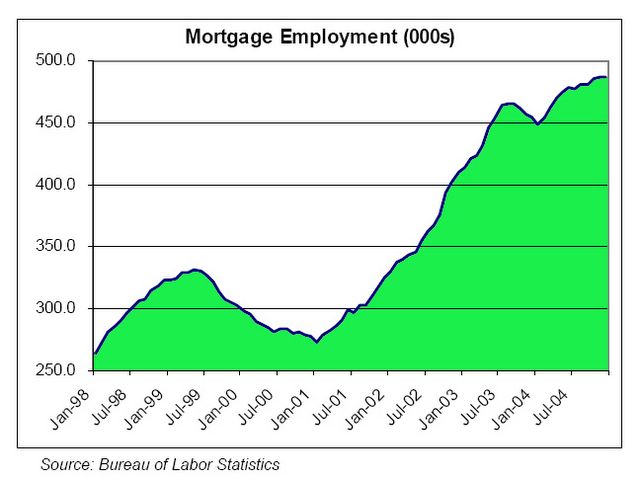
There has been a significant increase in mortgage brokers. There
has been a similar increase in residential building trades, appraisers,
home inspectors and other housing related occupations. The
impact of a housing slowdown on employment will be significant.

What will the end of the refinance boom and the housing boom
do to the mortgage industry ?

April 8, 2005

Economist's View / Mark Thoma

Economistsview offers leftist hardcore partisan commentary, often Oregon-centric, posing as economic analysis. (archives).


Update 2006 May: value added.
Update 2005 October: Offers pointers to academic papers and Fed speeches.

March 26, 2005

Torto Wheaton Research (TWR)

Torto Wheaton Research (TWR) studies commercial real estate.
Their Debt Risk Management has a nice list of features. See also
Portfolio strategy and misc research desk.

Continue reading "Torto Wheaton Research (TWR)" »

March 22, 2005

Centre for Real Estate

CRE: Centre for Real Estate is mostly about town planning,
environment and architecture, but also publishes on economic
topics such as, Is There a "Bubble" in US Housing Markets ? [PDF, 298k]

Continue reading "Centre for Real Estate" »

March 6, 2005

Housing market bubble ?

PMI's Economic and Real Estate Trends (ERET): [PDF, cached]

Economic and Real Estate Trends is a narrative publication based on an
internally developed PMI model. Issued quarterly, the report includes
commentary on the national economy and regional housing price trends.
In addition, select metropolitan areas are analyzed. The 50 most
populated metropolitan areas are featured in a tabular presentation
(Metropolitan Area Economic Indicators), based on a statistical model
utilizing economic data, real estate variables and market expertise.
The model provides several risk measures to gauge relative residential
lending risk.

January 16, 2005

Texas economic variables

DataBasics walks you through the essentials of Texas economic data.
The articles present numeric operations that economists use to make
data more meaningful. The data definitions are descriptions of
frequently used Texas economic variables that, taken together, help
paint a picture of statewide economic activity.

Texas economic variables.

January 10, 2005

In the Agora

In the Agora is a nice name for an Indianapolis-centric current
events blog by Zach Wendling and Paul Musgrave.

Recent controversies: Daylight Savings time.

January 9, 2005

Mortgage Blogs

The Mortgages Blog (by weblogsinc) is frequently updated with
mortgage industry news mixes some news items and more outside
links with descriptions.

Bankrate is potpourri of mortgage and consumer finance content,
more written for consumers than lenders, and syndicated onto
many consumer sites.

December 8, 2004

The sports economist / Skip Sauer

The sports economist by Skip Sauer covers stadium economics,
player-league bargaining, and more.

December 1, 2004

Economy Professor

Economy Professor provides a glossary of some well known terms, theories, and economists.

November 27, 2004

Toll Roads News

Toll Roads News. News about toll roads. World-wide.

Covers toll highways, parkways, bridges, tunnels, and truckways.
Recently, topics include Bston's Big Dig / Big Siv, Chicago Skyway,
and Toronto's 407ETR.

November 1, 2004

Tradesports' 2004 US Presidential election hourly data

Tradesports' 2004 US Presidential election hourly data.

Kerry +2.5 % on 2004 Nov 01 !

October 14, 2004

Chicago Boyz

Chicago Boyz examine the data on Iraqi war losses.

October 13, 2004

Mahalanobis / Michael Stastny

Mahalanobis is Michael Stastny's excellent economics blog.

He also has a sharp eye for current events, and bio'ed on Xing.

Michael_Stastny.jpg

October 8, 2004

Marginal Revolution

Marginal Revolution, good economics blog; tries hard to be mainstream.