Citibike angels program is pure arbitrage
Bike Angels forCitiBike NYC bike share.
Bike Angels forCitiBike NYC bike share.
Diane Garnick from TIAA; Chicago Booth
Date Written: February 27, 2017
Abstract
Mental Accounting is an important tool enabling us to make countless decisions each day. We code, categorize and evaluate our expenses using a system that we typically develop with our first paycheck. We routinely allocate some portion of our money to many buckets, and often over commit ourselves. 25% to housing, 25% to food, 25% to loans, and of course, another 50% to entertainment. We don't necessarily make the best decisions, but if we make a mistake we have time on our side.
Mental Accounting in Retirement involves a key change in mindset. Time is no longer on our side and (hopefully) our level of wealth is higher. Rather than allocate some funds to many buckets we propose fully funding one bucket before moving on to the next. This framework offers transparency into the age old question of how much guaranteed lifetime income each household needs while simultaneously offering savers insight into which goals they are on track to meet.
Keywords: Behavioral Finance, Mental Accounting, Mental Accounting in Retirement, Emotional Accounting, Lifetime Income, Psychological Biases, Behavioural Finance
JEL Classification: A10, D03, D10, D91
The for-profit Art Institutes programs that failed the federal test trained students in fields including commercial photography, video production, radio broadcasting, culinary arts, interior decorating and video game design. Other programs that crop up frequently on the failing list include cosmetology and barbering, acupuncture and massage therapy, criminal justice studies and low-level jobs in health care fields.
What these programs have in common is a combination of marketing appeal to young people -- design video games for a living! -- and little or no outside pressure to ensure that the education is both of high quality and leads to jobs that pay enough to finance the cost of student loans. Sure, there are good programs in all of these fields, including some offered by for-profit schools. But it can be very hard for the average consumer to know the difference beforehand.
https://www.nytimes.com/2017/01/13/upshot/harvard-too-obamas-final-push-to-catch-predatory-colleges-is-revealing.html
You can argue that the problems caused by, say, Romanians using the National Health Service are exaggerated, and that the benefits of immigration greatly outweigh these costs. But that's a hard argument to make to a public frustrated by cuts in public services -- especially when the credibility of pro-E.U. experts is so low.
For that is the most frustrating thing about the E.U.: Nobody ever seems to acknowledge or learn from mistakes. If there's any soul-searching in Brussels or Berlin about Europe's terrible economic performance since 2008, it's very hard to find. And I feel some sympathy with Britons who just don't want to be tied to a system that offers so little accountability, even if leaving is economically costly.
An adviser (Dan Davies) for Frontline Analysts, a global research outsourcing firm, supports Remain.
"These kids have grown up with computers. They have been downloading movies and music since they were 10 years old, so it's not much of a leap to download credit card numbers."
-- said Lt. Timothy Fenfert, who leads the Police Department's Special Fraud Squad in Brooklyn.
LendingClub's problems this week, musings of Matt Levine:
LendingClub got in trouble for being too much like a FintTech -- a "financial technology" company -- and too little like a bank, focusing on algorithms and speed and coolness rather than the plodding legalistic work that is the actual business of finance.
LendingClub got in trouble for being too much like a bank and too little like a FinTech, with mission creep, conflicts of interest and "a complicated network of middlemen" instead of a pure technology-driven neutral platform.
Before the 1980s, Texas followed a long, populist tradition that tried to protect family farmers and other small-scale businesses and consumers. Under its 1876 constitution, for example, Texas enacted consumer protections against predatory mortgage lending, with provisions that ironically helped to hold down foreclosures in Texas during the Great Recession.
In 1889, Texas became the second state in the country to enact an antitrust law. Two years later, it further pioneered government regulation of big business by establishing the Texas Railroad Commission, which went on to protect wildcatters and other small-scale oil producers by regulating the oil industry in ways that kept outside Goliaths like Standard Oil at bay. But since the 1980s, "pro business" in Texas has more and more come to mean just pro Big Business.
Second Measure by Mike Babineau and Lillian Chou tracks business' sales for investors.
Second Measure takes billions of anonymized credit card transactions and analyzes them so investors can see where consumers are voting with their dollars before a company's quarterly earnings come out.
More in data.
Continue reading "Track business' sales to aid investors " »
Update: Inventory management 2.
When an automaker posts its sales figures at the end of the month, how many vehicles actually left the dealer lot?
Not all of them, according to a top BMW executive, who admitted that his company and others "punch" up sales numbers to boost their standing, according to Automotive News.
Punching cars is "not an ideal practice," but it's a reality in the industry, BMW of North America CEO Ludwig Willisch said on March 22.
Speaking at the National Automobile Dealers Association-J.D. Power Automotive Forum in New York, Willisch said there was "a lot of pressure" to boost sales numbers. The practice involves an automaker purchasing its own vehicles to serve as dealer loaners, then quickly re-selling them as pre-owned after having seen very little use.
The issue of punching arose from last year's close four-way battle for the top luxury automaker spot in the U.S., a battle BMW won -- on paper, at least.
Recording 346,023 U.S. sales in 2015, BMW placed first in the race and Lexus third, but when actual vehicle registrations were tallied, Lexus came out on top.
Numbers gathered by IHS Automotive/Polk showed a gap of 10,764 vehicles between BMW's sales and registration figures, the largest of the top three luxury automakers.
The program, called EB-5, allows wealthy foreign investors, for a price ranging from $500,000 to more than $1 million, to put themselves on a path to United States citizenship. The money must be used to finance a business in this country and eventually employ -- directly or indirectly -- at least 10 American workers in economically depressed areas.
But EB-5 has been the subject of increasing scrutiny since investigators uncovered numerous cases of fraud, discovered individuals with possible ties to Chinese and Iranian intelligence using fake documents and learned that international fugitives who have laundered money had infiltrated the program.
"It's no secret that the program has long been riddled with corruption and national security vulnerabilities," said Senator Charles E. Grassley, Republican of Iowa and a frequent critic of the program.
A number of Democrats echo his criticism, in large part because while most visa applicants must meet education or work requirements, the primary requirement for the EB-5 program is a "lawful source of investment income," one Department of Homeland Security memo said.
"I don't believe that America should be selling visas and eventually citizenship," said Senator Dianne Feinstein, Democrat of California, who wants to terminate a part of the program that allows foreign applicants to invest through regional development centers that pool investor money. "The right to immigrate should not be for sale."
Continue reading "Investor immigrants are lucrative criminals seeking refuge ?" »
Fintech insurgents are moving and growing quickly, they must overcome big challenges of their own before reshaping the industry. They are still relatively small and niche players in the sprawling retail banking business. They are not deposit-taking institutions, where consumer savings are insured by the government.
They also lack the legal and regulatory apparatus that traditional banks have built over many decades. Already, some of the new services are facing regulatory scrutiny. In November, Apple, Google, Amazon, PayPal and Intuit formed a Washington-based advocacy group, Financial Innovation Now, to promote policies to "foster greater innovation in financial services."
Goldman Sachs set up its first office in San Francisco in 1968. In the 1990s, Wall Street banks sought out "the Four Horsemen," a contingent of local boutique investment banks that had cornered the market on virtually all the tech start-ups. JPMorgan bought Hambrecht & Quist (Mr. Perkins has long said the only banker he ever liked was Bill Hambrecht of Hambrecht & Quist); Deutsche Bank bought Alex. Brown & Sons; the predecessor to Bank of America bought Robertson Stephens; and Montgomery Securities was bought by NationsBank (which later merged with Bank of America).
Andreessen Horowitz is a talent agency as much as a tech investor. Marc Andreessen, the web pioneer who was a founder of Netscape and other companies before trying his hand at venture capital, has made this point explicitly a in 2010 interview of Michael Ovitz, the onetime Hollywood superagent who started Creative Artists Agency.
The Renaissance Kids typically have their pick of investment banks, and what makes them so attractive to Wall Street -- aside from their credentials, which look good on a pitch book -- is that they're interesting. They're not carbon-copy Alex P. Keatons. They read books, can wax eloquent on nonfinancial matters, and are good at male small-talk (which female Renaissance Kids also excel at). Executives look them over and imagine them schmoozing clients, passing the airport test, and eventually taking over for them at the top of the firm.
Goldman Sachs is especially desirous of Renaissance Kids, because it's always fancied itself the thinking man's investment bank. ("I think you also have to be a complete person. You have to be interesting," Lloyd Blankfein told the bank's interns last year.) But because Goldman wants them, everyone else does, too.
The problem, for Goldman and the rest of Wall Street, is that banks aren't pulling nearly the number of Renaissance Kids they once did. These firms are having no problems drawing applicants out of college, but what I've heard from senior Wall Street hiring managers is that they're not the right kind of applicants. They're second-stringers, as far as the banks are concerned. The students these firms want to attract -- badly -- are increasingly going to Google or Facebook instead of Goldman and J.P. Morgan. (Or, almost worse, going to Goldman and J.P. Morgan, working for a year or two, and then quitting to go to Google or Facebook.)
How would I receive the proposed disclosure, if I obtained my prepaid card at a retail store, rather than at a bank branch?
Pew is proposing a "fold out" version of its disclosure form that would be available in stores on the same hooks that display the prepaid cards. Right now, disclosures are typically contained inside the package containing the card, so consumers can't see them ahead of time, and they are often difficult to read, Susan K. Weinstock, director of Pew's safe checking research project said.
If there was a competition entitled "Correct the analyst's spreadsheet", that could be sort of cool, right?
The Stratton brokers could have just placed orders in these customers' accounts without their permission, but they rarely did. Unauthorized orders were more likely to trigger complaints to regulators, and the move would have violated some unofficial boiler-room code of honor. These guys took pride in their ability to talk suckers into parting with their life savings.
-- Ronald Rubin
Why have no top Wall Street executives have been charged criminally for the risky acts that triggered the crisis. The government also prefers to settle with big companies rather indict them, fearing that criminal charges could unnerve the broader economy.
The government investigations into JPMorgan, which focus on securities the bank sold from 2005 to 2007, raised questions about whether JPMorgan had failed to fully warn investors about the risks of the deals.
One of the largest pieces of the $13 billion deal could come from a settlement with the Federal Housing Finance Agency. The agency sued JPMorgan over loans it had sold to Fannie Mae and Freddie Mac, the government-controlled mortgage finance companies.
The settlement would also resolve a case related to Bear Stearns, the people briefed on the matter said, a lawsuit that has pitted the New York attorney general against JPMorgan.
Eric T. Schneiderman, the New York attorney general, sued JPMorgan last October, saying Bear Stearns and its lending unit, EMC Mortgage, had duped investors who bought mortgage securities assembled by the companies from 2005 through 2007. Through a deal backstopped by the government, JPMorgan bought Bear Stearns in 2008.
Mr. Dimon has called the lawsuit unfair, arguing that JPMorgan should not be penalized for buying Bear Stearns.
Yet JPMorgan's board, faced with regulatory problems, one more vexing than the next, is eager to strike a conciliatory stance. Toward that end, the bank's board approved the payment of about $1 billion in fines to government authorities so it could resolve investigations into the trading loss in London and an inquiry into the bank's credit card products.
But the accountants' job is to record, not to evaluate. The evaluation job falls to investors and managers. Accounting numbers, of course, are the language of business and as such are of enormous help to anyone evaluating the worth of a business and tracking its progress. Charlie and I would be lost without these numbers: they invariably are the starting point for us in evaluating our own businesses and those of others. Managers and owners need to remember, however, that accounting is but an aid to business thinking, never a substitute for it.
-- Warren Buffett
Uncertainty and the Oil Fields
The reason for the review is that an Australian scholar has recently published a paper offering "A Bayesian Understanding of Information Uncertainty and the Cost of Capital." The gist of it is that traders face information uncertainty, that is, the risk of a misleading signal about the value of an asset.
"The Bayesian position," says D.J. Johnstone of the University of Sydney Business School, "is that even a highly informative signal ... can bring an increase in uncertainty, and hence an increase in the cost of capital." This is at least somewhat counter-intuitive. Surely the highly informative signals (also known as "greater transparency") will lessen uncertainty and risk, thus reducing the cost of capital.
Ah, Johnstone says, perhaps not. Consider a world in which there are two possible geological formations involved in the search for oil: A and B. There may be oil under either plot. Geologists tell us that plot A belongs to a type of geological formation with a 0.5 frequency of oil. B-type plots, on the other hand, have a 0.95 frequency of oil. It isn't always obvious which is which, and oil companies like to figure out which is which before making the final decisive test to determine whether there is oil there.
Suppose also that the prior probability of oil under a random site, before we even know if the site is A or B, is 0.635.
Now, on Day 1, an oil company owns a piece of land that has not yet been tested for oil, or even tested to determine whether it is A or B. The market will presumably assess the value of this land accordingly. Prospective buyers will consider it as having a 0.635 likelihood of bearing oil.
On Day 2, the land is tested and found to be of Type A.
Thereafter, the market will lower the value of that land, because its likelihood of bearing oil has fallen to 0.5. There is greater uncertainty post-test than there was pre-test.
Continue reading "Understanding of Information Uncertainty and the Cost of Capital" »
In 2011, Jamie Dimon, chief executive of JPMorgan Chase, said that the proposed rules to overhaul derivatives, a commonly used financial instrument, "would damage America." He also said that the Basel rules were "anti-American." Comment letters filed by lobbyists with regulators used sophisticated-looking models to show how rules could hold back the economy.
"As far as the banks are concerned, there is never a good time to raise capital or increase regulation," Ms. Bair said. "When times are bad, they say it could hurt things, and when times are good, they say they don't need it."
Some analysts, however, caution against reading too much into the banks' strong profits.
Though banks have been preparing for new rules for months, many of them have not been fully executed, which means the true costs of the measures will not be known until later.
Michael Poulos of Oliver Wyman, a consultancy, says that "before the crisis, almost every bank account made money. Big accounts made money on the spread, and small accounts made money on incident fees. You made money on all the accounts with interchange fees. All of that is either severely curtailed or completely gone." Oliver Wyman reckons that US banks now lose money on 37% of consumer accounts.
For those concerned that their low net worth bars them from the banking system, there are two reasons for hope. The first is that lenders and credit bureaus are starting to use a broader range of data to determine the creditworthiness of prospective borrowers. Many of the unbanked have no credit histories. But data from rent, mobile-phone and utility bills give lenders a way to find lower-risk borrowers.
The second reason for optimism is an increasingly competitive market in pre-paid cards. Once simply reloadable proxies for cash, many of these cards now offer much the same features as bank accounts.
Taxes: Oh yeah, and I haven't assumed any taxes on the above calculations. In recent years, unrealized gains seems to be offset by losses (note the deep discount to book value of CNA). So it would be a wash. Plus, these folks tend not to pay taxes. I think any monetization will come through spinoffs, exchanges and other tax efficient means. Part of the discount in L stock might be due to people applying 20% discounts to the value of publicly listed holdings for tax and liquidity. It may be the correct way to look at things, but I'm not convinced enough to put it in my valuations.
Conclusion: Anyway, this L is a really boring stock
Brooklyninvestor's Loews adjusted book value update.
Part 2 is up.
The potential downgrades would cost those institutions billions of dollars in higher interest payments, steeper collateral costs and missed revenue opportunities.
What's making executives at Morgan Stanley and the scores of rivals waiting for Moody's decisions even more frustrated is they are fighting against an army of credit-rating analysts who are nowhere near as well-known and are paid a fraction of what bankers get. Even finding someone to blame can prove elusive, as Moody's ratings actions are decided by a voting committee of about a dozen analysts whose identities are never disclosed.
Moody's actions are faceless by design. The aim is to shroud at-times contentious decisions in an aura of mechanic precision, and to protect its analysts from the personalized attacks they may otherwise endure from finance ministers, bank executives and other debt issuers unhappy with their decisions.
While most people welcome leverage limits as the just consequence of Wall Street's greed, and conclude that we will be safer if these businesses are run more prosaically, there is a real danger that we have focused on the wrong problem, and will condemn our once enviable capital markets to a period of bland ineffectiveness. While lower leverage would certainly provide more of a margin against the inevitable future errors of Wall Street executives, hard limits on risk-taking might also lead to stifled innovation and slow economic growth. Would Michael Milken, at Drexel Burnham, still have created the junk-bond market--or Lewis Ranieri, at Salomon Brothers, the securitization market--if the Dodd-Frank law or the Volcker Rule had been around to curb their firms' ability to take risk?
The spread and evolution of the idea that the financial crisis was caused by a giant increase in leverage, enabled by the SEC, bears a passing resemblance to the old-fashioned, elementary-school game of telephone. While the change to the SEC's so-called net-capital rule in 2004 was plenty esoteric, in the main, it did not allow big securities firms to take on more leverage. The SEC did two things in 2004: First, it assumed the added responsibility of regulating Wall Street's larger holding companies--as opposed to just the broker-dealer subsidiaries within them. That's where more and more funky and risky assets, such as derivatives and mortgages, had been housed over the years. Second, the SEC required the holding companies to report their capital adequacy in a way that was consistent with international standards, and to discount their assets for market, credit, and operational risks. Clearly, the SEC did a poor job of monitoring Wall Street once it obtained this increased regulatory authority. But the rule change increased rather than decreased the SEC's oversight of the financial sector, and did not suddenly permit a dramatic increase in leverage.
Yet that's not how the rule change got interpreted. In the aftermath of the collapse of Bear Stearns, in March 2008, people were eager to know how a company that had thrived for 85 years, and that had $18 billion in cash on its balance sheet, could evaporate in a week's time. Enter Lee Pickard, a former director of the SEC's trading-and-markets division and one of the architects of the net-capital rule in 1975. In an August 2008 essay in American Banker, Pickard lambasted the 2004 change, which he believed had allowed Bear Stearns to incur "high debt leverage" without "substantially increasing [its] capital base." He argued that the original net-capital rule required securities firms to discount, or "haircut," the value of their assets depending on the assets' perceived risk, and that it limited the amount of debt they could incur "to about 12 times [their] net capital." After the SEC's 2004 rule change, he wrote, the large securities firms were permitted to avoid the haircuts and the limitations on indebtedness. According to Pickard, "The losses incurred by Bear Stearns and other large broker-dealers" were caused "by inadequate net capital and the lack of constraints on the incurring of debt."
Morgan Stanley deserves credit since it did not fire Barton Biggs, Byron Wien, or Stephen Roach during that period when most Wall Street firms replaced nourishment with treacle.
Two events come to mind.
In the summer of 1999, Barton Biggs debated James K. Glassman. This was the high summer - or, at least, the final summer - of the Internet bubble. It was obviously ridiculous but there was still time to get rich quick. To quote myself: "During the first four months of 1999, the average first-day percentage gains on IPOs were 271% (in January), 145% (February), 146% (March) and (119%) in April. More to the point is the lack of any operating record on the part of these enterprises. They were often no more than lavish compensation schemes for the promoters. Many of the companies had never earned a cent; quite often, they had never sold a thing; and not infrequently, they had neither a product to sell nor intended to develop a business.
"The book that captured the national idiom was Dow 36,000, by James K. Glassman and Kevin Hassett. They posted a preview on the editorial page of the Wall Street Journal on March 17, 1999: "Our calculations show that with earnings growing in the long-term at the same rate as the gross domestic product, and Treasury bonds below 6%, a perfectly reasonable level for the Dow would be 36,000 - tomorrow, not 10 or 20 years from now."
The debate between Biggs and Glassman is a classic example of people believing what they want to believe while ignoring the proverbial elephant in the room. Of course, in 2012, the obvious catastrophic consequences of central banking's destruction of the world's currencies as well as stock, bond, and commodities markets are not up for discussion.
-- Frederick Sheehan
Continue reading "Barton Biggs vs James K. Glassman and Kevin Hassett" »
Though smartphone payments have a long way to go before they replace wallets altogether, Starbucks's adoption of Square will catapult the start-up's technology onto street corners nationwide, and is the clearest sign yet that mobile payments could become mainstream.
"Anyone who's going to break the mobile payments barrier in the U.S. has to overcome the resistance to try anything new when everything we have works really, really well, even cash, which is very convenient," said Bill Maurer, director of the Institute for Money, Technology and Financial Inclusion at the University of California, Irvine.
Signing up for Square involves supplying your bank routing and account numbers, so Square can deposit your money. Only the first $1,000 of each week's charges lands in your bank account immediately. Anything over that is reviewed by the company's auditors; it can take as long as 30 days before you see the rest of the money. That could be a downside if you sell a lot of used cars.
Then again, that's just for first-timers. The more you use the service without incident, the higher the company will raise that $1,000 threshold. In fact, if you're willing to share more details about your business with Square upfront, they'll raise that threshold from the start.
When everyone agrees, prices get stupid. Studies have shown that crowd estimates can be surprisingly accurate on average -- but only when there is sufficient diversity of opinion. Market valuations are the same way: When you have a diversity of opinion, reasonable estimates prevail as outliers cancel each other out. But when there is a critical mass of one-sided opinion -- when an overwhelming majority shares the same general view -- you get serious mispricings.
For Javaid Tariq, a taxi driver in New York City who sends money monthly to his family in Pakistan, the exchange rate is particularly infuriating because of how much money he loses. When he sent $300 to his family in April, he received 89.2 rupees for every dollar, less than the 91.2 exchange rate that he checks each morning, he said. For his family, that means 599 fewer rupees, or more than a week's salary in Lahore.
Immigrant advocates argue that many people do not have time to shop for better rates.
"These are people working who are often working minimum wage jobs with very little savvy or time about where to price-shop," said Francis Calpotura, the founder and director of the Transnational Institute for Grassroots Research and Action in Oakland, Calif.
High quality global journalism requires investment. Please share this article with others using the link below, do not cut & paste the article. See our Ts&Cs and Copyright Policy for more detail. Email ftsales.support@ft.com to buy additional rights. http://www.ft.com/cms/s/0/78b9df70-a978-11e1-9772-00144feabdc0.html#ixzz1wg4ig5p1
We need to adopt a corporate performance statement that is transparent and relevant for assessing value. This should include two separate sections: the cash flows the company realised during the reporting period and estimates of the company's future cash flow commitments. The statement begins with revenue and deducts cash outlays for operating expenses and capital investments to arrive at free cash flow. This is the cash available to pay interest and dividends and gives investors a baseline from which they can assess the company's prospects. Clearly stating the individual items that determine free cash flow is the best way to serve investors.
The second section presents estimates of the cash flows that the company anticipates it will need to satisfy future financial commitments, such as pension liabilities. Reporting a single estimate to capture an uncertain amount leaves investors in the dark. This corporate performance statement presents a most likely, an optimistic and a pessimistic estimate for each account. Management's discussion of the factors driving the estimates and the likelihood of each enables investors to form their own expectations in an informed fashion.
Continue reading "Beyond point estimates, financial statements edition" »
The SAS financial services modeling group in San Diego, exploring ways they can take advantage of high-performance analytics and big data techniques to deliver more models, more quickly, and to more customers. This wasn't completely an academic exercise--the team in San Diego has added several new customers recently and have been looking for ways to boost productivity, so this is the perfect setup for our high-performance story. Perhaps you've seen Jim Davis' blog where he ponders what you can do with all the extra time savings that high-performance analytics offers ... provide service to more customers is one good idea!
The biggest threat to incumbents, however, comes from outside the traditional banking sector, where hungry innovators are trying to cut the cost of investment advice and wealth management drastically. The most fertile ground for many of these new firms is in California, where a generation of technology entrepreneurs that made its money online is preparing to invest it online too. The region is already awash with traditional wealth managers. UBS, Goldman Sachs, JPMorgan and others are expanding in San Francisco and around Silicon Valley. They have recently been joined by online rivals such as Wealthfront, MarketRiders and Personal Capital, all of which use technology to help clients build customised asset portfolios at a small fraction of what traditional wealth managers would charge.
The biggest threat to incumbents comes from outside the banking sector, where hungry innovators are trying to cut the cost of wealth management.
Wealthfront, which is aiming its offering squarely at Silicon Valley's new rich, will manage money for a fee of 0.25% a year, using sophisticated algorithms that measure risk tolerance and build a diversified portfolio. Another new entrant is Personal Capital, started by Bill Harris, a former chief executive of PayPal and Intuit. It tries to straddle the world between cheap online wealth management and the old world of private banking. Customers can sign up online but the firm provides expert portfolio and tax-management advice and assigns wealth managers to individual customers. In Britain a firm called DCisions has crunched the data on millions of portfolios to obtain risk-adjusted returns as benchmarks for new investors. The data show up clearly how wealth managers' fees have affected the value of the portfolios and what difference the managers' advice has made.
Tom Blaisdell, a partner at DCM, a venture fund, manages his savings through MarketRiders. For a flat fee of $14.95 a month the firm assesses his tolerance for investment risk and helps him construct a portfolio of investments using exchange-traded funds that he can buy through any discount broker. The firm monitors his asset allocation as markets move and sends him quarterly instructions on what to buy or sell to rebalance his portfolio. "I've got a personal rant on this but 90% of what people call 'investing' in this country is what I call 'gambling'," says Mr Blaisdell. "It is a big area for innovation."
"STRATEGICALLY, I THINK in terms of millionaires and billionaires," says Jürg Zeltner, the head of wealth management at UBS, a Swiss bank. It is a claim that many big banks would like to make about their clients. Few can. With a squeeze on revenues from banking services for more down-at-heel folk, many of the world's biggest banks, as well as some smaller ones, hope to plump up their profit margins by serving the very wealthy. Yet margins in private banking and wealth management are also being squeezed, and new competitors from outside banking stand a good chance of breaking into this market.
Self-evidently, the big attraction for banks is that rich people have more money to invest and spend on advice than poorer ones. Definitions of rich customers vary from bank to bank and region to region, but there is a rough pecking order. Customers with financial assets above $1m (not counting their homes or businesses) are generally classified as high-net-worth individuals, and those with assets of $10m-30m as ultra-high-net-worth. The Boston Consulting Group puts the total investible assets of the world's wealthy at around $122 trillion last year, almost enough to buy all the shares traded on the New York Stock Exchange ten times over. Capgemini and Merrill Lynch come up with a more modest estimate of about $43 trillion. Whichever number is right, the market is certainly big enough to be interesting; and everyone agrees that it is growing quickly. The rich world is still home to most of the world's money: about a third is in America and another third in Europe. Yet the fastest growth is in Asia, where the assets of the rich increased by almost a fifth in 2010
Spitzer forced an industry-wide settlement in which the involvement of research analysts in IPOs was pared back and the "Chinese Wall" between research and banking was strengthened.
This industry reform had several consequences, some of which were positive and some of which were negative.
On the positive side, the reforms removed some stress for analysts. Once analysts were no longer evaluated in part on banking business, they focused more on serving institutional investor clients and researching already public companies. And that's unequivocally a good thing.
On the negative side, it became harder for companies to go public...because it turned out that having analysts involved in the screening, positioning, and marketing of deals and then providing follow-on research coverage of small companies made the whole IPO process work better. So that, arguably, was a bad thing.
Read more: Henry Blodget / businessinsider
Continue reading "Facebook IPO, why it's different from the dotcom ere $FB -- Blodget" »
Zuckerberg's torture-by-attorney didn't start in the past twenty-four hours, when law firms in New York and California initiated the first of what is sure to be a slew of lawsuits related to last week's controversial I.P.O. Ever since February, when Facebook filed its initial investment prospectus, the youthful C.E.O. has had to check with his own lawyers before saying virtually anything publicly--a requirement imposed as part of the S.E.C.'s pre-I.P.O. "quiet period," which applies to any company preparing to issue stock.
At that time, Wall Street research was under a microscope. Eliot Spitzer, then the New York attorney general, had exposed how analysts routinely slanted research to win lucrative investment banking business. In 2003, Lehman was among 10 firms that reached a $1.4 billion settlement. They all promised to wall off research operations from other parts of their business.
But Ted Parmigiani, says he was asked to break those new rules. Lehman bosses, he contends, told him to write research that would support investment banking business -- a violation of the Spitzer settlement. He says he was warned not to make negative comments about companies, even when he thought they were merited, lest he antagonize corporate executives. In 2003, he says, he was chastised for downgrading a company that was a corporate finance client of Lehman's.
Most alarming, Mr. Parmigiani says, was that Lehman had created a system that gave its stock trading desks access to its analysts' research recommendations before those recommendations were made public. The Product Management Group, as this business unit was known, scheduled analysts' calls on the firm-wide squawk box system and was part of the research department.
Mr. Parmigiani says the Product Management Group often delayed the announcements of recommendation changes for no apparent reason. He says he began to suspect that the delays were meant to allow Lehman's traders to put on positions ahead of the news and to give the firm's top sales representatives time to alert favored clients.
On March 30, 2005, Mr. Parmigiani had been scheduled to meet with a series of hedge fund clients, including Moore Capital, to discuss his research. At the last minute, Jared Demark, a vice president in Lehman's institutional equity sales who covered the hedge funds and had planned to accompany him, bowed out. In an e-mail to Mr. Parmigiani, Mr. Demark wrote: "Go to the Moore meeting without me, we have big ratings change looming ... "
While Mr. Parmigiani did not learn precisely what Mr. Demark meant by that e-mail, it fueled Mr. Parmigiani's concern that Lehman was alerting hedge funds to analysts' pending changes.
Lending Support to Kyes : Immigrants' Credit Associations Need to Be Encouraged--for Everyone's Financial Health
Voices
October 24, 1993. Ivan Light, a professor of sociology at UCLA, is the co-author of "Immigrant Entrepreneurs: Koreans in Los Angeles, 1965-1982." (Los Angeles: University of California, 1988).
When Jung-Hie Park sought to collect $50,000 owed to his kye , a popular financial institution in the Korean community, he turned to California courts for adjudication. Without examining the merits of his claims, Superior Court Judge Edward M. Ross ruled in September that kyes were an "illegal lottery" whose debts could not be collected in an American court.
Although Ross' decision may be appealed, it highlights the difficulty that American law encounters when attempting to digest foreign saving and credit institutions like the kye . In the language of anthropology, the Korean kye , the Mexican tanda , the Chinese hui , and the Vietnamese ho are examples of the rotating savings and credit association, a popular financial institution of the Third World
Continue reading "Kye ( Gye ), social credit of Korean America" »
To the auditing industry, the fact that investors tend to blame auditors when frauds go undetected reflects unrealistic expectations, not bad work by the auditors. The rules say auditors are supposed to have a "healthy degree of skepticism," but not to detect all frauds.
"There is a significant expectations gap between what various stakeholders believe auditors do or should do in detecting fraud, and what audit networks are actually capable of doing, at the prices that companies or investors are willing to pay for audits," stated a position paper issued in 2006 by the chief executives of the six largest audit networks.
Note that last part. They suggested that if investors were really worried about fraud, they should consider paying more for a "forensic audit" that would have a better -- but not guaranteed -- chance of spotting fraud. Don't like our work? Pay us more.
Ernst's audit opinion does not say, which is no surprise. Virtually every audit opinion in the world says almost the same thing, with no details about the company being audited. Auditors are paid millions of dollars to produce a report that no one thinks is worth reading.
On June 21, the Public Company Accounting Oversight Board, which regulates auditors in the United States, plans to ask for public comments on whether to require auditors to do more and say more.
One idea the board is expected to consider is requiring auditors to disclose more about what they did, and did not, do. Ideally, auditors would point to things that they could not audit. There are a lot of them now, and sometimes they are crucial.
Andy Haldane, the-regulator-who-explained.
Also: Andrew Haldane asks "Is the world becoming more short-sighted?" (Bank of England)
Under one equilibrium, patience wins the day. When long-term investors start in the ascendency, prices tend to correct towards fundamentals. The performance of untested investors pursuing momentum strategies falters, while those pursuing longterm strategies flourish. The fraction of long-term investors rises. The self-correcting tendencies of market prices are thus reinforced, further supporting long-term investors. The patience gene thrives, the impatience gene dies. Natural selection results in a self-improving cycle, as with dieting, happiness and exercise.
But there is a second equilibrium where this cycle operates in reverse gear. With a large fraction of momentum traders, prices deviate persistently from fundamentals. Among untested investors, momentum strategies now flourish while long-term fundamentalists fail. The speculative balance of investors rises, increasing the degree of misalignment in prices. The patience gene falls into terminal decline. Natural selection results in a self-destructive cycle, as with drug, alcohol and food addiction.
The recent financial crisis has generated many distinct perspectives from various quarters. In this article, I review a diverse set of 21 books on the crisis, 11 written by academics, and 10 written by journalists and one former Treasury Secretary. No single narrative emerges from this broad and often contradictory collection of interpretations, but the sheer variety of conclusions is informative, and underscores the desperate need for the economics profession to establish a single set of facts from which more accurate inferences and narratives can be constructed.
-- Andrew Lo
If migrants spent heavily, lenders encouraged them. Traditionally, credit card use was low (in part because of Islamic strictures against charging interest), but banks spotted a new market and moved aggressively.
With foreign banks like HSBC and Citigroup fighting locals for market share, the number of cards leapt to four million in 2008, a fivefold increase in five years, according to the Lafferty Group, a London research firm. But the country lacks a reliable credit bureau, so lenders could not tell how many cards or how much debt the borrowers carried.
"Banks were falling over themselves to lend, and they didn't have proper credit checks," said Andrew Neeson, a Lafferty analyst.
Courted with gifts and teaser rates, few borrowers understood the costs. The average interest rate in the Emirates last year, at 36 percent, was more than twice the global average, and banks routinely add another 10 percent for disability and death insurance. With penalties, some workers borrowed at rates of 50 percent or more.
Anyone can be tempted by easy credit, but migrants raised in poverty can find the glittering malls here especially intoxicating.
"The first time I used my card, I felt amazed," Ms. Naces said. "It's a feeling of excitement, power -- greatness even."
Rex Arcenio, a Filipino optometrist, accepted a gold card because it came with a Montblanc pen and a limousine ride to the airport for his annual leave.
"It was like a status symbol," he said.
He ran up $50,000 in debt -- for his children's education, his brother's cancer treatment and a house in Manila -- and was briefly jailed.
Technically, debtors go to jail for bouncing the blank "security checks" they must sign when accepting a card. If borrowers fail to pay, banks can deposit the checks for the sum owed, and bouncing a check is a crime.
Whether foreign or Emirati, borrowers must repay the debt after leaving jail, though banks often accept reduced terms.
If the greed of Boesky or Weill is unsurprising, the lack of greed evinced by some of Madrick's characters is striking. Paul Volcker, the Fed chairman whom Madrick eccentrically berates for his determined fight against inflation, was known to be frugal; John Reed, Citigroup's boss during the 1990s, was by Madrick's own account "thoughtful and unflashy." Reagan himself was more enthusiastic about self-reliance and hard work than about material advancement, remarking that "free enterprise is not a hunting license." Early in his career, Walter Wriston, Reed's predecessor at Citi and perhaps the character whom Madrick conjures most successfully, was offered a salary of $1 million to move to Monaco and work for Aristotle Onassis. He chose to remain in a middle-income housing project in Stuyvesant Village.
Age of Greed: The Triumph of Finance and the Decline of America, 1970 to the Present
Sebastian Mallaby -- the Paul A. Volcker senior fellow at the Council on Foreign Relations, is the author of "More Money Than God: Hedge Funds and the Making of a New Elite."
BOOKS
Why We Deregulated the Banks
By SEBASTIAN MALLABY
Published: July 29, 2011
Jeff Madrick traces the regulatory and cultural changes that led to America's current financial trouble.
"Look, if you can't compete in the major leagues for over a decade, it's time to go back to the minors," said the always outspoken Mike Mayo, an analyst with CLSA. His chronicle of ruffling bank management feathers, "Exile on Wall Street" (Wiley), will be published in the fall.
JPMorgan Chase is as well managed as any gargantuan bank can be. But if you look at its businesses, it's hard to see any area where it is clearly the best, something even its own executives concede. Not in credit cards, where the premier name is American Express. Not in money management, where you might offer up T. Rowe Price. Investment banking -- Goldman Sachs (the last quarter notwithstanding). Back-office transactions, State Street.
Yet even JPMorgan is merely trading at book value. Put another way, the market regards the value that JPMorgan provides as a financial services conglomerate as zilch. How well do all of JPMorgan's divisions work together? In presentations to investors, JPMorgan executives show how much revenue they gain from existing clients. But these measures are hardly unbiased. Executives have an incentive to defend their empires. Who is to say that a certain division of JPMorgan wouldn't have won that business anyway? And nobody measures how much a bank loses through conflicts of interest.
Making a nuanced argument, John Hempton, a blogger, investor and former regulator in Australia, says that it's better for shareholders -- and societies -- to have large banks with lots of market power. That makes them more profitable and leads them to take less risk, making them safer and more enticing for investors.
South American countries -- including Chile and Brazil, two of the region's healthiest economies -- are going through growing pains as the use of credit grows. The credit-fueled spending has driven extensive economic growth. But it has also opened the door to abuses, as credit issuers have used predatory techniques to lure customers, particularly young and less affluent ones, in countries where regulation is scant, annual interest charges can top 220 percent and consumers cannot seek bankruptcy protection, economists and consumer defense groups say.
"They are learning every trick that was learned in the United States to make credit cards the most valuable part of the banking business," said Lewis Mandell, a professor emeritus at the State University of New York at Buffalo, who wrote a book on the history of the credit card industry. "And unfortunately, the problems this caused in the United States are likely to repeat themselves in Latin America."
though the for-profit system serves only a little more than a tenth of those in postsecondary education, it accounts for nearly half of student loan defaults. The losses are generally of little concern to the companies themselves, because most of the tuition is paid by federal loans backed by the taxpayer. The defaulting students often end up with their lives in financial ruin.
Bankruptcy makes it possible to escape credit card and gambling debt but nearly impossible to escape student loan debt. As a result, students who default on school loans may never be able to have that weight lifted and can end up with creditors garnishing their wages.
The Obama administration has tried to address these problems with new rules to make programs with especially high levels of student debt and very low repayment rates ineligible for federal student aid. But these rules are insufficient.
Continue reading "For-profit colleges that leave students with crushing debt." »
n 2003, the Senate Permanent Subcommittee on Investigations looked into such transactions and found that in some cases, they were an elaborate way of using a charity's tax-exempt status to erase tax liabilities for the other shareholders of the company involved.
A charity involved in such a tax strategy would receive income from the company in proportion to the size of its holdings of nonvoting stock. But while that income was taxable, it was not distributed to the charity and stayed at the company to be reinvested.
The charity did not owe taxes on the income, anyway, because it was tax-exempt.
Later, the charity would sell the nonvoting shares back to the company at fair market value, and the company would distribute the income, tax-free, that had been associated with those shares among its other shareholders.
In other, similar cases, charities that received nonvoting stakes in privately held companies through gifts of stock used large losses they had incurred on unrelated businesses to offset taxes for other shareholders. Mr. Dryburgh wrote a paper on that type of tax shelter.
In 2004, the I.R.S. listed as "restricted" such transactions and denied deductions associated with them.
How a CPA would identify financial strength:
Cash to Equity
Underbillings
Quick Ratio
Current Ratio
Overbillings to underbillings
Long Term Debt to Equity
Return on Total Assets
Gross Profit
Contract Revenue to Working Capital
Revenues too Net Worth
Months in Backlog
The conventional wisdom has it that the final report of the Financial Crisis Inquiry Commission was a low-budget flop, hopelessly riven by internal political disputes and dissension among the commission's 10 members. As usual, the conventional wisdom is completely wrong. Actually, the report -- and the online archive of testimony, interviews and documents that are now available -- is a treasure trove of invaluable information about the causes and consequences of the Great Recession.
What one might call intellectual capture. While I would strongly argue that the FSA in my day did not favor firms unduly, it is perhaps true that we--and in this we were exactly like our American counterparts--were inclined to believe that markets were generally efficient. If willing buyers and willing sellers were trading claims happily, then, as long as they were "professional" investors, there was no legitimate reason to interfere in their markets. These people were "consenting adults in private," and the state should avert its gaze.
We now know that some of these market emperors had no clothes--and that their activities were far from benign: They could result in severe financial instability and generate serious losses for taxpayers, not to mention precipitate a global recession. That has been a grave lesson for regulators and central banks.
-- Howard Davies, former chairman of Britain's Financial Services Authority and a former deputy governor of the Bank of England, is director of the London School of Economics. His latest book is Banking on the Future: The Fall and Rise of Central Banking.
Abstract: The rapid growth of the market-based financial system since the mid-1980s changed the nature of financial intermediation in the United States profoundly. Within the market-based financial system, "shadow banks" are particularly important institutions. Shadow banks are financial intermediaries that conduct maturity, credit, and liquidity transformation without access to central bank liquidity or public sector credit guarantees. Examples of shadow banks include finance companies, asset-backed commercial paper (ABCP) conduits, limited-purpose finance companies, structured investment vehicles, credit hedge funds, money market mutual funds, securities lenders, and government-sponsored enterprises.
Shadow banks are interconnected along a vertically integrated, long intermediation chain, which intermediates credit through a wide range of securitization and secured funding techniques such as ABCP, asset-backed securities, collateralized debt obligations, and repo. This intermediation chain binds shadow banks into a network, which is the shadow banking system. The shadow banking system rivals the traditional banking system in the intermediation of credit to households and businesses. Over the past decade, the shadow banking system provided sources of inexpensive funding for credit by converting opaque, risky, long-term assets into money-like and seemingly riskless short-term liabilities. Maturity and credit transformation in the shadow banking system thus contributed significantly to asset bubbles in residential and commercial real estate markets prior to the financial crisis.
We document that the shadow banking system became severely strained during the financial crisis because, like traditional banks, shadow banks conduct credit, maturity, and liquidity transformation, but unlike traditional financial intermediaries, they lack access to public sources of liquidity, such as the Federal Reserve's discount window, or public sources of insurance, such as federal deposit insurance. The liquidity facilities of the Federal Reserve and other government agencies' guarantee schemes were a direct response to the liquidity and capital shortfalls of shadow banks and, effectively, provided either a backstop to credit intermediation by the shadow banking system or to traditional banks for the exposure to shadow banks. Our paper documents the institutional features of shadow banks, discusses their economic roles, and analyzes their relation to the traditional banking system.
First there's the cost: For-profit colleges are often much more expensive than comparable public ones. According to a report by the Government Accountability Office, one for-profit institution charged $14,000 for a certificate in computer-aided drafting that a local community college offered for just $520.
Then there's the issue of how the cost is covered: for-profit colleges take a disproportionate share of federal education loans. Although only 12 percent of post-secondary students go to for-profit colleges, they account for 23 percent of federal loans. And students at for-profit schools default on their loans twice as often as their public school counterparts, leaving taxpayers with the bill.
This is partly due to the open enrollment policies at for-profit colleges. It's disturbingly easy to get accepted, receive thousands of dollars in loans and then flunk out with crippling debt and no degree to show for it. I'm about to fail 4 out of 11 students in one of my classes because they simply stopped showing up. Some students will fail anywhere, but at this rate it's clear that many of them should never have been sold on the program in the first place.
I've also been on the other end of these sales tactics. I once looked into taking a class at a for-profit college. The admissions counselor was quite skillful at avoiding my questions about costs, and pressed me to enroll in a full degree program, despite my repeated refusals.
Problems with the for-profit business model don't end with recruitment; they extend to the classroom. While my nonprofit orientation covered how to create a syllabus and relate to students, the for-profit session addressed the importance of creating paper trails on attendance, should a student need to be flunked, and a video on how to avoid getting sued.
Here's the part that's really going to make me unpopular at my next faculty meeting. Many of my colleagues are excellent teachers, but their qualifications aren't much of a priority for the college. While teachers at a state or private university are typically expected to hold M.F.A.'s or Ph.D.'s, for-profit teachers need only to have taken a few hours of graduate course work.
Teachers at for-profits are paid less, and work more. Full-time instructors teach up to four times as many classes as their state school counterparts. And although nobody teaches only for the money -- I gross just over $30,000 a year, summers on, no benefits -- I earn 50 percent to 65 percent more at nonprofits. I try to treat both jobs with the same seriousness, but I'd be lying if I said this was always the case.
The business model of for-profit schools may pay off for shareholders -- just ask Goldman Sachs, which controls a third of the parent company of my for-profit employer, the Art Institute of Colorado -- but it clearly isn't as effective at educating students.
-- Jeremy Dehn teacher of film and video production at the University of Denver, the Art Institute of Colorado and the University of Colorado at Denver.
Under the current rules, schools with default rates of 25 percent or more for three consecutive years, or a default rate higher than 40 percent in a single year, lose their
eligibility for the federal student aid that provides most of the revenues for for-profit colleges.
Frederick Peters, the owner of Warburg Realty Partners, had run his business well in the 30 years he had owned Warburg Realty. Now through no fault of his own he found himself in a financial crisis that threatened the future of his firm. This was the definition of a clutch situation. Over the next few months, he responded well because his actions were guided by the five traits of people who are great under pressure:
He also avoided the three traps that cause most people to choke:
Alec Haverstick II, a co-founder of Boxwood Strategic Advisers, provided a tool that could take the passion out of financial decision-making. His rule was that when you have less than 12 months of cash left to cover your debt payments, you need to start selling assets. His prescription applied to anyone because the advice was not based on having a lot of money so much as being smart with the money you have left.
In "Fault Lines: How Hidden Fractures Still Threaten the World Economy" (Princeton University, $26.95), Raghuram G. Rajan concludes that the financial crisis erupted "because in an integrated economy and in an integrated world, what is best for the individual actor or institution is not always best for the system."
Like geological fault lines, the fissures in the world economic system are more hidden and widespread than many realize, he says. And they are potentially more destructive than other, more obvious culprits, like greedy bankers, sleepy regulators and irresponsible borrowers.
Mr. Rajan, a finance professor at the University of Chicago and former chief economist at the International Monetary Fund, argues that the actions of these players (and others) unfolded on a larger worldwide stage, that was (and is) subject to the imperatives of political economies.
He cites three fault lines: domestic political stresses; trade imbalances among countries; and the tensions produced when financial systems with very different structures interact. All three came together to damage the financial sector in 2008, he says, and could meet again to cause another crisis.
Continue reading "Fault Lines: How Hidden Fractures Still Threaten the World Economy" »
Nevertheless, JPMorgan agreed to sell the loan to Inbursa on July 15, 2009, court documents show. It did not inform Cablevision and went ahead with the deal despite the fact that Grupo Televisa and other banks were interested in purchasing part of the loan.
When it sold the loan to Inbursa, JPMorgan structured it as a participation agreement rather than an assignment; such agreements can be sold without the borrower's consent. Still, the terms of the original Cablevision loan stated that participations could be sold only if the lending relationship between JPMorgan and Cablevision did not change significantly. Cablevision argued that the transaction with Inbursa did just that.
Cablevision learned that the sale to Inbursa required JPMorgan to hand over virtually any information Inbursa wanted about Cablevision. Court documents show that this language was added to the agreement at Inbursa's request.
Since the princes are nicer and more impressive, it is easy to be seduced into the belief that they also are more trustworthy. This is false. During the last few years, for example, the princes at Citigroup, Bear Stearns, Goldman Sachs and Lehman Brothers behaved with incredible stupidity while the hedge fund loners often behaved with impressive restraint.
As Sebastian Mallaby shows in his superb book, "More Money Than God", the smooth operators at the big banks were playing with other people's money, so they borrowed up to 30 times their investors' capital. The hedge fund guys usually had their own money in their fund, so they typically borrowed only one or two times their capital.
The social butterflies at the banks got swept up in the popular enthusiasms. The contrarians at the hedge funds made money betting against them. The well-connected bankers knew they'd get bailed out if anything went wrong. The solitary hedge fund guys knew they were on their own and regarded their trades with paranoid anxiety.
Updated tables tracking federal financial reform.
For decades an order to buy or sell a security went to a person in a trader's jacket standing on the floor of an exchange, often at the NYSE in Lower Manhattan. If you wanted to sell stock in General Electric, for instance, these so-called specialists would find a buyer. If they couldn't find one, they bought it themselves.
In exchange for their services, the specialists pocketed some of the difference between the price at which you were willing to buy and the price at which a GE holder was willing to sell.
This system came under attack in the early 1980s from Nasdaq, a rival marketplace for stocks, which began using computers to make trades. The pitch was it could match buyers and sellers faster than humans, and for less money.
Then, starting in the late '90s, the NYSE specialists got hit again, this time with a series of blows: new rules encouraging computer matching of buyers and sellers, a shift to quote stock prices in minute increments of decimals instead of fractions, and a decision to cut the minimum spread that specialists or other middlemen could grab for themselves from 6.25 cents per share to a penny.
''It used to be an oligopoly, an old boy's club,'' said Irene Aldridge, head of an HFT shop called Able Alpha Trading and author of ''High-Frequency Trading.'' ''But now it's a completely level field.''
Critics of high-frequency trading say all this talk about narrowing spreads for ordinary investors distracts from a key problem: Split-second trading without human supervision is a recipe for disaster
Continue reading "High Frequency Traders (HFT) Driven by Spread Squeeze" »
FBI fraud alert for mortgage.
Akerlof and Romer (1994)? They show that the common thread in many financial crises is "looting", i.e., fraud. Reading their paper, it is clear that the current crisis was utterly predictable. The Wall Street "banksters" make the street gangs you refer to look like a bunch of pikers.
Looting: The Economic Underworld of Bankruptcy for Profit
George A. Akerlof
University of California, Berkeley; National Bureau of Economic Research (NBER)
Paul M. Romer
Stanford Graduate School of Business; National Bureau of Economic Research (NBER)
April 1994
NBER Working Paper No. R1869
Abstract:
During the 1980s, a number of unusual financial crises occurred. In Chile, for example, the financial sector collapsed, leaving the government with responsibility for extensive foreign debts. In the United States, large numbers of government-insured savings and loans became insolvent - and the government picked up the tab. In Dallas, Texas, real estate prices and construction continued to boom even after vacancies had skyrocketed, and the suffered a dramatic collapse. Also in the United States, the junk bond market, which fueled the takeover wave, had a similar boom and bust.
In this paper, we use simple theory and direct evidence to highlight a common thread that runs through these four episodes. The theory suggests that this common thread may be relevant to other cases in which countries took on excessive foreign debt, governments had to bail out insolvent financial institutions, real estate prices increased dramatically and then fell, or new financial markets experienced a boom and bust. We describe the evidence, however, only for the cases of financial crisis in Chile, the thrift crisis in the United States, Dallas real estate and thrifts, and junk bonds.
Our theoretical analysis shows that an economic underground can come to life if firms have an incentive to go broke for profit at society's expense (to loot) instead of to go for broke (to gamble on success). Bankruptcy for profit will occur if poor accounting, lax regulation, or low penalties for abuse give owners an incentive to pay themselves more than their firms are worth and then default on their debt obligations.
A theory of Aaron Fine, a partner and consumer banking specialist with the consulting firm Oliver Wyman. He argues that more affluent customers have suddenly become a lot more valuable to the banks.
Why? Well, a big chunk of the fee income from the more stretched classes of bank customers stands to go away because many of those people will opt out of paying fees to overspend.
"I expect you'll see another wave of innovation coming from the banks," he said. "And perhaps the first segment they'll address is the higher balance accounts."
Continue reading "Ideal customer according to Oliver Wyman" »
Shelby, the ranking Republican on the Senate Banking Committee, has already signaled that he'll fight the Obama administration's push for a "Volcker rule" to rein in too-big-to-fail financial behemoths. The conservative message guru Frank Luntz has drafted a memo instructing G.O.P. legislators on how to defeat a new Consumer Financial Protection Agency while camouflaging themselves as populist foes of the very banks and credit card companies that that agency would regulate. That's a neat trick -- Luntz's nonpolitical clients include Merrill Lynch and American Express -- and it helps explain why Wall Street is now tilting its contributions to Congressional Republicans for 2010.
![Reblog this post [with Zemanta]](http://img.zemanta.com/reblog_e.png?x-id=491a5982-1e93-4a7a-95f8-14ac46f0bb21)
Continue reading "Shelby, Senate Banking Committee vs Volcker rule" »
a bubble is a form of psychological malfunction. And like mental illness there's a tricky gray area between being really sick and just having a few problems, Mr. Shiller said during a panel discussion at the World Economic Forum in Davos, Switzerland.
The solution: a checklist like psychologists use to determine if someone is suffering from, say, depression. So here is Mr. Shiller's checklist.
Figures released this week by the Federal Reserve showed that Americans owed $10.8 trillion on home mortgages at the end of the third quarter, down 2.2 percent from a year earlier and the lowest level since mid-2007.
Similarly, the Fed said that outstanding credit card bills in October totaled $888 billion, down 8.5 percent from a year earlier. That number was the lowest since March 2007.
Those trends do not, however, necessarily indicate that Americans have paid down their debts and are starting to lead the more frugal lives that some financial planners have been recommending for years. There has undoubtedly been some of that, but the declines also indicate that banks have been forced to write off a lot of bad debts and have grown more stingy in granting credit.
As can be seen from the accompanying charts, banks' credit card write-offs have soared, to an annual rate of 10.2 percent in the third quarter of this year.
And the Mortgage Bankers Association reported that at the end of the third quarter, 4.5 percent of all mortgages were in foreclosure -- one in 22 mortgages. It said another 6.1 percent -- one in 16 -- were at least two months overdue. Those figures are for all mortgages, not just subprime ones.
The for-profit higher education sector is no stranger to scandal. In the 1980s and early '90s, it came to light that hundreds of fly-by-night schools had been set up solely to reap profits from the federal student loan programs, in part by preying on poor people and minorities. The most unscrupulous of them enrolled people straight off the welfare lines, and got them to sign up for the maximum amount of federal student loans available--sometimes without their knowledge or consent.
The rampant abuses caught the attention of the news media, sent shockwaves through Capitol Hill, and led to a year-long, high-profile Senate investigation led by Senator Sam Nunn, the Georgia Democrat. The standing-room-only hearings had all the trappings of scandal, with trade school officials pleading the Fifth and a school owner, who had been convicted of defrauding the government, brought to the witness table in handcuffs and leg irons.
Key lawmakers considered kicking all trade schools out of the federal student aid programs--a virtual death sentence given the institutions' heavy reliance on these funds. But Congress ultimately stepped back from the brink and instead strengthened the Department of Education's authority to weed out problem institutions. Under the new rules, for-profit colleges had to get at least 15 percent of their tuition money from sources other than federal loans and financial aid. Also, if more than a quarter of a school's students consistently defaulted on their loans within two years of graduating or dropping out, the school could be barred from participating in federal financial aid programs. The idea was to get rid of those schools that were set up solely to feed on federal funds and didn't provide the meaningful training students needed to get jobs and pay off their debt. As a result, during the 1990s more than 1,500 proprietary schools were either kicked out of the government's financial aid programs altogether or withdrew voluntarily. In an effort to rein in abusive recruiting tactics, in 1992 Congress also barred schools from compensating recruiters based on the number of students they brought in.
These changes shook up the industry. The old generation of trade schools gradually died off and were replaced by a new breed of for-profit colleges--mostly huge, publicly traded corporations. The largest, the Apollo Group, owns the University of Phoenix, which serves more than 400,000 students at some ninety campuses and 150 learning centers worldwide. Others include the Career Education Corporation, which serves 90,000 students at seventy-five campuses around the world, and Corinthian Colleges, which serves 69,000 students at more than 100 colleges in the United States and Canada.
Not only did these companies promise that their schools would be more responsive to the needs of students and employers than the previous generation, they also said they would be more accountable to the public because, as publicly traded companies, they were heavily regulated. "We've seen a fire across the prairie, and that fire has had a purifying effect," Omer Waddles, then the president of the Career College Association, told the Chronicle of Higher Education in 1997. "As our sector has weathered the storms of recent years, a stronger group of schools is emerging to carry, at a high level of credibility, the mantle of training and career development."
In reality, the new breed of schools had quite a bit in common with their predecessors; in some cases, they even operated out of the same buildings and employed the same personnel. What's more, rather than making them more accountable, the fact that they were publicly traded created a powerful incentive for them to game the system. After all, to keep their stock prices up and investors happy, the schools had to show that they were constantly expanding, which meant there was intense pressure to get students in the door and signed up for classes and financial aid.
Continue reading "Private schools, private loans, not all exclusive and elusive" »
MSNBC: In hindsight was Paulson right? If Congress did not write that $700 billion check would banks have collapsed?
Warren: I have to say I think there would have been some real pain. There are some businesses today that are alive that would have been wiped out. However, I am just not convinced at all that we would have gone into a death spiral"
MSNBC: With the facts he knew at the time, was it the right call?
Warren: (struggling to be polite) "You know, let me say it this way. The question about whether or not the world as we know it has ended, depends on what you think the world is as we know it. If you think the world as we know it, are a handful of huge financial institutions, the dinosaurs that roamed the earth, then you're right. They are not going to exist without huge infusions of government money. On the other hand if what you really believe is that our economy and our world is 115 million American households you start to see it very differently. And you say, you know if the dinosaurs are gone there are still a lot of stuff to be done.
Visit msnbc.com for Breaking News, World News, and News about the Economy
The popularity of the term "green shoots" shows the kind of social epidemic underlying our changing thinking. The phrase was propelled in Britain by Shriti Vadera, the business minister, in January, and mutated into a more contagious form after Ben Bernanke, the Federal Reserve chairman, used it on "60 Minutes" on March 15.
The news media didn't need to change the term for different cultures around the world. With nothing more than a quick translation -- brotes verdes, pousses vertes, grüne Sprösslinge, etc. -- it is now recognized as a symbol of a revival coming soon.
All of this suggests that a social epidemic is supporting renewed confidence. This confidence can keep growing by contagion, as a kind of self-fulfilling prophecy, and we may see the markets and the economy recover further.
The traumatic upheaval that has roiled Wall Street during the past two years has produced - surprisingly quickly - a widely acknowledged new pecking order in the world of high finance: Goldman Sachs, in trading, and JPMorgan Chase, in banking, have become the undisputed industry leaders, with a hand in nearly every deal or trade. Clients can try to avoid these two, but only at their own peril.
The likes of Morgan Stanley, Barclays and Bank of America/Merrill Lynch - wounded but not fatally - continue to seek a firm footing on which to operate, while the so-called "zombie banks", such as Citigroup and Wells Fargo, remain on life support. Boutiques, such as Lazard, Greenhill, Rothschild, Evercore and Jefferies, that primarily provide advice to clients - and little capital - have been hiring broadly and have seen a resurgence of activity in their restructuring businesses, where a wave of recapitalisation and "amend and extend" deals have allowed many overleveraged companies to avoid bankruptcy filings. For the boutiques, the question remains whether, any time soon, there will be enough non-restructuring advisory business - formerly known as M&A - to justify all the new hiring.
But none of this is particularly surprising in the wake of the worst crisis to hit banking since the Great Depression produced the Glass-Steagall Act and the separation of investment banking from commercial banking.
What does seem to be spooking Wall Street these days, though, is the traction that some private equity firms, such as KKR and Apollo Advisors, and hedge funds, such as Citadel Investment Group, appear to be "backward integrating" into investment banking by building up their businesses that compete with Wall Street in the lucrative underwriting of debt and equity securities.
Credit rating mapped to loss rate by score band using a credit model.
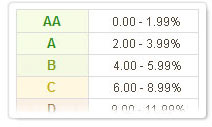
Prosper comes back to life, with SEC filing.
Finding Alpha: The Search for Alpha When Risk and Return Break Down (Wiley Finance) by Eric Falkenstein (Hardcover - Jun 29, 2009) is anticipated and now available.
The typical Amazon new vs used arbitrage occurs. New $56, vs used $103.
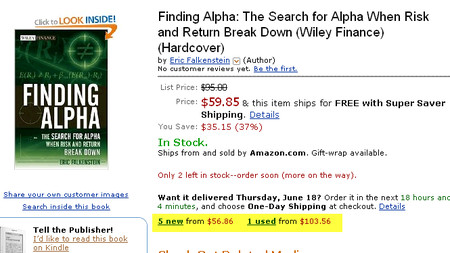
See previously Big Picture Barry Bailout Nation arbitrage.
Bernanke speaks:
1. How Did We Get Here? What caused our financial and economic system to break down to the extent it has?
2. What Is the Fed Doing to Address the Situation?
3. Does the Fed's Aggressive Response Risk Inflation Down the Road? Could the Fed's aggressive actions to stabilize the economy today lead to an inflation problem down the road?
4. Why Did the Fed and the Treasury Act to Prevent the Bankruptcy of Some Major Financial Firms? Why did the Fed and the Treasury act to prevent the bankruptcy of some major financial firms, such as the investment bank Bear Stearns and the insurance company American International Group, or AIG?
Continue reading "Bernanke: 4 questions (and 4 answers) on economic crisis" »
For years, managing a hedge fund, and making a fortune for yourself in the process, was the running dream on Wall Street. But now that industry, like much of finance, is withering. Many hedge fund investors are folding. Since last May, these funds' assets under management have dwindled to $964 billion from $1.4 trillion. The private equity business, one of the iconic businesses of the boom, is struggling with a deep slump of its own.
Most large banks have over $US 1 trillion assets under management.
Continue reading "Hedge funds industry shrinks to under $ trillion " »
I think it's wise to be wary of nationalization. It should be a last resort, and I've gotten a sense recently that a lot of people are talking about it awfully casually. Still, it's true that there are some benefits to nationalization, and one of them is that it allows us to avoid the problem of valuing and buying up toxic assets from troubled banks. If the government owns the whole bank, then the bad stuff can be easily hived off without any kind of valuation at all, and then left to sit for a while before it's sold off.
-- Kevin Drum
and gets comments like
First, from the perspective of national goals, the American financial and banking system has been a dismal failure, with real industries, most particularly capital goods, and public infrastructure, STARVED for funds for almost three decades now. Instead, the financial and banking system has supported ever increasing debt, and ever more complex derivatives based on that debt, none of which has done an iota of good for the real economy.
-- Tony Wikrent
The best way for the government to avoid the obvious outcome in such a situation is for the government to take over and run the bank: nationalization. Since the government has an interest in protecting its own liabilities, rather than maximizing shareholder value, the chances of crazy gambles will be minimized. In any case, since the government is taking virtually unlimited downside, it should by rights have all the upside as well -- i.e., ownership.
-- Felix Salmon
and gets some smart comments (David Merkel)
Debt-for equity cramdowns may not work in some cases because at larger banks the debt is usually at the holding company, and the bad assets are at the operating banks subsidiary. Better for the FDIC to force some sort of compromise where the operating subsidiary is made whole, while forcing holders of securities in the holding company (common, preferred, sub debt, sen debt) to face an uncertain future, while the healthy bank subsidiaries continue to operate.
Our biggest banks would identify their bad loans and foolish investments. And they would then pay a fee to a new state-backed insurer to protect themselves from losses over a certain level on these stinky assets.
.
But the banks would retain these bad assets on their balance sheets. They would not be transferred to a new toxic bank. We as taxpayers wouldn't own the stinky loans - though we would be liable for losses on them over a certain level
Finally, Eugene F. Fama has the clearest mind:
The FDIC may simply shut the failed bank, auction its assets, and use the proceeds to pay off depositors and other liability holders in order of priority. If the market value of the failed bank's assets is less than its insured deposits, the FDIC supplements the bank's assets to pay off the insured deposits. If the FDIC charges appropriate premiums for deposit insurance, the insurance is a fair game and does not produce losses for taxpayers, at least on average.
There are many variants of FDIC intervention, but they typically have one common property. They solve the debt overhang problem. Non-insured debtors are paid off only to the extent that the market value of the assets of a failed bank exceeds its insured deposit liabilities. This means that any new equity capital injected after the reorganization increases the market value of assets and the market value of equity capital dollar for dollar.
If you were doing business with Morgan Stanley, your ability to short the stock was a hedge. Say there had been a short-sale ban, or an uptick rule making it hard to short What else might you have done? Well, you might have severed your relationship with Morgan Stanley even faster, accelerating the run on the bank. Or you might have bid up CDS to even more dizzying heights. Or you might have stopped writing Morgan Stanley CDS, prompting others to de-risk in some other fashion.
Valued as a spinoff, but not operated as a spinoff ?
As financial innovations go, tracking stocks have been a bust for a decade and a half. Consider this: From 1984 to 1999, underwriters brought an average of more than 50 equity carve-outs to the Street each year. During that same time period, investment bankers launched a grand total of 23 trackers. That's it.
In a perfect world, things would have stayed that way. In our world, tracking stocks are suddenly popular. This is particularly true at old-economy companies, where managers now seem intent on setting up their new-economy operations as separately valued -- but not truly separate -- businesses. Credit Suisse First Boston, for one, has CSFBdirect for its online brokerage. Sprint has Sprint PCS, which is tied to its wireless business.
Bear Stearns: When was the building at 383 Madison Avenue at 47th worth more than the banking firm ?
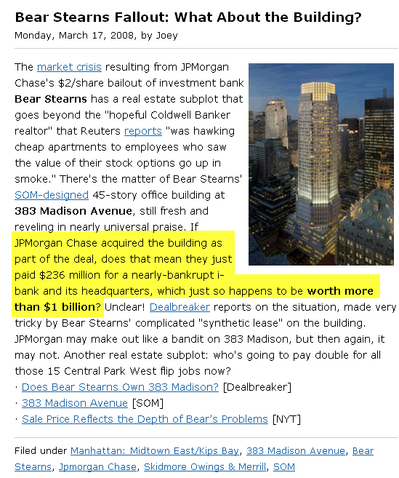
See also: Value of GM vs value of GM building.
As a banker, let me describe what we do wrong when we accept and review an application for a credit card. First, we don't verify income. The first 'C' of credit: Capacity to repay, is completely ignored by the banks, just as it was in when they approved subprime mortgages. Then we ask for "household income" -- as if other parties in the household could be held responsible for that debt. They cannot. And since we don't ask for any proof of income, the customer can throw out any number they think will work for them. Then we ask if they rent or own and how much they pay. If their name is not on the mortgage, they can state zero. If they pay $1,000 in rent, they can say $500. (Years ago we asked for a copy of the lease to verify this number.) And finally, we don't ask how much of a credit line the consumer is looking for. The banker can't even put that amount into the system. There isn't any place on the application for that information. We simply put unverified information into a mindless computer and the computer gets the person's credit score and grants them the biggest line that score and income (ha!) qualifies for.
Joe Nocera finds the Tanta of credit cards.
"Kent Hance was a down-home boy, real homey, and George W. wasn't homey like Kent," recalled Johnnye Davis, a Republican leader in Odessa. "He didn't come across to the voters as well as Kent did, with the little jokes that Kent told."
While Mr. Bush now is sometimes mocked for an ignorance of policy details, back then people thought he had the opposite problem: a tendency to drop references in his speeches that baffled audiences, like a discussion of anti-inflationary economic policy.
"He was quick, a bit too quick, so that people didn't always get it," Mrs. Davis said. "He was so darn intelligent that a lot of what he said went over people's heads. He's learned to explain things a little better since then."
Another problem was that while Mr. Bush never really had a clear campaign strategy, Mr. Hance did: he focused his campaign on emphasizing local ties and on casting Mr. Bush as a carpet-bagger from the East. One of Mr. Hance's most effective radio spots was this one, read by an announcer:
"In 1961, when Kent Hance graduated from Dimmitt High School in the 19th congressional district, his opponent George W. Bush was attending Andover Academy in Massachusetts. In 1965, when Kent Hance graduated from Texas Tech, his opponent was at Yale University. And while Kent Hance graduated from University of Texas Law School, his opponent" -- the announcer's voice plunged -- "get this, folks, was attending Harvard. We don't need someone from the Northeast telling us what our problems are."
Continue reading "Bush in 1978: before playing country cowboy" »
In 2006, the question was the canary in the coal mine question, 'Will the subprime mortgage industry meltdown, and would the meltdown spill over to other financial sectors ? '
In 2007, the question became, 'What started the meltdown ?'. Chris Whalen has an excellent summary of what we know in autumn 2007.
For securities, this brings us to the three categories of investments; Levels 1, 2 and 3. Here's a guide:
Current Name; Level 1
Prior Name; Trading Securities
English Translation; We're selling now
Valuation (exit); Market value, probably on an exchange
Current Name; Level 2
Prior Name; Available for Sale
English Translation; We're selling if the price is right
Valuation; Market value, preferably on an exchange
Current Name; Level 3
Prior Name; Held to Maturity
English Translation; We're not selling
Valuation; Cost, unless the loss is "other than temporary".
Do you see a trend in valuations? It's ALL exit value. It's all based on intent. The reason we don't time value discount Level 1 and 2 securities is because the cash conversion is projected to happen now (or soon enough).
Continue reading "Level 1, 2, 3: for sale on the market ?" »
ETF Connect reports on exchange traded funds.
Index Exchange-Traded Funds (ETFs) and Closed-End ETFs (CEFs) feature
intra-day trading and stock exchange listing. They rapidly are changing
the way many financial advisors and investors manage their portfolios.
Index ETFs, including SPDRs, Diamonds and HOLDRS.
Closed-End ETFs, including municipal bond and country funds.
Bronte Capital on Wachovia's quest for deposits and on WaMu 'this is not a credit driven crisis. It's a funding driven crisis'.
Aleph blog explains covered bonds, proposed to save the mortgage market.
It is not a passthrough, it is a bond. The covered bond buyers do not receive the principal and interest from the security held by the bank, the bank receives it. The covered bondholder (in absence of default) receives timely payment of interest at the stated rate, and principal at maturity. Only in default does the value of the security for collateral matter. If the collateral is insufficient to pay off principal and interest, the covered bondholders are general creditors for the difference.
The RC-C section in a FDIC CALL report shows loans secured by
real estate. Manually add up the various detail lines in RC-C,
subheading 1, to get the totals.
Total Assets - $2.118B
(RC-C.1) Loans secured by real estate $1.360B ( 64.2% )
Where does one get the RC-C.1 data?
Each bank submits CALL data to the FDIC on a quarterly basis.
The data usually becomes available 15-30 days after the quarter
ends.
Search for banks and download/view as PDF data at the FDIC
Institution Directory.
[Via CR/Comments]
Interest Rate Risk Monitor by James Baker
obsesses about bonds and interest rates.
And from the bond glossary:
Bond-Equivalent Effective Margin (BEEM): The average spread of an adjustable
rate security over the underlying index for the life of the instrument.
BEEM assumes the index remains constant and the coupon of the security
completely resets to the index over time, taking into account all caps, collars
and floors.
REMIC (Real Estate Mortgage Investment Conduit): A tax treatment introduced
by the 1986 Tax Reform Act for multi-class mortgage-backed securities such
as CMOs, Strips and senior/subordinated pass-throughs. An objective of the
REMIC legislation was to permit issuers to assume a more streamlined legal
form than that of the owners trust under which most CMOs had previously
been issued. Issuers have the option to elect REMIC tax treatment until 1992,
when REMIC tax treatment becomes mandatory. REMIC treatment identifies
the securities created as one or more "regular" interests and a single "residual"
interest. In market parlance, the term REMIC is used to refer to a structured
mortgage-backed security electing REMIC status. More loosely, it is used
interchangeably with CMO.
Chris Whalen @ PRMIA, (archives).
Example:
There is nothing you can do to "fix" a CDO, to make it liquid,
other than to standardize the terms and trade it on an exchange.
The liquidity gridlock prevailing in the secondary market for CDOs
is the normal situation for such unique and entirely opaque
instruments, whereas the past illusion of liquidity was abnormal,
a byproduct of the "irrational exuberance" described by Greenspan
himself. Buy Side investors accepted the fallacy of liquidity -- until
they asked the Sell Side dealers to bid on the paper. That's when
the current trouble really began.
The history is that lenders move in great caravans between two
extreme points, which we can call stringency and accommodation.
-- James Grant, the editor of Grant's Interest Rate Observer.
Continue reading "Lending money: stringency and accommodation" »
capitaliq corporate data: credit review.
epicureandealmaker on fat tails.
Derivatives: Transfering risk or reducing risk ?
Review Paper. Interest-rate term-structure pricing models: a review
Riccardo Rebonato
Interest-rate term structure modelling from the early short-rate-based
models to the current developments; use models for pricing complex
derivatives or for relative-value option trading. Therefore, relative-pricing
models are given a greater emphasis than equilibrium models.
The current state of modelling owes a lot to how models have
historically developed in the industry, and stresses the importance
of 'technological' developments (such as faster computers or more
efficient Monte Carlo techniques) in guiding the direction of theoretical
research.
The importance of the joint practices of vega hedging and daily
model-recalibration is analysed in detail. The relevance of market
incompleteness and of the possible informational inefficiency of
derivatives markets for calibration and pricing is also discussed.
Continue reading "Interest-rate term-structure pricing models: Riccardo Rebonato" »
Accrued Interest aka accruedint, smart about finance and economics.
Why Home Depot should borrow more.
Way of The Turtle, by Curtis Faith.
Relatively simple trading systems can provide a
tradable edge, but it is psychologically difficult
for traders to follow these systems and exploit
that edge.

Recommended via Traderfeed Brett and Abnornal.
Prosper now enjoys some powerfu tools.
regression analysis forum
adverse selection says avoid the high rate borrowers.
Money Walks journal of patterns in data, performance.
Erics great survey or lenders: oustandings, return
Prosper Analytics animated charts, not quite chart junk. ROI.
P2P conventional loan analytics.
Prosper's own loan performance database.
The Politico tracks Washington-centric partisan politics,
by ex-Washington Post staffers at Capitol Leader.
it would seem that a sequence of price declines continuing for
many years has some substantial probability of happening.
Traditional finance theory has trouble reconciling even a semi-predictable
sequence of price declines with basic notions of market efficiency. The
situation we are facing is a reminder of the glaring inefficiencies and
incompleteness of existing markets for residential real estate, and
may be regarded as evidence that institutional changes will be coming
in future years to fundamentally change the nature of these markets.
Things That Go Boom
By ROBERT J. SHILLER
February 8, 2007; Page A15
AllAboutAlpha, example:
value premium, value pricing.
return = alpha + beta * (market return)
Housingderivatives tracks futures and options in housing prices.
Moody's Commercial Mortgage Metrics (Moody's CMM)
Commercial Mortgage Metrics from Moody’s and TWR,
the leading source for commercial real estate performance
and valuation forecasting.
Risk Measures provided by CMM:
Probability of Default,
Loss Given Default,
Expected Loss,
Value at Risk,
Yield Degradation,
Risk Adjusted Yield,
Distance to Default.
Hayre L.S., Chaudary S. et Young R.A. : "Anatomy of prepayments",
Journal of Fixed Income, 10, 2000. [PDF]
The paper is actually in chapter 4 of Hayre's book:
SSB's guide to MBS and ABS.
The fun is tranching pools of mortgages into different securities.
You take a package of mortgages, preferably from different areas
of the country, and then you create different tranches with
different credit qualities, and then one zero coupon that bears
all the residual risk.
The first tranch, naturally, gets all the guarenteed income stream
(mortgage payments) and bears *no* (or actaully, very little)
prepayment risk (it is good to maturity).
The next tranch gets income stream, and bears some prepayment
risk (if there are a lot of prepayments, it gets a swath if the other
tranches are fully repaid), and on down the line.
The last tranch before the zero gets income, but bears risk
if the income falls short (mortgages default), and also bears
*the most* risk for prepayment (it has a call option owned
by the mortgage holders, they can repay the loan if the
interest rate changes). If you own this last tranch, you have
lots of duration and gamma risk, whereas if you own the
first tranch you have a very different profile.
The 'residual zero' tranch is practically binary.
Either it pays off, or it defaults and gets the (last) bit of
recovery value in liquidation. Lots of folks use equity
models to calculate expected return on these.
Freddie and Fannie do this, but also Morgan Stanley and Goldman.
If you want to play, you can call them and they can cobble toghether
a structured deal that will match pretty much any flavor you want.
Some of their customers are developers who are highly exposed
to one geographic area (say, Toll Brothers) and need hedging.
A good intro book is Collateralized Mortgage Obligations
by Chuck Ramsey and Frank Fabozzi. It goes beyond CMOs and
talks about a lot of the risk horizons and what traders of these
do and play with. Lots of former interest rate traders apparently
do well in this field.

As far as point three: you are talking 'real options' theory here,
and you have to look for a lot of asset value delta to overcome
the (identified) barriers to exit and entry and transactions costs.
I have yet to see a good book on the real options of real estate,
but the ones that come close deal with mineral rights and land
and mostly were developed for energy exploration. Not really
'commercial' or 'residential' real options.
allaboutalpha, another investment and finance strategy journal
where Alpha Male opines about portabe alpha.
financialrounds, an east coast finance
Professor.
Example: Scams.
Financial Rounds recommends Eastern Finance Association's
Meetings.
Carried Interest examines PIPE: private investment in public equity.
A PIPE is an alternative available to publicly traded companies that
need to raise money but don't want to go through the complexity
of selling shares through a secondary offering. Instead, the company
finds an investor and sells him a block of newly issued shares at an
agreed price or a block of debt which can later be converted into
shares (a structured PIPE).
Tightening aimed (indirectly, of course!) at asset bubbles will be
reversed, big time, if and when those bubbles pop.
This is the Greenspan Put !
-- Paul McCulley.
Seeking Alpha neatly ontologized money science into
* Exchange-Traded Funds (ETFs)
* Market Commentary
* China Investing
* Media Investing
* Digital Media Investing
* Stock Market Blogs
* Economics Blogs
* Venture Capital Blogs
* Personal Finance Blogs
and brings me Herb Morgan, Chief Investment Officer of Efficient Market
Advisors, on The Problem With Vanguard ETFs.
LIBOR (London Inter-Bank Offered Rate) is based on rates that
contributor banks in London offer each other for inter-bank
deposits.
From a bank's perspective, deposits are simply funds that are
loaned to them. So in effect, a LIBOR is a rate at which a
fellow London bank can borrow money from other banks. Rate
calculations incorporate variables such as time, maturity
and currency rates. There are hundreds of LIBOR rates reported
each month in numerous currencies.
Examples: the 1 Year LIBOR as published monthly by Fannie
Mae: rate history.
Macroeconomic variables besides inflation and real activity drive the
yield curve in the framework of no-arbitrage affine term structure
models. We construct model-based projection of all the latent factors
onto the observable macro factors, which are real activity and
inflation.
As a result, the factors are decomposed into the “macro” part: a
linear function of the macro variables and their lags; and the truly
novel part which is orthogonal to the entire history of the macro
variables. We are able to relate the unexplained part of the short
rate to such measures of liquidity as the AAA credit spread and MZM
growth rate. The unexplained part of the slope is highly correlated
with the budget deficit.
Continue reading "Macroeconomic determinants of the yield curve" »
Financial Rounds on how to argue gently *.
See also Suzette Haden Elgin ...
FR visits the FMA and finds another golden oldie: NotN.
Continue reading "Financial Rounds: Academics argue gently" »
Buy a fund of funds or a hedge fund index ?
Measure risk with more than Sharpe ratio and multi-factor models.
edhec-risk reports research on investment alternatives.
Indexes and benchmarking
Multi-style multi-class risk allocation
Style and Performance analysis.
With very Germanic style:
Unique Access to all Information
Edhec-risk.com offers a unique access to all information appearing in
the different sections and archives. The information is accessed using
a search engine which generates both the key words and the content of
available documents. All the information available on the site is
accessible in relation to the key themes that correspond to the
Centre’s research programmes.
Conceived in 1949 by Alfred Winslow Jones, then an editor at Fortune
magazine, a hedge fund hedged its bets by taking "long" positions on
undervalued stock and "short" positions on overvalued stocks. The idea
was to be smart and nimble and bold, and to make oversized returns.
In the last decade, however, hedge fund companies have started to
resemble mutual fund companies: big, plodding institutions for
pensioners. Fewer and fewer hedge funds are now making impressive
returns for their investors. In the 10 years through April 1995,
according to the HFRI Fund Weighted Composite Index, the typical
hedge fund has only just managed to beat the S.& P. 500 Index, with
an average annual return of 11.97 percent compared with 10.26 percent
for the S.& P. 500. In other words, the Wild West has become a
suburban community, where managers ride golf carts instead of bucking
broncos.
What happened? For one thing, the amount of money invested in hedge
funds has doubled in the last five years, to $1 trillion. It's hard to
find creative places to park that much money. Besides, no special
skills are needed to create a hedge fund - that's why everyone and his
uncle know somebody who's starting one. Investors are partly to blame.
They love the glamour of investing in hedge funds, but, at the same
time, they can't tolerate risk. Most investors can't tolerate even a
month of losses.
The real problem with hedge funds may be the managers themselves:
they're earning too much money. It's almost vulgar. In the past, hedge
funds were paid 1 percent of assets under management, plus 20 percent
of that year's return. Recently, even as their performance has sagged,
more and more hedge funds have increased their fees to 2 percent of
assets under management - plus 20 percent of returns. To make big
money for themselves, hedge fund managers don't have to make big
returns; they just need to hold on to their pool of clients.
Glyn Holton's Risk Glossary explains common terms such as capital asset
pricing model (CAPM).
One of the most interesting ways to trade implied volatility (long)
is to buy forward starting out of the money calls on S&P500. At some
shops you can get decent pricing and better deal than the vol swap
market offers.
Since the option is forward starting it does not have any time decay
until the strike is set at a "strike date". At strike date the option
turns into a regular european call, which you can sell or dynamically
manage.
This strategy works like a call on volatility in the sense that vega
is convex. The skew and liquidity is a risk factor so I wouldn't got
that far out of the money.
In a way, hedge funds are to mutual funds what Evel Knievel was to
weekend motorcyclists. Unlike mutual funds, which are restricted in the
ways they can invest, hedge funds can use leverage, trade derivatives
and bet that stocks will fall, a technique called shorting. And unlike
mutual funds, which generally try to beat a market average, hedge funds
seek positive returns, even in down markets.
In 2003, the 25 highest-paid hedge fund managers earned more than $200
million, on average, according to a survey by Institutional Investor
magazine. The top-ranked manager, George Soros, took home $750 million
that year. At No. 2 was David Tepper, manager of the $3 billion
Appaloosa funds, who earned $510 million, according to the magazine.
Riskmetrics journals and old (1999-2002) Working Papers.
Torto Wheaton Research (TWR) studies commercial real estate.
Their Debt Risk Management has a nice list of features. See also
Portfolio strategy and misc research desk.
PRMIA guide [PDF] prepares you for the Professional Risk Manager (PRM) exam.
Hedge Week newsletter. See also Hedgefund News.
IAFE: International Association of Financial Engineers
The IAFE is the professional society dedicated to fostering the
profession of quantitative finance by providing platforms for the
discussion of cutting-edge and pivotal issues in the field. Founded in
1992, the IAFE is composed of individual academics and practitioners
from banks, broker dealers, hedge funds, pension funds, asset
management firms, technology firms, regulatory bodies, accounting,
consulting and law firms, and universities across the globe. Through
frank discussions of current policy issues, hosting programs to
educate the finance community, and recognizing the outstanding
achievements in the field, the IAFE acts as a beacon for the
development of quantitative finance.
Throughout its history, the IAFE's pre-eminent leadership has
positioned us to respond with savvy to the evolving needs of the
financial engineering community. The IAFE's programs – from our
area-specific committees to our evening forums to the Financial
Engineer of the Year Award – are designed to provide our membership
with uniquely valuable activities to enhance their work in the field.
What is Financial Engineering ?
Financial engineering involves the development and creative
application of financial theory and financial instruments to structure
solutions to complex financial problems and to exploit financial
opportunities. Financial engineering is not a tool. It is a profession
that uses tools, of which derivatives are one. Importantly, financial
engineering differs from financial analysis. The term “analysis” means
to “decompose in order to understand.” The term “engineering” means to
“build.”
Money words investing and finance glossary.
Example: Bulge Bracket
Two approaches to examine the accuracy of default probability forecasts
for different rating grades and in particular, the respective
advantages and disadvantages of the two methods. Also, the effect of
independence assumptions is taken into account by modelling latent
variables like the asset correlation and dependency in time. Both
tests, the Extended Traffic Light Approach as well as an ad hoc normal
test work on time-varying default probability forecasts. They are
considered with respect to their practical use and potential
application in validating default forecasts in credit institutions.
Continue reading "Validating Default Probabilities on Short Time Series" »
Credit risk is the distribution of financial losses due to unexpected
changes in the credit quality of a counterparty in a financial
agreement. Structural, reduced form and incomplete information
estimate joint default probabilities and prices of credit sensitive
securities.
Continue reading "Credit Risk Modeling and Valuation: An Introduction" »
The determinants of regulatory capital (the minimum required by
regulation) and economic capital (the capital that shareholders would
choose in absence of regulation) in the context of the single risk
factor model that underlies the New Basel Capital Accord (Basel II)
do not depend on the same set of variables and do not react in the
same way to changes in their common determinants.
For plausible parameter values, they are both increasing in the
loans’ probability of default and loss given default, but variables
that affect economic but not regulatory capital, such as the
intermediation margin and the cost of capital, can move them
significantly apart. The results also show that market discipline,
proxied by the coverage of deposit insurance, increases economic
capital, although the effect is generally small.
Continue reading "Economic and Regulatory Capital What is the Difference ?" »
| Interest rate modelling for practical implication: Interest Rate Models by Damiano Brigo and Fabio Mercurio. |
 |
For a clear and conicse treatment we also suggest you Antoon Pelsser's Efficient Methods for Valuing Interest Rate Derivatives which is extremely interesting. |  |
Probability of Default (PD)
- the probability that a specific customer will default
within the next 12 months.
Loss Given Default (LGD)
- the percentage of each credit facility that will be lost
if the customer defaults.
Exposure at Default (EAD)
- the expected exposure for each credit facility in the
event of a default.
401k planning contributions and investing for retirement: now.
Surveys on the use of agency credit ratings reveal that some
investors believe that rating agencies are relatively slow in
adjusting their ratings. A well-accepted explanation for this
perception on the timeliness of ratings is the "through-the-cycle"
methodology that agencies use. According to Moody's, through-the-cycle
ratings are stable because they are intended to measure the risk of
default risk over long investment horizons, and because they are
changed only when agencies are confident that observed changes in a
company's risk profile are likely to be permanent. To verify this
explanation, we quantify the impact of the long-term default horizon
and the prudent migration policy on rating stability from the
perspective of an investor - with no desire for rating stability. This
is done by benchmarking agency ratings with a financial ratio-based
(credit scoring) agency-rating prediction model and (credit scoring)
default-prediction models of various time horizons. We also examine
rating migration practices. Final result is a better quantitative
understanding of the through-the-cycle methodology.
By varying the time horizon in the estimation of default-prediction
models, we search for a best match with the agency-rating prediction
model. Consistent with the agencies' stated objectives, we conclude
that agency ratings are focused on the long term. In contrast to
one-year default prediction models, agency ratings place less weight
on short-term indicators of credit quality.
We also demonstrate that the focus of agencies on long investment
horizons explains only part of the relative stability of agency
ratings. The other aspect of through-the-cycle rating methodology -
agency rating-migration policy - is an even more important factor
underlying the stability of agency ratings. We find that rating
migrations are triggered when the difference between the actual agency
rating and the model predicted rating exceeds a certain threshold
level. When rating migrations are triggered, agencies adjust their
ratings only partially, consistent with the known serial dependency of
agency rating migrations.
Continue reading "How Ratings Agencies Achieve Rating Stability" »
Banks must measure the loss arising from counterparty default in order
to achieve Advanced-IRB compliance under the proposed Basel II minimum
regulatory capital framework. Which discount rate to use on cash
received post-default is a question that is the subject of
considerable disagreement amongst practitioners and banking
supervisors. We review alternative extant proposals and develop a new
method for choosing an appropriate discount rate contingent upon the
risk of the recovery cash flow. An example of how supervisory
determined LGD discount rates could be set is demonstrated.
Empirically, the required rate of return on defaulted corporate bonds
is shown to be similar in magnitude to the yield on BB rated debt. For
defaulted small and medium enterprise (SME) bank loans, the mean
discount rate is found to be similar, on average to the contract rate
pertaining at the time of default.
Continue reading "Discount Factor for Estimating Economic LGD" »
ETFs are shares of a basket of stocks bought and sold as a single
investment. Investment companies create these stocks by buying the
underlying stocks and issuing ETF shares. Unlike mutual funds whose
price is set once per day, ETFs trade on stock exchanges at
constantly changing market prices. This prevents market timers
getting preferential prices like the recent mutual fund scandals.
Very large investors can issue new shares or redeem their shares for
the underlying stocks. This keeps the ETF price close in price to the
underlying shares. ETFs do not trade at sizable discounts or
surpluses to the underlying stocks like closed end mutual funds. If
the ETFs begin to trade with any significant discount or surplus,
large investors will issue new shares or redeem their shares to
eliminate the discount or surplus.
Global Forex Trading offers DealBook® FX 2 'powerful online
currency trading' tool that provides you with instant access
to the forex market.
PRMIA's risk news.
Week In Risk is published every Friday by Risk Communications.
It is (was ?) distributed by PRMIA, the Professional Risk Managers
International Association.
Prediction Markets
We analyze the extent to which simple markets can be used to aggregate
disperse information into efficient forecasts of uncertain future
events. Drawing together data from a range of prediction contexts, we
show that market-generated forecasts are typically fairly accurate,
and that they outperform most moderately sophisticated benchmarks.
Carefully designed contracts can yield insight into the market's
expectations about probabilities, means and medians, and also
uncertainty about these parameters. Moreover, conditional markets can
effectively reveal the market's beliefs about regression coefficients,
although we still have the usual problem of disentangling correlation
from causation. We discuss a number of market design issues and
highlight domains in which prediction markets are most likely to be
useful.
Justin Wolfers (Stanford University)
Continue reading "Market-generated forecasts are typically accurate" »
Understanding Credit Spread Markets
I describe results of empirical studies of historical spreads in the
corporate bond market and show how spread changes, regardless of
credit rating, are largely determined by a single common variable. In
addition, I calculate the component of corporate credit spreads due to
default probability and report analyses of the residual spreads as
functions of credit quality and duration.
Analysis of spread changes for other spread markets (e.g.
asset-backeds, emerging markets, etc.) reveal a large, but smaller,
degree of spread co-movement across sectors and indicate that sector
spreads trend and mean revert on roughly similar time scales. That is,
spread changes trend in the short term (under two years) and
mean-revert over longer periods.
That information, along with the CAPM and our strategists' monthly
outlooks, was used to construct a cross-sector asset allocation model
that consistently outperformed a benchmark portfolio in ten years of
out-of-sample testing.
Terry Benzschawel (Citigroup Global Markets)
Continue reading "Credit Spread determined by a single common variable" »
As the director of risk analysis for the Office of the Comptroller of
the Currency, Jeffrey Brown spends most of his time reviewing how
banks use credit scoring and other risk-management tools. [1]
Credit scoring has revolutionized lending, but critics worry
institutions are pushing this technology beyond its limits.
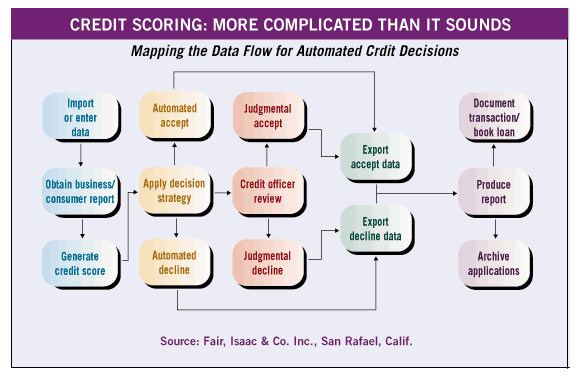
Probably the biggest eye-catcher is iShares FTSE/Xinhua China 25
Index Fund (FXI) — the first ETF investing solely in China
available to U.S. investors. Launched earlier this month,
the ETF tracks the 25 largest and most liquid Chinese stocks.
Of course, there's increasing talk of China's red-hot economy
cooling, but few expect the growth spigot to be shut entirely.
The China 25 Index Fund's expense ratio of 0.74% is higher
than that of most ETFs, but it's substantially lower than the
average China-region mutual fund's expense ratio of 2.37%,
according to Lipper. ETFs, by nature, carry lower expense ratios
than their mutual-fund counterparts. [1]
Standard and Poors index tracker.
FX FXStreet Foreign Exchange Currency news on trading and trends.
The VIX takes the weighted average of implied volatility for the
Standard and Poor's 100 Index (OEX calls and puts) and measures the
volatility of the market. A low VIX indicates trader confidence. A
high Vix the opposite. Dividing the S&P 500 by the Vix (ratio) gives
the confidence level in relation to the market. The higher the ratio
the higher the confidence.
How much do you need to know to pass the CFA ? Here is some
advice for Chartered Financial Analyst aspirants.
They do not mean - have a general idea or sense of the material
or be able to pick the concept out of a lineup based on your
initial impression or cued recall.
They do mean Very quickly, relative to similar concepts and
formulas, distingush and differentiate the key concepts, recall
the special exceptions or impacts that the concept had on other
concepts, be able to calculate forward and back into or out of
the relevant formula, and finally (the test taking part) be able
to quickly pick out the imbedded error or limiting factor in each
the accompanying 'wrong' answers among the choices presented so
that you can pick that which is least or most likely to conform
to the issue or question presented.
See also CFA, FRM communities.
Post exam gossip is taken to a new level when people around the
world share a common exam, and share it on web forums. Let the
CFA candidates second guess until exam results are posted.
Hedgefund.net has hedgefund news. See also
Hedge-Fund Manager vs Investment Bankers in the
New York Wiki and Hedge Week.
Dominant Score Cutoff Strategies
The purpose of this research is to develop new results for
(1) the equivalence of statistical, business and economic
dominance in risk scoring,
(2) dominant risk scoring strategies in the presence of
non-dominant scores, and
(3) the effect of Bayesian score combination on dominant
risk scoring strategies.
One can show that there is ROC dominance if and only if there
is dominance of expected profits or efficient frontiers that
involve different business measures such as profit/volume
tradeoffs. If there is no such dominance, an intersection of
the ROC curves for two different scores nevertheless yields
a dominant strategy for use of the different scorecards and
the cutoffs. Finally, we show that a Bayesian combination of
the two scores leads to a dominant ROC curve with a single
dominant strategy.
*.
Mathematica 5.1 is coming real soon.
ArrayPlot for flexible large-scale array visualization.
Integrates over regions:
* Regions defined by multivariate polynomial inequalities
* Problems over transcendental regions (where solvable)
* Integrable regions involving infinite ranges
* Undefined parameters in the region specification (solutions are
generated for all possible values)
EquationTrekker explores and interacting with the solutions of ordinary
differential equations (ODEs) is included with Mathematica 5.1.
Among other capabilities, it provides an easy way to investigate
dynamical systems properties, phase spaces, and Poincaré sections.
See also comp.soft-sys.math.mathematica Mathematica
newsgroup at googlegroups.