According to the RAND report, a quick, pre-emptive attack on an emerging fire could save $3.3 million, on average. Thus, it said, spending more on firefighting planes could save money over all.
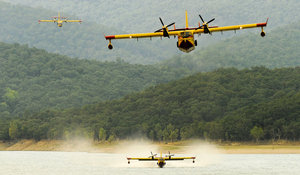
Edward G. Keating, an economist who was the study's lead author, said some government agencies leased the scooper planes for $1.5 million to $2.5 million per season; depending on estimates of the destructiveness of fires and the effectiveness of air tankers, it might save money to use up to 55 of them, the study said.
But the Forest Service, which relies on older tanker planes that must land at an airport and be refilled by pumper trucks and which uses only a handful of scoopers, said the RAND study was wrong. The skimmer planes mostly drop water or foam, when often what is needed is fire retardant, said Thomas L. Tidwell, the chief of the Forest Service. And, he said, "they're underestimating the cost of scoopers and overestimating the cost of tankers."
Congress is considering a plan submitted by the Forest Service this year to buy C-130J air tankers, a variant of the Pentagon's cargo plane, but those could cost $85 million to $90 million each once refitted to carry fire retardant, government officials say.
The new study and the Forest Service's response highlight fundamental disagreements about how to fight fires. The study, for example, noted a "dearth of statistical evidence" about the effectiveness of using air tanker drops on already large fires. It used a term sometimes used by firefighters, who refer to "CNN drops," high-visibility efforts that give the impression of a strong government response.
The study also acknowledged uncertainties about the relative value of water, which is cheap and widely available, and retardant. Some of the water will blow off target or evaporate on the way down, and it will not last long on the ground, so dumping it in the path of a fire may not be effective. (Aircraft do not usually put out fires; they slow them down so workers on the ground can extinguish them or establish a firebreak around them.)
"Often when we're having these large fires, the relative humidity is in the single digits," Mr. Tidwell said, and what reaches the ground may be "just a real light sprinkling."
The retardant, which is denser and does not evaporate, can penetrate the canopy of leaves if the fire is in a wooded area, experts say, and can be dropped from a higher altitude, reducing risks.
Mr. Keating, the study's lead author, said such operations would be dangerous even with newer equipment. "There are extremely irregular wind currents because of the heat coming off the fire," he said. "You're at high elevation and low altitude in irregular terrain," close to the ground in mountainous areas, "and, oh, by the way, it's on fire." In some crashes, pilots may have become lost in the smoke.
But the RAND study argues that more frequent drops of water may be more effective. A scooper plane, which flies about 100 miles an hour over a river or lake and lowers a small scoop to skim off hundreds of gallons in a few seconds, can manage 60 loads a day if the water is convenient. That may be 10 times the capability of a plane dropping retardant. Two-thirds of the fires fought by the Forest Service are within 10 miles of a suitable body of water, the study said, and fires near towns are even more likely to be near water.
Another goal is to spot emerging fires that can be stopped by dropping water or retardant and focus on those, a challenge that the study called "dispatch prescience." Some firefighting assets, including helicopters, move so slowly that positioning them in places where they are most likely to be needed is an important step.
Firefighting strategy has other complications. Some environmental experts worry that scooper planes, or helicopters that lower buckets to collect water, could spread exotic mussels that contaminate rivers or lakes. And in some places, planes dump saltwater on the soil.
The Forest Service contracts for a variety of aircraft, mostly converted antisubmarine warplanes from the middle of the last century. At times it has used the Bombardier 415, a Canadian plane designed to fight fires. The plane can land on water, but refills its tanks, totaling 1,600 gallons, by skimming water off the surface in a fast pass.
A California company, International Emergency Services, has been trying to market a Russian plane that holds 3,000 gallons. This year, the company flew two Forest Service engineers to Russia to evaluate the plane, the BE-200. David Baskett, the president of International Emergency Services, offered to bring the plane to the United States for a "flyoff," but, he said, the Forest Service has not responded.
Continue reading "Fighting forest fires from airplanes" »