Main

December 22, 2009

Light rail of Tempe, Arizona

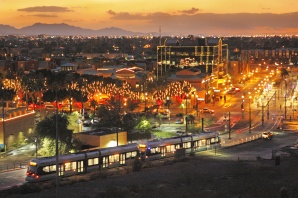
The silver and teal trains that light up the bridge over Town Lake, swish through downtown, sound their bells near campus and travel along Apache Boulevard have become part of Tempe's identity.

Metro light rail has changed the landscape of the city since service began last Dec. 27. As the transit system marks its first year of operations Sunday, Tempe is celebrating the successes.


tempe_lightrail_train_PHP4B32E6D0A4073.jpg


People driving from the West and East Valley to get to the nearest light-rail station made the Phoenix and Mesa end-of-the line stops the most popular of the 28 stations. But Tempe's station near University Drive and Rural Road is on track to be the third most frequented stop. Students and faculty using that station and others hubs near Arizona State University account for a bulk of light-rail riders.

An ASU study released earlier this year also showed Tempe's land value near rail stations had increased at a greater rate compared to Phoenix and Mesa.

Continue reading "Light rail of Tempe, Arizona" »

December 14, 2009

Pocket parks


Pocket parks -- also known as miniparks and vest-pocket parks -- are small patches of landscaped nature generally built on vacant building lots or scraps of city land that fall between the cracks of real estate interests.

Jacob Riis, the urban reformer, is credited with inventing the pocket-park concept in 1897, when he served as the secretary of a city committee on small parks. The committee issued a statement declaring that "any unused corner, triangle or vacant lot kept off the market by litigation or otherwise may serve this purpose well." Though turn-of-the-last-century New York was filled with spaces that fit the bill, Riis's idea went largely unrealized until after World War II, when bombed-out building sites in European cities provided opportunities to create small parks at less cost than reconstruction would have entailed.

Mr. Hoving may have seen parallels between New York's crumbling urban landscape and Europe's war-ravaged capitals when he started his micro-park effort in 1966. That year, he identified 378 vacant lots and 346 abandoned buildings in Bedford-Stuyvesant alone.

Continue reading "Pocket parks" »

October 17, 2009

Whitopian migration results from tempting pulls as much as alarming pushes

When those pop-up lists beckon you from your Web browser ("Retire in Style: Fifteen Hotspots!"), or those snappy guidebooks flirt with you from the bookstore shelves (America's 25 Best Places to Live!), ever notice how white they are?
Whitopian migration results from tempting pulls as much as alarming pushes. The places luring so many white Americans are revealing. The five towns posting the largest white growth rates between 2000 and 2004 -- St. George, Utah; Coeur d'Alene, Idaho; Bend, Oregon; Prescott, Arizona; and Greeley, Colorado -- were already overwhelmingly white. Certainly whiter than the places that new arrivals left behind and whiter than the country in general. We know why white folks are pushed from big cites and their inner-ring suburbs. The Whitopian pull includes economic opportunity, more house for your dollar, a yearning for the countryside, and a nostalgic charm.

Most whites are not drawn to a place explicitly because it teems with other white people. Rather, the place's very whiteness implies other perceived qualities. Americans associate a homogeneous white neighborhood with higher property values, friendliness, orderliness, cleanliness, safety, and comfort. These seemingly race-neutral qualities are subconsciously inseparable from race and class in many whites' minds. Race is often used as a proxy for those neighborhood traits. And, if a neighborhood is known to have those traits, many whites presume -- without giving it a thought -- that the neighborhood will be majority white.

Searching for Whitopia: An Improbable Journey to the Heart of White America (Hardcover)
by Rich Benjamin (Author)

October 6, 2009

Hovnanian on cheap design

Even among competitors, he gained a reputation as a builder of bare-bones homes who kept prices low. In the early 1980s, for example, the typical Hovnanian condominium residence was a two-bedroom, two-bathroom dwelling that cost about $30,000. In his developments, Mr. Hovnanian kept prices down by omitting the amenities, like swimming pools and community buildings, that other builders used to attract buyers.

"There are limited recreation facilities going in because people have little time for socialization," Mr. Hovnanian told The New York Times in 1983, explaining his philosophy.

By 1989, his company had sold more than 30,000 condominiums and other residences in states stretching from New Hampshire to Florida. The projects were so popular that they sometimes sold out over a weekend. Mr. Hovnanian also operated a finance company that made loans to buyers, who sometimes bought more than one residence, including some as investments.

Since then, the company has built more than 200,000 other homes. And in recent years, it has expanded its portfolio to include the construction of medium-price homes, luxury homes and retirement communities with recreational facilities.

Continue reading "Hovnanian on cheap design" »

October 4, 2009

Low-income housing in New Orleans stokes long-simmering tensions

James Perry, executive director of the housing center and a candidate for mayor of New Orleans, said class animosity might be at the root of much of this anger, though discrimination against the poor is not a violation of the Fair Housing Act. It is illegal to discriminate against minorities, however, and given that a disproportionate number of those who need affordable housing in the area are black, he said, these arguments almost inevitably involve race.

Continue reading "Low-income housing in New Orleans stokes long-simmering tensions" »

September 12, 2009

New Canaan: Concentric larger, smaller lots sized ring the transact

The 22-square-mile town of New Canaan, CT, has concentric circles of one-third-, one-half-, one- and two-acre lots, capped by a swath of homes on four acres or more. About 1,200 apartments and condominiums mingle with roughly 6,000 single-family homes.

Continue reading "New Canaan: Concentric larger, smaller lots sized ring the transact" »

August 16, 2009

Texting while walking: dangerous at any age

We've all heard that driving and texting is dangerous, but Dr. Milteer (Dr. Regina M. Milteer, a pediatrician in Fairfax, Va., and member of the Academy of American Pediatrics council on communication and media) warned that pedestrian accidents have occurred because children were texting as they crossed the street and were not aware of their surroundings. And even though it may not be as hazardous to use cellphones while sitting at the dinner table or mingling with friends, it is just plain rude.

Continue reading "Texting while walking: dangerous at any age" »

August 7, 2009

stupid stupid stamps

stupidstupidstamps is another tumblr example of blogging one thing and one thing only.

copernicus_stamp_250.jpg

Stamps are educational. Here, millions of Americans are introduced to the inventor of Orange-On-A-Stick, who apparently lived a REALLY long time.

Continue reading "stupid stupid stamps" »

June 27, 2009

New rail lines, new urbanism, still growing

Urban-style development may be the brightest spot in a generally gloomy market. A recent survey of developers and investors by the Urban Land Institute for its annual Emerging Trends in Real Estate report found that urban redevelopment had the best prospects among all types of housing, while urban mixed-use properties and town centers scored high among niche property types. "These are the places that will be creating and holding value," Ms. Poticha said. She said proximity to public transit could raise property values significantly.

"It's moved from being an interesting idea to a core investment," said Jonathan F. P. Rose, the president of the Jonathan Rose Companies, a New York-based developer and investor.

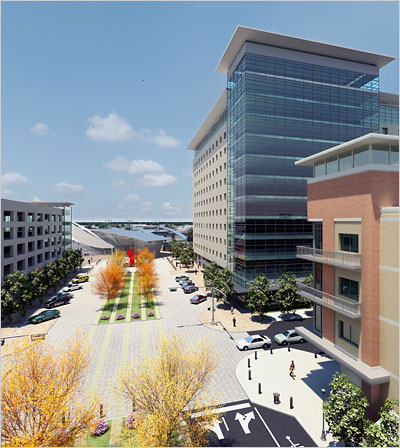
The most successful projects do more than build housing near transit stations. They take pains to create livable neighborhoods, with parks, paths, retail stores and places for people to gather. "Place-making is key," Ms. Poticha said.

new_carrolltonTX_14sqftC_large.jpg

Continue reading "New rail lines, new urbanism, still growing" »

May 27, 2009

Cited for parking in their own driveway

Cars parked in front of their owners houses, but partly on the street, or partly on the side walk, are sometimes given parking tickets.

Pedestrian advocates emphasize the 'blocking the sidewalk -- stop sidewalk parking' aspect. Others just want the free parking without acquiring the land to build private parking.

See also old Ken Garcia column in SF Gate (may be on BATN).

May 23, 2009

Late night safety bus

If public transport and public health could merge, there would be a safe way to get home at night.

Atrios would approve, if public safety is a public good.


Phoenix, AZ 2009 May 21:

The Valley's light rail will soon extend its hours on the weekends.

Currently, the light rail makes its last run at 11 p.m.

However, starting July 1, the trains will leave from both ends of the line at 2 a.m., which means if your stop is somewhere in the middle, the final train will sometimes come past 2 a.m.

On Wednesday, the METRO Board of Directors approved the new hours.

The change was made after getting feedback from passengers and businesses along the light rail route.

Melissa Harrigan, a bartender at Zuma Grill in Tempe, said she thinks the change will be good for business because people will be able to stay longer.

She also said that she feels it will keep the roads safer because a bigger group of people won't be drinking and driving.

According to a METRO news release, the estimated fiscal and maintenance impact for extended weekend service is $254,500 annually to the METRO operating budget.

After six months, the Board will review ridership statistics and costs associated with the service extension to see if the change is cost effective.


Published in transit, urbanism, UK, SFO, ny.

May 22, 2009

Town for car-free life: Vauban

While there have been efforts in the past two decades to make cities denser, and better for walking, planners are now taking the concept to the suburbs and focusing specifically on environmental benefits like reducing emissions. Vauban, home to 5,500 residents within a rectangular square mile, may be the most advanced experiment in low-car suburban life. But its basic precepts are being adopted around the world in attempts to make suburbs more compact and more accessible to public transportation, with less space for parking. In this new approach, stores are placed a walk away, on a main street, rather than in malls along some distant highway.

"All of our development since World War II has been centered on the car, and that will have to change," said David Goldberg, an official of Transportation for America, a fast-growing coalition of hundreds of groups in the United States -- including environmental groups, mayors' offices and the American Association of Retired People -- who are promoting new communities that are less dependent on cars. Mr. Goldberg added: "How much you drive is as important as whether you have a hybrid."

Levittown and Scarsdale, New York suburbs with spread-out homes and private garages, were the dream towns of the 1950s and still exert a strong appeal. But some new suburbs may well look more Vauban-like, not only in developed countries but also in the developing world, where emissions from an increasing number of private cars owned by the burgeoning middle class are choking cities.

In the United States, the Environmental Protection Agency is promoting "car reduced" communities, and legislators are starting to act, if cautiously. Many experts expect public transport serving suburbs to play a much larger role in a new six-year federal transportation bill to be approved this year, Mr. Goldberg said. In previous bills, 80 percent of appropriations have by law gone to highways and only 20 percent to other transport.

In California, the Hayward Area Planning Association is developing a Vauban-like community called Quarry Village on the outskirts of Oakland, accessible without a car to the Bay Area Rapid Transit system and to the California State University's campus in Hayward.

Continue reading "Town for car-free life: Vauban" »

November 14, 2008

Why Squatter Cities Are A Good Thing ?

A TED talk, The Shadow Cities Of The Future and Why Squatter Cities Are A Good Thing by Robert Neuwirth, author, Shadow Cities: A Billion Squatters, A New Urban World, gives a different take on development economics, from mud hut cluster to developed city, with or without debt and property rights.

Video after jump.

Continue reading "Why Squatter Cities Are A Good Thing ?" »

July 22, 2008

McMansions no more (Leigh County, PA)

Bethlehem Township developer Abraham Atiyeh announced two weeks ago that he's building a downtown Bethlehem development of town homes starting at $129,000, and national builder Pulte Homes has halted its large-home building in the area and last winter began marketing a new home, called "The Lehigh", with 1,050 square feet and starting price of $139,000.

McMansions No More ** Fewer behemoth homes may be built in the Lehigh Valley as turmoil in the housing market opens the door for smaller, more affordable living
Morning Call - Allentown, Pa.
Author: Matt Assad
Date: May 25, 2008
Start Page: A.1
Section: National
Text Word Count: 2299

[Via McAll]

February 11, 2007

Alpine, NJ is in the winners' circle

Experts say the phenomenon of the newly rich gravitating
toward country-club enclaves like Alpine is well established
in American society.

The old adage is crowding into the winner’s circle
and so these superaffluent communities are very desirable
for the big winners in our society, and there’s always
the contrast between the old money and new money.

-- Jim Hughes,
Dean of the Edward J. Bloustein School of Planning and
Public Policy at Rutgers University.

Especially in the case of hip-hop stars, many of whom insist
they’ll never lose touch with their street roots.
-- NYT, on Alpine NJ, 07620.

Continue reading "Alpine, NJ is in the winners' circle" »

June 10, 2006

Silicon Valley is grown, not built. By Paul Graham

Shorter Silicon Valley.
Need nerds (smart creative fanoys, not computer operators)
and rich people (investors and mentors within an hour's drive),
nice place to live (San Fanciscso, Boston, Seattle, Buffalo, Pittsburgh)
Need free thinking ofbeat (Portland, Boulder, New York,
Los Angeles, Las Vegas
) not stodgy (Saint Louis, Detroit) bureaucrats.

Silicon Valley is grown, not built (comments).

-- Paul Graham

Continue reading "Silicon Valley is grown, not built. By Paul Graham" »

April 25, 2006

Top 18 skylines in world

City views, cityscapes: Top 18 skylines in world.

March 16, 2006

McMansion congratulations

When neighbors return, after having moved out temporarily to
have one of these steroid palaces built for them, I'm at a loss
for what to say.

Nice house seems insincere.

Where the hell did you get the money ?
would be aggressive and intrusive.

But it seems as if you should say something, right?
I want to say,

Why ? or,

You expecting quintuplets ?

I settle for

Looks like it's really coming along.

December 29, 2005

New Haven apartments

Agent for some nice downtown New Haven apartments.

December 26, 2005

transport and transit: transportblog

Update 2006 November 24: transportblog is back to full strength posting.

Sadly, transportblog was on hiatus in 2005
Coverage of transport and transit, wide ranging.

July 29, 2005

bad architecture in Beijing

An investigation of the not-so-subtle bad architecture in Beijing.

Three Rockets

Continue reading "bad architecture in Beijing" »

July 1, 2005

Art of the New Urbanist Deal

New urbanism proposes new models for the urban design of
master-planned communi-ties and town centers. The financial
performance of three projects is examined in detail: Seaside, a
second-home resort in Florida; Lakelands, a master-planned community
in Gaithersburg, Maryland; and Haile Village Center, a mixed-use
residential, commercial, and retail center outside Gainesville,
Florida.

Seaside, which consists of 630 residential units, about 45,000 square
feet of retail, and about 18,000 square feet of commercial space, has
slowly developed into a financial success. The first lots sold in 1982
for $15,000; by 1992, the average price of new lots sold was $130,000
and by 2001 it was $690,000. The project has become a model for
several larger second-home village-type resorts in northwest Florida.
Lakelands, with 220 developable acres, has about 1,572 residential
units (houses as well as multi-family), the majority produced by
national homebuilders. The selling rate has been good: in the first
three years, the project sold about 400 units a year.

The land at Haile Village was originally bought for $2,500 per acre
and is today sell-ing for more than $300,000 per acre; the value of
the project at build-out is estimated to be about $500,000 per acre.
Due to lack of visibility, there has been some difficulty in
attracting a large variety of retail tenants.

Continue reading "Art of the New Urbanist Deal" »

May 24, 2005

Union City intermodal station

Union City, CA intermodal station will connect BART, Dumbarton Rail,
Capitol Corridor, and ACE Rail.

April 28, 2005

Urban Review STL

Excelent Urban Review STL architrectural review of Saint Louis, MO
housing and commercial real estate.

April 22, 2005

The High Cost of Free Parking

Free parking isn't really free. In fact, the average parking space
costs more than the average car. Initially, developers pay for the
required parking, but soon tenants do, and then their customers, and
so on, until the cost of parking has diffused throughout the economy.
When we shop, eat in a restaurant, or see a movie, we pay for parking
indirectly because its cost is included in the price of everything
from hamburgers to housing. The total subsidy for parking is
staggering, about the size of the Medicare or national defense
budgets. But free parking has other costs: It distorts transportation
choices, warps urban form, and degrades the environment.

It doesn't have to be this way. In The High Cost of Free Parking,
Donald Shoup proposes new ways for cities to regulate parking, namely,
charge fair market prices for curb parking, use the resulting revenue
to pay for services in the neighborhoods that generate it, and remove
zoning requirements for off-street parking. Such measures, according
to the Yale-trained economist and UCLA planning professor, will make
parking easier and driving less necessary.


The High Cost of Free Parking
by Donald C. Shoup.

Continue reading "The High Cost of Free Parking" »

March 26, 2005

Torto Wheaton Research (TWR)

Torto Wheaton Research (TWR) studies commercial real estate.
Their Debt Risk Management has a nice list of features. See also
Portfolio strategy and misc research desk.

Continue reading "Torto Wheaton Research (TWR)" »

November 12, 2004

New Partnews for New Urbanism

New Partnews for New Urbanism have a nice conference in Miami.

October 18, 2004

Architectural eyesores

Architectural eyesore of the month, selected by James Howard Kunstler.