Q. Every time I wait in the Long Island Rail Road section of NYC Pennsylvania Station, I hear chirping, tweeting birds. The sound is louder near overhead speakers, so I'm assuming it's a recording. Is it supposed to make passengers calmer, like Muzak?
A. You are hearing a "talking kiosk," designed to help visually impaired passengers and others navigate the confusion of the station. The kiosk is in the Long Island Rail Road's main concourse, between the entrances to Tracks 14 and 15.
"To help visually impaired customers locate the kiosk, it emits the song of the lark sparrow (Chondestes grammacus), a bird species native to the American West, that is found by audiologists to have a unique set of phonetic properties considered effective for directional way-finding," said Susan McGowan, a spokeswoman for the railroad.
The current model was installed in December 2008, replacing an older one that also chirped. This one features a touch-activated tactile map of the station, visual displays for the partially sighted, and a voice designed for phonetic clarity, Ms. McGowan said in an e-mail message. As a customer touches different parts of the map, the kiosk describes the location and gives directions. It also offers general information about Penn Station and the Long Island Rail Road.
CAMERAS TACKLE LOW LIGHT From the beginning of digital-camera time, the rule was: if you want to take no-flash photos in low light, you'd better buy yourself one of those big, black, heavy S.L.R. cameras. Too often, the pocket cameras that make up 90 percent of camera sales produce blurry or grainy shots in low light.
This year, the camera companies finally abandoned their decade-long obsession with megapixels. Instead, several of them began working on things that really count -- like bigger sensors for better pictures.
Panasonic and Olympus teamed up to create the Micro Four Thirds format: coat-pocketable cameras that take near-S.L.R.-quality photos. Fujifilm and Sony released new shirt-pocket models whose redesigned sensors do exceptionally well in low light. And Canon's PowerShot S90 combines an unusually large sensor (for a little camera) and a remarkable lens to produce amazing low-light shots.
Still, even these cameras may someday seem laughably crude; already, high-end cameras like the Canon EOS 5D MKII actually "see" better in low light than you do. Trickle-down theory, do your thing.
Continue reading "Coat pockets vs shirt pockets as benchmarks" »
As Bill Simmons tells it now, all he really needed to know about Internet success he learned as a nearly anonymous blogger -- the term had not gained currency, but it still fits. "The question was, how do you keep people coming back?" he said. His insights were to update his posts frequently and to be provocative, to get a discussion going among and with his readers.
So three big changes:
1. The new Live Feed is linked-to at the top of the page and shows a number of new items since your last visit.
2. Highlights plus hot status updates are now the default, the new News Feed.
3. Birthdays and other important events have taken the place of the old Highlights section; they are of particular interest to users and will now be easier to see.
What It Means
Facebook says that after viewing your new News Feed, you can go check out the raw Live Stream of all the most recent updates from your contacts. That's the opposite of the way FriendFeed did it and neither strategy should be taken for granted. Decisions like this impact a major method of communication for hundreds of millions of people around the world.
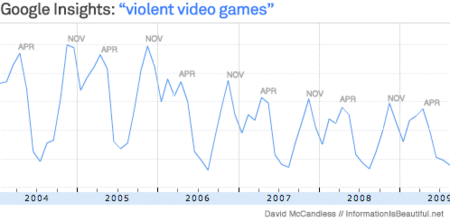
informationisbeautiful, informative charts convey information.
Example:
Every April and November the issue flares up. Why?
April 20th is the anniversary of the Columbine Massacre. Though dimishing, the echoes of that event still reverberate through the group mind.
Not sure about the November peak? Maybe because Christmas video games are announced?
Products under development "are in one of two states--either too early to tell or too late to change.''
He finished the book in 1982, after moving to Yale. No publisher would print it to his exacting standards. Tufte wanted the book to exemplify the design principles he articulated. It had to have lavish, abundant, high-resolution images and footnotes alongside the text so a reader wouldn't have to flip pages to find a reference. The book had to be printed on thick, creamy paper and sell for a reasonable price, about $30. "Publishers seemed appalled at the prospect that an author might govern design,'' he later wrote. So he took out a second mortgage at nearly 18 percent interest and produced the book himself.
---- Edward Rolf Tufte
Were the Channels and Subscribe features insufficient ?
Google struck back yesterday, launching two new important YouTube features. The first is YouTube's new high-definition option, which switches to wide screen and features much higher resolution than the usual fare. Since most videos are not HD-formatted, YouTube has set up an "HD Videos Area," where users can search for the highest-quality films the site has to offer. Low-resolution video has been one of the issues keeping advertisers from throwing money at the site, and this may help turn things around.YouTube's second initiative tackles the site's maddening lack of navigability. Even though companies like CBS and MGM have signed deals to post feature-length shows on YouTube, no one can find them, thanks to the peculiar architecture of the Web site. Now, YouTube has started collecting movies, music, and news on three separate landing pages. The news page will offer video broadcasts of breaking news, and the music and movies pages will showcase the most popular songs and feature-length films, broken down by category. Users will still find themselves lost in YouTube's architecture most of the time, but at least it's a start.
They found that Web searches for things like headache and chest pain were just as likely or more likely to lead people to pages describing serious conditions as benign ones, even though the serious illnesses are much more rare.
For example, there were just as many results that linked headaches with brain tumors as with caffeine withdrawal, although the chance of having a brain tumor is infinitesimally small.
Would such inference be addressed better by a frequentist or bayesian mindset ?
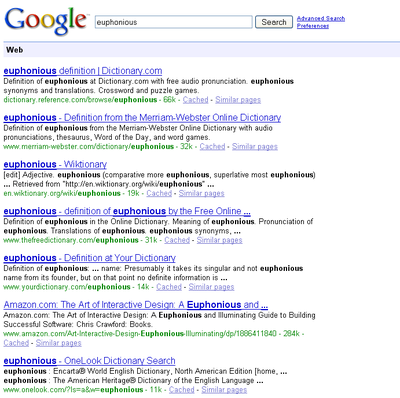
The lack of specific content in the cached header teasers of major dictionary sites is very annoying.
Better would be to show some information about the word and dictionary sites would compete on quality of definitions.
Signs Indicate Queens, NY Street Numbers and House Numbers.
In order that a house number may be of greatest value in indicating
the location of its premises, the number is divided into two parts,
separated by a dash, in which the first part of the number is the
same as that of the nearest cross street or avenue, intersecting
the avenue or street to the west or north, and the second part of
the number represents the distance, as expressed in lot intervals,
between such corner and the house, a number being assigned
for each 20-foot space.
Infosthetics shows time trends.
Data visualization in web browser, with interaction.
New champion: IBM's Many Eyes.
Liked by JHeer and radar.oreilly.
tag cloud, an lternative to zoomclouds.
kizmeet: example:
Visualization and segmentation: Gelman's
Bag of tricks for teaching statistics.
See also Gelman's Data Analysis Using Regression and Multilevel/Hierarchical Models.
Trulia tracks real estate markets; updates in TruliaBlog.
Sample housing market search Great Neck NY, 3 bedroom, 2 bath.
An example of good URL engineering:
trulia.com/NY/Great_Neck/price_0-750000/baths_2-3/.
See also: Zillow.
Comedy, tradedy, romance. The elegant design
of Shakespeare's life work.
Not yet: Browse by or search for work's name Hamlet, character
name Ophelia or search for content text nunnery.
Information architecture artifacts: ia flickr: ia discuss.
Bonus: Flickr's newr interface.
Graph Paper / Christopher Fahey.
Beautiful design, and observations about information architecuture.
Example: full-focus states.
Snap Job Search.
Best use of incremental search partitioning and refinement
of multi-faceted search and browsing.
Snap journal.
Battelle comments.
Visual thinking and marketing by Xplane.
Charmingly illustrated technology and business process graphics
remind me of Richard Scary's Busyown.
Subtraction by NYT designerism and ia by Khoi Vinh.
Net Vibes aggregates information into a personal dashboard.
Like myway.com, or my.yahoo.com, but with perhaps less syndicated content.
Dashboard spy gallery of mangement dashboards and consoles full of KPI
(Key performance indicators).
Update 2006 Dec.: Moved to enterprise-dashboard.com.
Ed Tufte adds,
Tag soup and del.icio.us tags, and now Zoom Clouds of tags.
boxesandarrows has been upgraded.
Looks good.
You can see where the conversations are happening and
who’s having them. Each page posts stats on conversations
and people, so you can quickly find the most interesting,
controversial or insightful moments on the site.
Rely on RSS, not new tags to find new content: undeniably geeky.
Google maps mania charts the
mash ups and applications.
Fetch headlines from Google News on a schedule, then rank
headlines by factors:
* appearance day and time,
* prominence on the google news page,
* number of appearances,
* others;
weighted to estimate referer traffic these links bring to their
source.
Listed are the top scoring stories in recent time periods, followed
by a ranking of sources. More detailed reports are linked-to at the
bottom of each table.
[*]
What exactly is an “Information Architect” or “Information Architecture” ?
Explain it in 10 words or less. And then, take all the words you
need to explain the difference between an information architect and
a designer (not an artist, but a designer).
-- 37signals
findarticles is the poor man's Lexis/Nexis.
Can't find it there ? Try MozBot instead.
43folders for power users and alpha geeks.
Today's tactical equivalent to Seven habits of highly effective people.
GIS realtime for commuting, BusMonster (motd) maps routes through Seattle.
With help by Intelligent Transportation Systems Research Program at UW.
Search for stylized facts or for Coruscation at Mozbot, France's prettier Google.
Riander, travails of a user experience and user-centred desisgn
consultant. Who better to run DUX, aka Design for User Experience ?
The excellent Tom Peters offers pithy business advice for the post-modern
economy. Well organized site.
Clay Shirky on tagsonomy: tags are cheap reader (not author/editor)
supplied metadata, having (at least) these characteristics:
1. It’s made by someone else
2. Its creation requires very few learned rules
3. It’s produced out of self-interest (Corrolary: it is guilt-free)
4. Its value grows with aggregation
5. It does not break when there is incomplete or degenerate data
And this is what’s special about tagging. Lots of people tag links on
del.icio.us.
Tagsonomy by del.icio.us offers well-categorized ontology of topic links.
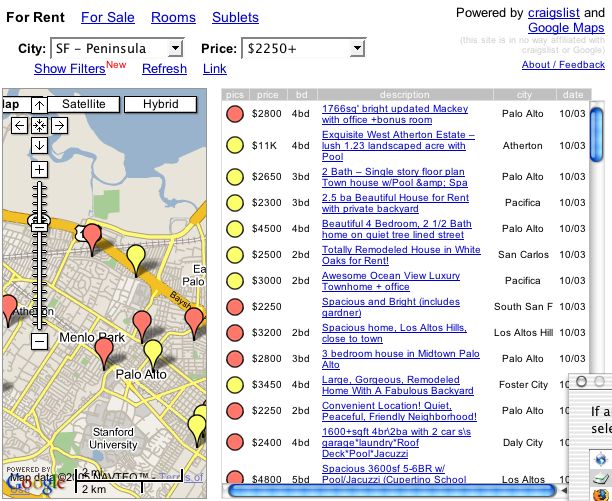
Craig's List and Google Maps merge, and the result is good.
See for rent and for sale listings plotted on a map,
pins colourized to show availability of pictures,
drill down the matches to a feature set or price band.
Daou Report ia blog portal with refreshed ledes.
Mostly political; page layout shows left is left and right is right.
Clusty headlines are groupable into clusters
by reader-specified criterion.
Clusty shows Stylized Facts as in these clusters:
Market (30)
⇨Growth (17)
⇨Statistical, Empirical (10)
⇨Interest Rates (9)
⇨Bank, Research (7)
⇨Volatility, Modeling (7)
⇨Behavior, Generate (6)
⇨Generate The Stylized Facts (5)
⇨Economic Blog (3)
scholar.google.com searches refereed publications.
Sample search mortgage prepayment modlleing.